
Last reviewed: August 2026
You have read that a fractional CMO is a strategic hire, not an execution hire. It is in every scope-of-work template, every coaching program, and every article ranking for this search term. Set the strategy, manage the agency, report to the board, and stay out of the ad account.
Then look at what fractional executives actually report doing. In the largest survey of fractional work published to date, 91% said they do hands-on execution rather than advice alone. The job postings advertise around 10 hours a week. The median practitioner bills 21. The advice everyone repeats describes a minority of engagements as though it were the standard.
Get Remote Job Tips in Your Inbox
Weekly strategies, salary data, and new opportunities
Unsubscribe anytime. No spam.
Execution is not a scope failure you can prevent with a better contract template. It is the modal engagement. Which means the useful question was never "how do I avoid doing the work" — it is "how do I price it." That distinction matters more than your rate card, because published retainers barely move between an advisory engagement and one where you are personally rebuilding the lifecycle emails. Hours move. Rates don't.
In August 2026 we compiled fractional CMO rate and hours data from two published 2026 surveys with disclosed sample sizes (n=1,733 and n=213), read the live CMO rate benchmark off Go Fractional, and counted fractional CMO listings across seven job boards and specialist marketplaces. Below: what the work pays once you account for hours, why five reputable sources publish five incompatible salary figures, and where engagements actually originate — which is almost nowhere a job board can show you.
- $180/hr average fractional CMO rate, median $175, with the middle 50% running $125–$220/hr (Go Fractional CMO benchmark, accessed August 2026)
- $209/hr average for the marketing function across fractional executives (Fractional Work Report 2026, n=546 rate subsample)
- 91% of fractional workers do hands-on execution rather than advice only (Fractional Work Report 2026, n=1,733)
- 10 hours advertised vs. 21 hours billed — typical weekly ask in a posting against the median client-facing hours practitioners actually report
- 50% run two to three concurrent clients (n=107 of 213, Go Fractional, April 2026); 64% run two or more (Fractional Work Report 2026, n=1,733)
- 72% found their first fractional client through someone in their personal network (n=1,733)
- $160,147 — Glassdoor's average fractional CMO "salary," drawn from 37 self-reported entries
- 84,722 vs. 0 — Indeed's nationwide fractional CMO listing count against its own count with the remote filter applied, read the same day
Every number above is counted or published with a date attached. Here is where each came from, including the two claims we threw out.
How We Collected This Fractional CMO Rate and Hours Data
Rate and hours figures come from two surveys published in 2026 that disclose their sample sizes, which is rarer in this market than it should be. The first is the Fractional Work Report 2026, built on 1,733 complete responses. That headline number deserves an asterisk we will state plainly: 810 respondents are currently active fractional workers, 235 are past, and 688 are aspiring — people who have not yet done the work. The report does not specify which base each individual figure uses. The second is Go Fractional's 2026 State of Fractional Work, fielded in April 2026 with 213 respondents, whose published tables show base counts that sum exactly to 213. Both are run by companies that sell into this market, and both are self-selected samples drawn from their own communities — which means they systematically oversample people for whom fractional work is going well enough that they still answer surveys about it. The practitioners who quietly went back to a salaried job in month seven are not in either dataset. This is the best evidence available and it is not a census.
The CMO-specific rate band was read directly off Go Fractional's CMO benchmark page in August 2026. That page is derived from live job postings and updates continuously, so it is quoted here with an access date — figures published elsewhere without one are frequently stale snapshots of the same URL.
Salary widget figures from Glassdoor and ZipRecruiter are reported side by side rather than averaged, because they measure different units and averaging them would manufacture a number that describes nothing. All of it is cross-referenced against the BLS Occupational Outlook Handbook entry for advertising, promotions, and marketing managers, May 2024. Listing counts were read across Indeed, LinkedIn, SimplyHired, Go Fractional, HireAFractionalExec, Fractional Pulse, and Fractional Jobs in August 2026, recording the query scope for each.
Two widely circulated claims were deliberately excluded. The first is that the fractional CMO population doubled from 60,000 to 120,000 between 2022 and 2024. Traced back through three intermediaries, it originates in a report counting all fractional professionals across every function; somewhere in transit "fractional leadership" became "fractional CMO," and the 2022 baseline appears in no primary source at all. The second is any figure for how long it takes to land a first client. No published survey reports it with a sample size. The three-to-six-month number in circulation is one author's unsourced estimate, and repeating it with a citation would launder an opinion into a statistic. Rates were verified in August 2026; retainer floors move with the funding market.
What Fractional CMO Jobs Actually Pay: The Execution Gravity Scale
The rate card is the wrong unit of analysis. Published fractional CMO retainers cluster between $5,000 and $20,000 a month, and that band barely shifts between an engagement where you advise a marketing team and one where you are the marketing team. What shifts is hours.
Run the arithmetic on a single $10,000 monthly retainer. At 10 hours a week, that is roughly $233 an hour. At 25 hours a week, the same retainer pays about $92 an hour. The invoice is identical. The client is happy in both cases. You have taken a two-and-a-half-fold pay cut and there is nothing on paper to show it happened.
The Execution Gravity Scale is a 10-point rubric measuring how far an engagement pulls from strategic direction toward hands-on delivery — which sets your effective hourly rate more reliably than your rate card does.
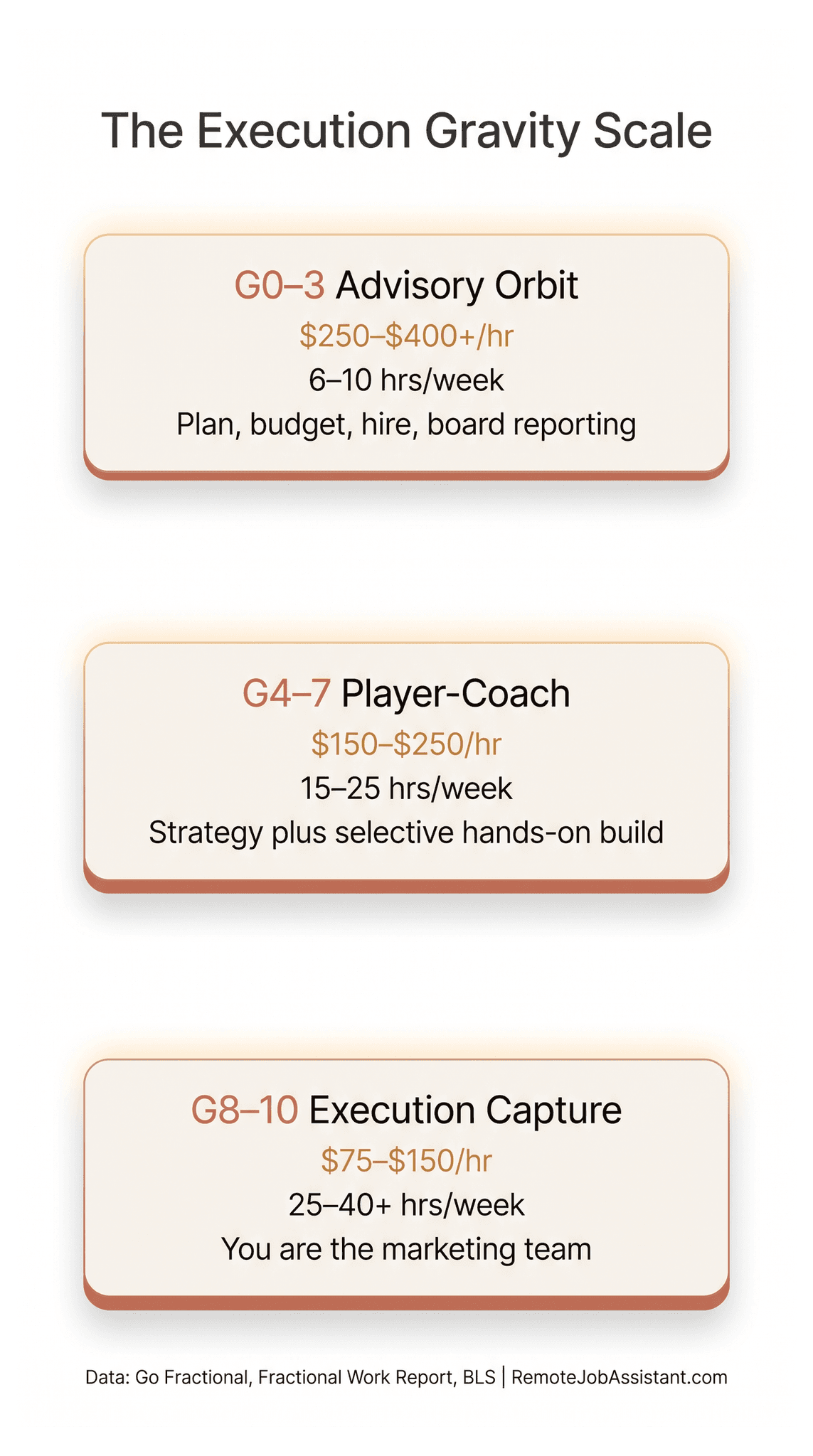
- G0–3 Advisory Orbit — $250–$400+/hr effective, $6K–$12K/mo at 6–10 hrs/week. You set the plan, allocate budget, hire and manage the team or agency, and report to the board. You open no ad platform and write no copy. This requires the client to already have a functioning execution layer beneath you. It is the engagement the marketing describes and the minority that actually exists.
- G4–7 Player-Coach — $150–$250/hr effective, $8K–$18K/mo at 15–25 hrs/week. You own positioning and the demand model, and you personally rebuild the lifecycle sequence or the paid account because nobody else on the team can. This is where the 91% live, and where most of the money is.
- G8–10 Execution Capture — $75–$150/hr effective, $5K–$12K/mo at 25–40+ hrs/week. You are the marketing department wearing a CMO title: weekly deliverables, a campaign calendar, someone else's quarterly targets. The retainer can look identical to a G4 engagement. Your effective rate is a third of it.
How to use it: on the scoping call, ask the client to list every deliverable they expect in the first 90 days, then count the ones that only you can personally produce. Zero to two, treat it as Advisory Orbit and price at your full rate. Three to six, treat it as Player-Coach minimum and quote accordingly — anything less and you are subsidizing them. Seven or more, either add an explicit execution-layer clause naming who does the work you are not doing, or decline. And if the client will not enumerate deliverables at all, that is the answer: the scope is undefined because they intend to fill it later, with you.
Here is the same money at three different gravity scores.
| Gravity band | What you actually do | Hrs/week | Monthly retainer | Effective rate |
|---|---|---|---|---|
| G0–3 Advisory Orbit | Plan, budget, hire, board reporting | 6–10 | $6K–$12K | $250–$400+/hr |
| G4–7 Player-Coach | Strategy plus selective hands-on build | 15–25 | $8K–$18K | $150–$250/hr |
| G8–10 Execution Capture | You are the marketing team | 25–40+ | $5K–$12K | $75–$150/hr |
There is a structural reason marketing engagements drift downward and finance engagements don't, and it is worth understanding before you blame yourself for poor boundary-setting. A fractional CFO's scope is bounded by a calendar. The month-end close happens and then it is done. The audit concludes. The raise either closes or it doesn't. Those are terminating events, and they cap the work no matter how enthusiastic the client is. Marketing has no equivalent stop. There is always another channel to test, another launch to support, another campaign the founder saw a competitor run. The scope has no natural terminus, so it expands to fill whatever hours you leave unguarded. This is why the same person can hold a disciplined fractional CFO engagement at 8 hours a week and watch a marketing engagement quietly triple.
Your rate card doesn't set your rate. Your scope does — and the retainer is the same number either way.
That reframe changes what you negotiate. Instead of arguing your hourly up from $175 to $225, you argue about which deliverables sit with you and which sit with an agency, a contractor, or a hire the client makes in month two. The second conversation is worth several times the first, and clients find it easier to say yes to because it isn't about your price.
It also changes how you read the first call. The drift rarely announces itself. It arrives as a sequence: the engagement is scoped as high-level strategy, week three brings a request to "just take a look at" the nurture sequence, and by month two the standing Monday call has become a status meeting about work you are doing yourself. Nobody lied. The client genuinely believed they had an execution layer, and what they had was a contractor on 10 hours a month and a founder who used to write the emails.
Three signals in a scoping call reliably predict a G8–10 engagement. The client cannot name who currently executes marketing, which means the answer is nobody and the answer is about to be you. The client describes the role as "hands-on" or "player-coach" while quoting an advisory retainer — they have told you the gravity score and priced the other one. And the client frames the hire against a salary comparison, usually some version of a full-time CMO would cost us $250K. That framing is worth taking seriously, because it is often accurate about their intent.
Here is the part the coaching content avoids saying: a meaningful share of fractional CMO engagements are staff augmentation with a better title on it. The arrangement lets a founder acquire senior marketing capacity without a headcount, without benefits, and without the awkwardness of a termination if it doesn't work. "Fractional CMO" is cheaper to say than "head of marketing we can cancel in 30 days," and it flatters everyone in the room. That is not a reason to refuse the work — it is frequently good, well-paid work. It is a reason to price it as what it is rather than what it is called.
Stop Applying Manually
Our AI applies to hundreds of matching jobs while you sleep. Wake up to interviews, not more applications.
Fractional CMO Salary Data: Why Every Source Disagrees
Search the pay for this job and you will get five numbers that cannot all be true. They are all technically accurate. They are measuring different things and printing the results in identically shaped boxes.
Glassdoor reports an average of $160,147 a year, with the 25th percentile at $123,517, the 75th at $210,393, and the 90th reaching $266,624. That distribution rests on 37 self-reported entries. Thirty-seven people is a mid-sized marketing team, not a labor market, and the figure should never be quoted without that denominator attached.
ZipRecruiter puts the average at $111,632 a year, or $53.67 an hour, as of July 2026 — 25th percentile $80,500, 75th $132,500, 90th $162,000. That figure is derived from job postings, which means it inherits the same loose keyword matching that produces the listing counts we will get to shortly.
The BLS median for advertising, promotions, and marketing managers is $161,030 as of May 2024, with 6% projected employment growth from 2024 to 2034. That is a full-time W-2 benchmark and the most methodologically sound number in the group — but it describes a different job.
Salary ranges in this section derive from the two 2026 surveys and the live rate benchmark described in the methodology above, cross-referenced against BLS figures for the same occupational category. We report the widget figures individually rather than blending them. Ranges shift as the funding market moves, so check the linked sources for current numbers.
| Source | Figure | Sample | What it is actually measuring |
|---|---|---|---|
| Glassdoor | $160,147/yr | 37 self-reported | Practitioners, self-selected |
| ZipRecruiter | $111,632/yr | not disclosed | Job postings, keyword-matched |
| Go Fractional | $180/hr | not disclosed | Live posting rates, rolling |
| Fractional Work Report | $209/hr (marketing) | 546 | Survey respondents, Director-level and above |
| BLS | $161,030/yr | — | Full-time W-2 marketing managers |
Thirty-seven people submitted the salary that half the internet quotes as the fractional CMO benchmark.
Underneath all five figures sits one shared category error: annualizing a role that is by definition part-time and multi-client. A fractional CMO with three clients is not earning a salary. They are earning three retainers, each with its own gravity score, its own renewal risk, and its own effective hourly rate. Averaging them into a single annual number discards the only information that matters.
There is a related trap worth naming briefly. A single mid-band fractional retainer, annualized, lands close to what several of these boards print as a full-year "salary" — which is why the boards make fractional work look like a pay cut against a full-time seat. It is a unit error, not a market signal. The fractional CFO guide works through that arithmetic in detail; the correction is identical for marketing, so we will not repeat it here. What is specific to marketing is the hours problem, and that one does not appear on any board.
If you are benchmarking against staying employed, the honest comparison is a marketing manager role or a director seat in the marketing and growth category, not a widget average built from 37 entries. Our guide to remote marketing jobs paying six figures covers those in-house bands in detail.
Where Fractional CMO Jobs Actually Come From
Competitors will tell you these jobs are not on job boards. That is true, and none of them show you the evidence, so here it is.
In August 2026, Indeed showed 84,722 fractional CMO listings nationwide. Apply the remote filter on the same day and it returned zero results. LinkedIn showed "1,000+," which is its display ceiling rather than a count, and not one of the first ten results carried the title Fractional CMO — they were growth leads, a founding GTM role, and a chief growth officer. Of Indeed's first ten, roughly three were genuinely fractional marketing work. One was a Fractional Chief Medical Officer, matched on the acronym.
The reason is structural rather than sinister. General job boards match loosely on tokens because their economics reward inventory volume over precision. A posting containing "fractional" anywhere and "CMO" anywhere is enough to enter the index, and nobody is penalized when the two words belong to different sentences.
Now look at the boards that publish auditable, human-curated counts. Go Fractional listed 35 open roles with 50 posted over the prior 90 days. HireAFractionalExec showed 11 CMO roles out of 284 active listings. Fractional Pulse showed 2 of 113. Fractional Jobs carried roughly one literal CMO title. Four independent specialist marketplaces converging between 1 and 35 is the trustworthy signal. Two general boards reporting five-figure counts is an artifact.
That convergence is useful rather than depressing. Thirty-five real listings can be read in ten minutes; 84,722 cannot be filtered at all. The specialist boards are worth monitoring precisely because they are small — but they are a supplement to referral flow, not a replacement for it.
Because the actual market runs on relationships. In the Fractional Work Report sample, 72% found their very first fractional client through someone in their personal network, and 94% won clients through network referrals. Go Fractional's April 2026 respondents said the same thing from the other direction: 92% rely on personal networks, 54% on LinkedIn, and 29% on fractional talent platforms, while 90% named client acquisition their single biggest challenge (n=213). The bottleneck in this career is not capability. It is distribution.
Read that 72% carefully, though, because it is a survivorship statistic. It describes how people who successfully built a practice got their first client. It cannot tell you the conversion rate of a network, because the practitioners whose networks produced nothing are not in the sample — they went back to salaried work and stopped answering surveys about fractional careers. The honest version of the finding is narrower and more useful: if you land a first client, it will almost certainly come from someone who has already watched you work. Whether your particular network will produce one is a question no published dataset answers.
No published survey anywhere reports how long it takes to land a first fractional client. The three-to-six-month figure you will encounter is one writer's unsourced estimate that has been recirculated until it acquired the texture of data. Plan your runway on your own pipeline and your own savings, not on a number nobody measured.
One number that should be encouraging: 47% of fractional professionals in the Go Fractional sample were in their first year, against 23% at one to three years and 30% past three years. This is a market with a wide front door. You are not late.
Stop Applying Manually
Our AI applies to hundreds of matching jobs while you sleep. Wake up to interviews, not more applications.
The 90-Day Attribution Trap
Most fractional CMO engagements run six to twelve months — 60% last six months or longer in the Fractional Work Report sample. Client patience, however, is quarterly, because that is the rhythm their board reports on. The gap between those two clocks is where engagements die.
The mechanism is a lag structure, not a performance problem. Pipeline generated in month one closes in month four at a typical B2B sales cycle. Brand work compounds slower than that. If your engagement is evaluated on revenue closed within 90 days, you are being measured on your predecessor's funnel, and the work you actually did will show up in a quarter you are no longer being paid for.
None of this is personal, and none of it is new. Marketing has the shortest tenure in the C-suite even when the role is permanent: Spencer Stuart's 2025 CMO Tenure Study puts average CMO tenure at S&P 500 companies at 4.1 years, down from 4.3 the prior year, against 4.7 for CFOs and 7.6 for chief executives. The impatience you will encounter as a fractional is the same impatience full-time CMOs absorb, compressed into a shorter contract.
The fix is contractual rather than tactical, and it is a single question asked before you sign: ninety days from now, what number will tell you this is working? Then make sure the answer is one that can actually move in ninety days. Qualified pipeline created rather than revenue closed. Activation rate rather than retention. CAC payback trajectory rather than CAC itself. Write whichever they name into the statement of work, in their words, with the baseline it is measured against. Leading indicators move inside a quarter; lagging ones do not, and agreeing to be measured on a lagging indicator in a 90-day window is agreeing to lose on a schedule.
Watch the renewal mechanic too. Engagements rarely end in an argument. They end in a quiet non-renewal that was decided weeks earlier. A 30-day check-in that surfaces a mismatch in month one is worth more than a polished quarterly business review in month five, because in month one the scope is still negotiable.
If the client can't name the number that earns your renewal, they've hired you to be blamed, not to be right.
For anyone weighing this against a salaried path, it is worth reading the trade-off honestly alongside high-paying remote roles and the $150K+ salary band, where the comp is lower-variance and the political risk is someone else's problem.
Stop Applying Manually
Our AI applies to hundreds of matching jobs while you sleep. Wake up to interviews, not more applications.
Who Should Not Take Fractional CMO Work
Almost nobody publishes a disqualification list, which makes this decision harder than it needs to be. Answer four questions honestly instead.
Can you name fifteen people who have watched you operate and would take your call this week? Not connections — people with direct evidence of your work. With 72% of first clients arriving through personal networks, this is the binding constraint, and no amount of positioning or content substitutes for it. If the number is closer to five, your ramp is longer than your runway.
Have you personally owned a pipeline or revenue target? In the Fractional Work Report sample, 87% of respondents had 11 or more years of experience and 83% were Director-level or above. Someone who has carried a number asks different questions in a scoping call — about attribution windows, sales capacity, deal cycles — and clients hear the difference immediately. The gap shows up in the questions you don't think to ask.
Could you absorb four months without an invoice? Twenty-seven percent of Go Fractional's respondents ran a single client (n=58 of 213). That is concentration risk with no severance, no notice period, and no unemployment insurance behind it. A client who loses funding does not give notice.
Do you want to diagnose, or to execute a brief? The client's stated problem is frequently not their actual problem — they ask for demand generation when they have a positioning failure, or for a rebrand when their sales process is broken. Being paid to disagree with the person signing the check is most of the job.
If three of those four answers are no, the honest move is to build the missing one from inside a salaried seat rather than from unemployment. An in-house social media manager or growth lead role will be better compensated per hour worked and will keep building the network you will need later. The people who do well here are operators with a real network, a bounded specialty, and genuine tolerance for selling — and the last one disqualifies more good marketers than the first two combined.
Frequently Asked Questions
I'm a VP of Marketing making $180K — would going fractional actually pay more?
On rate alone, yes: the marketing function averages $209/hr across fractional executives (n=546), which clears a $180K salary at roughly 17 billable hours a week. The catch is utilization and gravity. Half of practitioners run two to three concurrent clients (n=107 of 213), and if those engagements sit at G8–10 on the Execution Gravity Scale, your effective rate lands near $100/hr and the math inverts. Model the hours, not the headline rate.
How many fractional clients do I need to replace a full-time CMO salary?
At the typical $8K–$18K monthly retainer band, two mid-band clients put you in the $190K–$430K annual range gross — before self-employment tax, health insurance, unpaid selling time, and gaps between engagements. Most practitioners target three so that losing one is a setback rather than an emergency, which matches the 64% who run two or more clients (n=1,733).
Is it normal for a fractional CMO to do hands-on execution work?
It is the norm, not the exception: 91% of fractional workers report doing hands-on execution rather than advice alone (n=1,733). The widely repeated claim that fractional CMOs should never touch execution describes the minority of engagements that sit in Advisory Orbit. Price for the execution you will actually do instead of writing a contract that pretends you won't.
How do I know which level of The Execution Gravity Scale an engagement is?
Count the deliverables in the scope that only you can personally produce. Zero to two means Advisory Orbit, where you direct an existing execution layer. Three to six means Player-Coach, the most common band. Seven or more means Execution Capture — you are being hired as staff at a retainer price, and the effective rate will be roughly a third of what an advisory engagement pays at the same monthly invoice.
Where do fractional CMOs actually find clients if the job boards are full of fake listings?
Through people who have seen them work: 72% found their first client through a personal connection and 94% won clients via network referrals (n=1,733). The specialist marketplaces are genuine but small — four of them collectively listed between 1 and 35 open CMO roles in August 2026, against Indeed's 84,722 keyword-matched results and zero when the remote filter was applied.
What should I charge for my first fractional CMO engagement?
The published CMO band runs $125–$220/hr for the middle 50%, with an average of $180/hr (Go Fractional, accessed August 2026). First engagements typically land in the lower half of that. Rather than discounting the rate to win the deal, hold your number and reduce scope — a narrower engagement at full rate sets a ceiling you can build on, while a discounted broad engagement sets one you will fight for years.
How long do fractional CMO engagements usually last?
Most run six to twelve months, with 60% lasting six months or longer (n=1,733). Renewal generally turns on whether leading indicators moved inside the first quarter, which is why agreeing to be measured on closed revenue in a 90-day window is the most common unforced error in this work.
Start Your Fractional CMO Practice
The one thing worth carrying into your next scoping call is the gravity question. Before the rate comes up, count the deliverables only you can produce, place the engagement on the Execution Gravity Scale, and let that decide what you quote. A $12,000 retainer is an excellent month or a mediocre one depending entirely on an answer you can get in the first conversation, if you remember to ask.
Two things are worth doing this week. Price your last engagement retroactively: take the retainer, divide by the hours you actually worked rather than the hours you quoted, and see which band it lands in. Most people are one tier lower than they assume. Then set your floor for the next conversation before you are in it.
For calibration, remote marketing manager and director roles show what companies pay in-house for the same scope, and the six-figure marketing salary band and executive listings above $200K bracket what you are giving up and what you are competing with. The fractional CFO market is worth reading as a contrast case: same business model, but scope terminates, and rates behave completely differently as a result. If you are running a salaried search while building a client book — which most people should for the first two quarters — Auto-Apply absorbs the application volume so your evenings go to pipeline instead of forms. And if you are positioning around a platform specialty, HubSpot and Salesforce fluency price well in both markets.
Anyone can put the title on a LinkedIn profile this afternoon. What you actually get paid is decided by a question most people never ask out loud: how much of this work would simply not happen if you didn't do it yourself?
Ready to Find Your Remote Job?
Browse thousands of curated remote jobs or let AI apply for you.
Browse Remote JobsRelated Job Guides

Remote Jobs for Seniors: What 4,435 $75K+ Postings Show
Remote jobs for seniors that pay $75K+: we read 4,435 remote postings for age signals. Pay climbs from $115K to $201K with experience. Here's where to aim.
32 min read
Best Certifications for Remote Jobs: What 2026 Postings Say
We read 4,476 remote jobs paying $75K+ in 2026. Only 2.1% require a certification. See which credentials lock doors, which break ties, and which to skip.
32 min read
Easiest Jobs That Pay $100K: What 3,702 Remote Postings Ask
We read 3,702 remote jobs paying $100K+ in 2026. Only 30% hard-require a degree; years are the real gate. See the easiest $100K roles and their hidden catch.
32 min read