
Last reviewed: August 2026
You've probably typed "remote tax jobs" into a search bar and gotten the same wall every time: aggregator pages promising six thousand listings, a seasonal gig at TurboTax, and a handful of postings that say "remote" in the title and "3 days in office" in paragraph four. What nobody on that results page tells you is that you're actually looking at two different job markets that happen to share a keyword.
Market one is seasonal preparation: hourly, credential-gated, running January through April, built for people who want $30-something an hour on their own schedule. Market two is year-round tax work at companies and CPA firms — provisions, compliance, review, advisory — where remote managers are being offered $140K to $180K because firms literally cannot fill the seats locally. Your resume doesn't decide which market you're in. Your credential and your calendar do.
Get Remote Job Tips in Your Inbox
Weekly strategies, salary data, and new opportunities
Unsubscribe anytime. No spam.
We analyzed 185 unique tax job postings across 103 companies, pulled from the SmartRecruiters and Workable global ATS networks in August 2026, and cross-referenced compensation against Salary.com benchmarks (August 1, 2026) and Bureau of Labor Statistics 2025 wage data. This guide covers what remote tax work actually pays at each credential level, which companies are verifiably hiring, and how to move from one market to the other.
Based on our analysis of 185 tax job postings across 103 companies (SmartRecruiters + Workable ATS data, August 2026):
- 16% (n=29 of 185) were flagged fully remote — but 42% (n=77 of 185) were hybrid
- 46% (n=43 of 93 SmartRecruiters postings) carried manager, director, or head-of titles — this is a senior-skewed remote market
- $140K–$180K — employer-entered salary ranges on fully remote tax manager and director postings (RES Consultant Group, August 2026)
- $125,329 median for tax managers nationally (Salary.com, August 2026)
- $83,680 median for accountants and auditors; $54,920 for tax preparers (BLS, 2025)
Those numbers frame everything that follows: remote tax work exists, it pays well, and it is concentrated at the top of the credential ladder.
The Two Remote Tax Markets
Every "remote tax jobs" search result mixes two markets with different pay models, different calendars, and different gatekeepers. Sorting yourself into the right one is the first decision, because the application strategy for each is completely different.
| Seasonal preparation | Year-round tax | |
|---|---|---|
| Calendar | January–April, some extension work | Full year: provisions, quarterly estimates, planning |
| Pay model | Hourly (state-based rates) plus bonus | Salary: $67K–$180K by level |
| Credential floor | Prep experience; EA/CPA for expert tiers | CPA strongly preferred; EA viable at firms |
| Typical employer | Intuit TurboTax Live, seasonal firm contracts | Corporations, regional CPA firms, fintech startups |
| Remote logic | Built remote-first — volume work, distributed by design | Remote because firms can't hire locally |
| Ceiling | Approx. $35/hr, resets every season | Tax Director, $150K–$180K on current postings |
The reason market two went remote is structural, not cultural. The AICPA has documented a multi-year collapse in the accounting talent pipeline — fewer graduates sitting for the CPA exam while experienced tax people retire out. A regional firm in Ohio that needs a tax manager can either poach from the firm across the street (there's nobody there either) or open the search to all fifty states. That's why the remote share of high-paying remote roles in tax skews so heavily toward senior titles: firms go remote at exactly the level where the shortage bites.
Seasonal prep, by contrast, was remote before remote was normal — the work is standardized, volume-driven, and reviewed centrally, so it distributes cleanly.
How We Collected This Data
The figures in this post come from our analysis of 185 unique tax job postings across 103 companies, collected on August 31, 2026 via the SmartRecruiters and Workable global job-search APIs (93 and 92 postings respectively, deduplicated by posting ID). SmartRecruiters reported 924 total live postings matching "tax" across its network at collection time; Workable reported 845 for "tax accountant," 359 for "tax preparer," and 316 for "tax manager." Remote and hybrid status comes from each posting's structured workplace field, and we spot-checked flags against posting text because employers sometimes mark in-office roles as remote.
Salary figures were cross-referenced with Salary.com benchmark data (as of August 1, 2026) and BLS 2025 occupational wage data, accessed through ONET. Employer-entered compensation ranges from ATS postings are labeled as such — they're primary-source, but entered by the employer, not independently verified. Two honest gaps: Reddit and Glassdoor block automated collection, so no sentiment data from either appears here, and BLS.gov itself was unreachable at collection time — we cite its figures through ONET, which republishes the same series. Data reflects August 2026; we re-pull the postings each hiring cycle.
Stop Applying Manually
Our AI applies to hundreds of matching jobs while you sleep. Wake up to interviews, not more applications.
The Credential Ladder: What Remote Tax Jobs Actually Pay
Here's the framework that makes sense of every salary figure in this market.
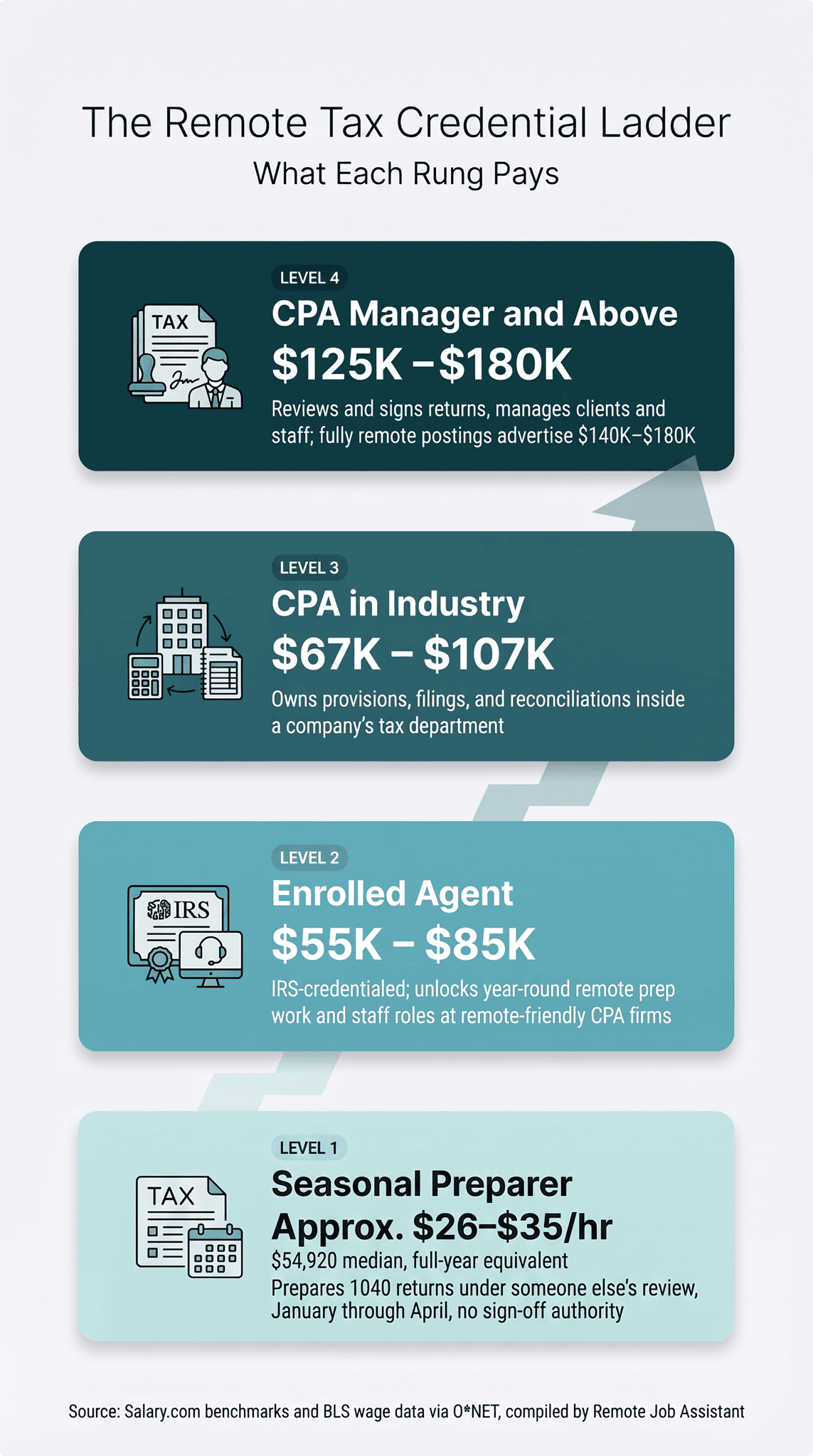
The Credential Ladder: In tax, remote eligibility and pay ceiling are set by which credential you hold — not by years of experience. Each rung unlocks a category of remote work the rung below cannot reach.
- L1 — Seasonal Preparer (no credential, approx. $26–$35/hr): Prepares individual 1040 returns under someone else's review. No sign-off authority. Work exists January through April. BLS puts the tax preparer median at $54,920 for full-year equivalents (n=90,600 employed, 2025 data).
- L2 — Enrolled Agent ($55K–$85K): IRS-credentialed, can represent clients before the IRS. Unlocks year-round remote prep work, expert tiers at TurboTax Live, and staff roles at remote-friendly CPA firms.
- L3 — CPA in Industry ($67K–$107K): Owns provisions, filings, and reconciliations inside a company's tax department. Salary.com's ladder runs from $66,709 for Tax Accountant I to $107,442 for Tax Accountant IV (August 2026 benchmarks).
- L4 — CPA Manager and Above ($125K–$180K): Reviews and signs returns, manages clients and staff. Tax Manager median is $125,329 nationally; fully remote postings currently advertise $140K–$180K.
How to use it: Find your current rung, then read the next rung's criteria — that's your interview talking track, and in tax, it's also your remote-eligibility unlock.
Here's the ladder against current market data:
| Level | Credential | Salary range | Source |
|---|---|---|---|
| Seasonal Preparer | None (experience only) | $54,920 median (full-year equiv.) | BLS 2025 |
| Enrolled Agent | EA | $55K–$85K | Salary.com / posting data, Aug 2026 |
| Tax Accountant I–II | CPA track | $66,709–$77,932 | Salary.com, Aug 2026 |
| Tax Accountant III–IV | CPA | $88,230–$107,442 | Salary.com, Aug 2026 |
| Tax Manager | CPA | $125,329 median; $116,454–$132,630 typical | Salary.com, Aug 2026 |
| Remote Tax Manager/Director | CPA | $140K–$180K | Employer-entered ATS ranges, Aug 2026 |
Salary ranges derive from our analysis of 185 tax postings collected in August 2026, cross-referenced with Salary.com's tax manager benchmark and BLS 2025 wage data via O*NET's occupational summary. Employer-entered ATS ranges are labeled; ranges shift as markets move.
Why the ladder bends at CPA
Notice the jump: Tax Accountant IV to Tax Manager is roughly $18K; Tax Manager to a remote manager posting is another $15K–$55K. The bend has a legal cause, not a market one. Signed returns and reviewed provisions require someone with sign-off authority, and states gate that authority behind the CPA license. Supply of licensed reviewers is shrinking while filing complexity grows — so the scarce thing isn't tax knowledge, it's the legal right to put your name on the work.
The gap between a $67K and a $125K remote tax job isn't hours worked. It's whose name goes on the return. At $67K, someone else's license absorbs the mistake. At $125K, the notice comes addressed to you, and the firm is paying for exactly that.
That's also why remote accounting careers generally hit their ceiling lower than tax: audit and bookkeeping have their own ladders, but tax adds IRS representation and multi-state complexity that compounds the shortage. If you're weighing specializations, remote financial analyst roles pay comparably at mid-level but lack the credential moat that protects tax salaries in a downturn.
EA or CPA: the decision rule
The ladder is descriptive. Here's the prescriptive version, because "get credentialed" is useless advice when the two credentials cost different amounts of your life.
- Sit for the EA if you want year-round remote work inside 18 months, you're coming from seasonal prep, or you have no accounting degree and don't intend to get one. The Special Enrollment Examination has three parts, no degree or experience requirement, and a suitability check that includes your own tax compliance — an unfiled return in your past can hold up enrollment after you've passed. Per the IRS SEE FAQ: $317 per part, non-refundable, paid when you schedule; up to four attempts per part per testing window; and the window runs May 1 through the end of February, so a March or April sitting doesn't exist and a February fail costs you the spring. Keeping it is 72 hours of continuing education per three-year cycle, minimum 16 a year.
- Go CPA if your target is L4 — $125K and up, review and sign-off, manager title — or if you want the option of partner. Budget 150 credit hours, four exam sections, and most states' supervised-experience requirement before the license is in hand. It's the slower path by a year or more, and it's the only one that reaches the top of the ladder.
- If you're unsure, EA first. It's reversible: the CPA supersedes it later and nothing you studied is wasted. The reverse — turning down year-round income while you finish a CPA you may never complete — is the expensive mistake.
One thing the exam-prep marketing leaves out: at CPA firms, the EA gets you the staff role and rarely the manager track. The review work may be identical, but most states require CPA firms to be majority-owned by licensed CPAs, so the partner path is CPA-only by rule, not by bias. Treat the EA as the bridge to remote work, not as a substitute for the license if partner is the goal. If you want the unvarnished version of this argument from people living it, r/taxpros is where working EAs and CPAs have it weekly — read it before you buy a review course (Gleim, Surgent, and Becker are the ones preparers actually use).
Companies Hiring Remote Tax Professionals in 2026
Aggregators inflate. These are employers whose remote tax hiring we verified directly in ATS and career-page data this August:
| Company | What they hire remotely | Credential floor | Comp signal |
|---|---|---|---|
| Intuit (TurboTax Live) | Tax Expert, Tax Associate, Business Tax Expert, Business Tax Associate | EA/CPA/attorney for Expert tiers; experience only for Associate | Hourly, state-based, undisclosed |
| RES Consultant Group | Tax Manager, Tax Director placements at CPA firms | CPA | $140K–$180K (employer-entered) |
| Cynch AI | Tax Associate through Senior Tax Manager — a full remote ladder | CPA track | Not disclosed |
| Bosch Group | Tax Counsel (US, remote-flagged) | JD/CPA | Not disclosed |
| Creative Chaos | Tax Specialist for US returns | Enrolled Agent | Not disclosed |
Three things stand out in that table. First, the highest-paying verified remote roles come through a recruiting firm placing at regional CPA firms — not through a brand you'd recognize. Second, one venture-backed startup (Cynch AI) is building an entire tax team remote-first, associate through senior manager, which is the clearest possible signal that distributed tax teams work. Third, Intuit's expert careers page is the single largest structured remote tax employer, and it's honest about its model: seasonal, hourly, credential-tiered.
Postings like these cycle constantly — recent openings on our remote job board cover tax and adjacent finance roles at the $75K+ level, and salary-filtered views like $100K+ remote positions surface the manager-and-above tier as it appears.
Stop Applying Manually
Our AI applies to hundreds of matching jobs while you sleep. Wake up to interviews, not more applications.
Seasonal Remote Tax Work: The Honest Math
Seasonal prep deserves a clear-eyed look, because it's simultaneously underrated as a side income and oversold as a career.
The Intuit model is the reference point. TurboTax Live hires four remote roles: Tax Expert and Business Tax Expert (active EA, CPA, or attorney credential required) and Tax Associate and Business Tax Associate (no credential, but minimum two seasons of paid prep experience and 30+ returns per season — business roles require three seasons and 20+ business clients filing 1065s or 1120-S forms). Pay is hourly and varies by state; Intuit doesn't publish rates. You commit to at least 20 hours a week in four-hour-minimum shifts, seven days a week between 5am and 9pm Pacific, with equipment shipped to you and a performance bonus at season's end.
Why don't they publish the rate? Because it's set per-state against local prep wages — publishing one number would anchor every negotiation. Third-party aggregators claim wide ranges, but we can't verify them, so we won't quote them.
Seasonal work re-interviews you every year. There's no tenure, no compounding equity, and your January start depends on last season's customer ratings. It's a genuine on-ramp to an EA credential and a real income supplement — but it is a gig, and gigs don't build ladders by themselves.
Who it's right for: credentialed preparers who want deliberate seasonality (four intense months, eight free ones), career changers using it to log the prep seasons that firm jobs require, and anyone testing whether tax work suits them before spending 300 hours on an EA or CPA. If you're already at L3 on the Credential Ladder, seasonal work is a pay cut — skip it.
Breaking Into Year-Round Remote Tax
The path in depends on where you're standing.
From general accounting: You're closer than you think. Corporate tax departments habitually hire staff accountants who know Excel and reconciliations, then train the tax layer. Target "Tax Accountant I" postings, take the pay match, and let the ladder's structure do the work — the I-to-IV progression is approximately $41K of headroom before you touch the manager bend.
From seasonal prep: The bridge is the Enrolled Agent credential. It's IRS-administered, requires no degree, costs a fraction of the CPA, and moves you from "seasonal help" to "year-round staff" at remote-friendly firms. Two verified examples from our August data: Creative Chaos hires EAs remotely for US returns, and Intuit's Expert tier pays above its Associate tier on the same work.
From Big 4: The prestige pyramid inverts for remote. The Big 4 have spent 2024–2026 pulling people back to offices, while understaffed regional firms — the employers nobody brags about at reunions — are the ones posting fully remote manager and director roles at $140K–$180K. Be honest about the trade, though. You give up the brand on your resume, the structured national training, and the clean exit into a Fortune 500 tax department that the Big 4 name buys. You also give up specialization: at a regional firm a tax manager reviews the S-corp, the partnership, the owner's 1040, and the multi-state apportionment, often in the same week, with no national office to call. Regional partners know this, and the unspoken objection in your interview is whether a Big 4 senior who has only ever done one slice of the work can run a generalist book. Answer it before they ask: name the return types you've reviewed, the ones you haven't, and how fast you'll close the gap. If your goal is remote plus senior comp, the "step down" is a step up — as long as you've priced in what you're leaving.
Busy season is the part every posting undersells, so price it in before you sign. February through April 15 will include Saturdays whatever the listing says, and year-round firms have a second one: the September–October extension wave, which is when remote review roles turn into review mills. The mechanism is simple. A $140K remote manager title at a regional firm is usually purchased with review volume — the firm needs a licensed reviewer to clear a backlog, and you're it. Ask two questions before you accept: how many preparers feed each reviewer, and how many returns a reviewer is expected to clear in a peak week. A firm that answers with numbers has a staffing model. A firm that answers "it varies" is telling you the number is whatever the partners need it to be. The compensating asset is real — May through August and the year-end stretch run on provisions, planning, and quarterly estimates at a humane pace — and it's what makes the job worth keeping. If your applications aren't converting, the problem is usually volume and targeting rather than qualifications; our breakdown of why qualified candidates don't get interviews applies doubly in a credential-gated field.
In the first call with any CPA firm, ask: "How many of your current tax staff are fully remote, and for how long?" Firms that solved distributed review years ago will answer with numbers. Firms that answer with policy language ("we support flexibility") are hybrid in disguise.
Red flags in remote tax postings. Walk away, or at least ask:
- "Remote" plus core hours in a time zone you don't live in. Fine when it's stated in the posting. The flag is when core hours first appear in the offer letter — it means the partners are in the office and expect you on their clock, which during extension season is the 8pm message asking where a return is.
- "Remote during busy season, hybrid otherwise" — or the reverse. Either way, the firm hasn't decided what it is, and the undecided version usually resolves toward the office. Ask which of the current tax staff have been fully remote through at least one full busy season.
- A manager title with no staff described. A "Tax Manager" posting whose duties are preparing returns rather than reviewing them is a senior preparer job with a manager's expectations and a preparer's support. The title is the raise; the workload is the catch.
- A chargeable-hours target with no peak-week number. Firms that publish an annual target but won't say what a March week looks like are telling you the peak is uncapped.
- "Must reside in" a short list of states. That's a payroll-registration and nexus constraint, not a preference — the firm doesn't want to register in your state. It won't move for you, so don't spend the application.
Stop Applying Manually
Our AI applies to hundreds of matching jobs while you sleep. Wake up to interviews, not more applications.
What Nobody Tells You About Remote Tax Work
The real center of gravity is hybrid. Only 16% (n=29 of 185) of the tax postings we analyzed were flagged fully remote, but 42% (n=77 of 185) were hybrid. Tax went most of the way home and stopped — partly from review-culture habit, partly because partner-track development still happens shoulder-to-shoulder. Practically: filtering for "remote only" hides more than half the flexible market. Tax is a work-from-home profession still pretending it isn't.
ATS remote flags lie in both directions. In our collection work we routinely find postings flagged remote whose descriptions require three office days, and city-listed postings that are functionally remote. Read the description before you trust the badge — and expect the same scrutiny in reverse from employers reading your location.
Your address is a tax question. There's a professional irony here: hire a remote tax person in a new state and you've potentially created payroll withholding and nexus obligations in that state. Some employers restrict remote tax hires to states where they already operate — so a rejection may be about their filing footprint, not your resume. (The people who administer this problem have their own strong remote market — see remote payroll careers.)
Senior-heavy is the market's shape, not a phase. 46% (n=43 of 93) of SmartRecruiters tax postings carried manager-or-above titles. Firms are buying sign-off authority, not headcount — which is exactly why climbing one rung on the Credential Ladder moves your remote options more than five years of same-rung experience.
Frequently Asked Questions
Can I get a remote tax job without a CPA?
Yes — on two of the four Credential Ladder rungs. Seasonal associate roles need prep seasons, not credentials, and the Enrolled Agent credential unlocks year-round remote work at firms like Creative Chaos and Intuit's Expert tier. The fully remote roles above $125K in our August 2026 data, though, all sat at CPA-required levels.
I've done four seasons of seasonal prep — how do I turn that into a year-round remote tax job?
Sit for the Enrolled Agent exam; four seasons is more than enough experience to pass with focused study. Then target remote-friendly regional CPA firms rather than national brands, and lead with your return volume — "120+ returns per season" reads as production capacity to a firm drowning in work.
What's the difference between an Enrolled Agent and a CPA for remote tax work?
The EA is IRS-issued, tax-only, no degree requirement, and unlocks representation and year-round prep — the $55K–$85K remote band. The CPA is state-issued, covers all accounting, requires 150 credit hours, and carries sign-off authority — which is why manager roles at $125K+ effectively require it. EA first for speed, CPA if you want the ceiling.
How much do remote tax managers actually make?
The national Tax Manager median is $125,329 with a typical range of $116,454–$132,630 (Salary.com, August 2026). Fully remote manager and director postings in our ATS sample advertised $140K–$180K — a premium that exists because firms open remote searches precisely when they can't fill the seat locally.
Are remote tax jobs really remote, or hybrid in disguise?
Mostly hybrid: 16% (n=29 of 185 postings, August 2026) were flagged fully remote versus 42% hybrid. Fully remote concentrates at two extremes — seasonal prep and manager-plus roles. Always verify against the posting text; workplace flags are wrong often enough to matter.
Is seasonal work at Intuit TurboTax Live worth it for an experienced preparer?
As deliberate seasonality or an on-ramp, yes: equipment provided, schedule flexibility, and Expert-tier rates for credentialed preparers. As a career, no — it's hourly, resets annually, and depends on customer ratings. Use it to fund the EA, then move to a firm.
Which level of the Credential Ladder do I need for a $100K+ remote tax job?
L4 — CPA with review or sign-off responsibility — is where $100K+ reliably lives; the Tax Accountant IV benchmark ($107,442) is the only sub-manager rung that crosses it. If you're at L3, the fastest path is taking review work off a manager's plate now and interviewing on that story in 12 months.
Do remote tax jobs disappear after April 15?
Seasonal roles wind down; year-round roles don't. Corporate tax runs on a full calendar — quarterly provisions, estimated payments, planning, and the September–October extension wave. That second busy season in fall surprises people, and it's also why firms keep year-round remote staff instead of re-hiring every January.
Start Your Remote Tax Career
The market splits cleanly: pick seasonal for flexibility or year-round for the ladder, then climb by credential, not by tenure. The data says the top of that ladder is where remote concentrates — 16% fully remote overall, but $140K–$180K advertised at exactly the level where the shortage bites.
Start with where the jobs actually are rather than where aggregators say they are — our review of the best remote job boards separates the curated boards from the scrapers, and the high-paying remote jobs guide maps which fields share tax's credential premium. When you're ready to apply at volume across $75K+ remote listings, automation beats spreadsheets.
Tax returns are signed by people, not offices. The credential that lets you sign is the same one that lets you leave.
Ready to Find Your Remote Job?
Browse thousands of curated remote jobs or let AI apply for you.
Browse Remote JobsRelated Job Guides
Remote Underwriting Jobs: 2026 Salary and Hiring Guide
Remote underwriting jobs in 2026: posted pay from $60K to $290K+, which carriers and lenders actually hire remote, and the authority level that unlocks it.
30 min read
Remote Physician Jobs: 2026 Salary and Career Path Guide
Remote physician jobs in 2026: six career paths from telemedicine to medical director, real pay from $150K to $300K+, licensing strategy, and who's hiring.
23 min read

Remote Event Planning Jobs: What Actually Goes Remote
Only 12% of event job postings are fully remote and none were titled Event Planner. See which titles actually go remote, what they pay, and how to pivot.
24 min read