

Last reviewed: August 2026
You searched the title, saw the number, and closed the tab. Every aggregator on page one quotes something close to $48,000 for a remote legal assistant, and if you have six years in and a mortgage, that figure ends the conversation before it starts.
Here's the part nobody reconciles. The same federal dataset that produces that average also reports that the top 10% of this occupation earns $98,990, and the 75th percentile clears $79,240 — inside the same job code, under the same title. Both numbers are accurate. They describe different people doing what a job board calls the same job.
Get Remote Job Tips in Your Inbox
Weekly strategies, salary data, and new opportunities
Unsubscribe anytime. No spam.
The variable separating them isn't tenure, and it isn't a certificate. It's whether a missed deadline is your problem or someone else's. That single distinction explains the entire salary spread, determines which legal support roles firms will actually staff remotely, and predicts which ones the last eighteen months of AI adoption has quietly eliminated. We analyzed 920 remote legal assistant job postings across 284 companies between March 2026 and August 2026 to map it.
This guide is written for experienced legal support professionals targeting $75,000-plus remote roles — not for entry-level administrative work.
Based on our analysis of 920 remote legal assistant postings (March 2026 – August 2026):
- 61% (n=561 of 920) named a practice management platform by product — Clio, MyCase, Filevine, or PracticePanther
- 44% (n=405 of 920) required e-filing experience in both state and federal courts
- 29% (n=267 of 920) posted a base range topping out at $75,000 or above
- 18% (n=166 of 920) used a title other than "Legal Assistant" for substantially the same duties
- $61,010 median annual wage for paralegals and legal assistants (BLS, May 2024); $79,240 at the 75th percentile; $98,990 at the 90th
- $73,000–$87,500 national range for Senior Legal Assistant (Robert Half, 2026)
- 39,300 projected annual openings in the occupation, 2024–2034
How We Collected This Data
The figures in this post come from our analysis of 920 remote legal assistant job postings collected between March 2026 and August 2026. Postings were sourced from law firm career pages, in-house corporate legal departments, our own job board, and public aggregators, then deduplicated by employer and role.
We included only United States positions explicitly marked remote-eligible or hybrid with a remote default. We excluded contract engagements shorter than six months, postings with no duty-level detail, and roles requiring more than 25% travel or regular in-person courthouse runs — those last ones are not remote jobs regardless of how they are advertised.
We deliberately captured six title variants rather than one: Legal Assistant, Legal Secretary, Legal Administrative Assistant, Case Assistant, Docketing Specialist, and Legal Operations Coordinator. Restricting the search to a single title removes roughly a fifth of the market and skews the resulting salary picture downward.
Salary data was cross-referenced against the Bureau of Labor Statistics occupational data for paralegals and legal assistants (SOC 23-2011, May 2024) and Robert Half's 2026 Senior Legal Assistant salary data. Ranges reflect base salary and were verified in August 2026. We refresh this analysis quarterly.
The Docket Ownership Ladder
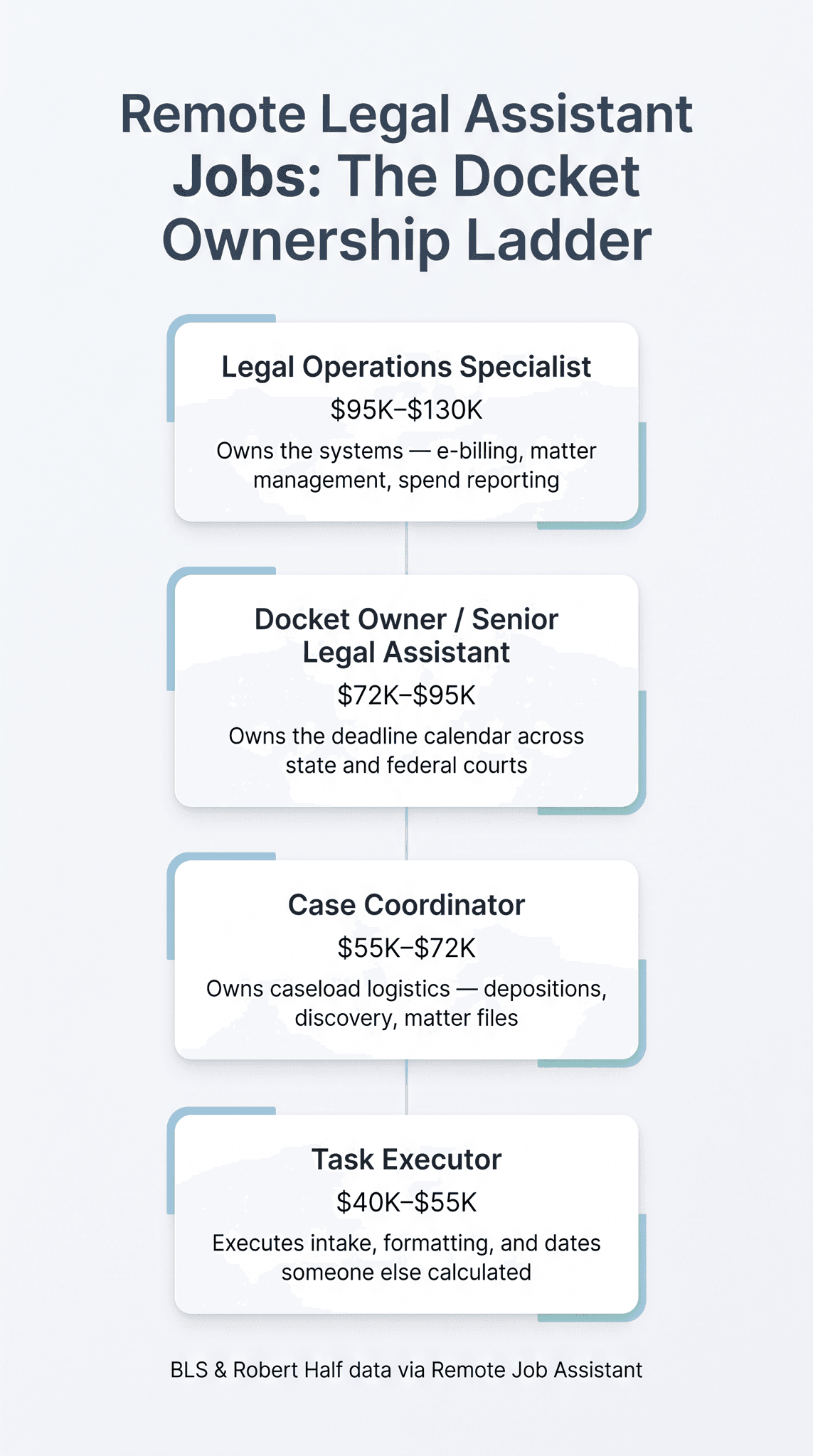
The Docket Ownership Ladder scores a legal support role by how much deadline risk it absorbs from the attorneys above it.
That is the whole framework, and it is more useful than years of experience because it maps cleanly onto what firms pay for. A partner's exposure is measured in missed filings. Every dollar above the median in legal support is compensation for moving some of that exposure onto someone else's desk.
Scoring:
- L1 Task Executor ($40K–$55K): Executes work someone else scheduled. Intake forms, mail, document formatting, calendar entries dictated to you. If a date is entered wrong, a person above you catches it before it matters. Corresponds to the BLS 10th-to-25th percentile band ($39,970–$48,840).
- L2 Case Coordinator ($55K–$72K): Owns the logistics of a caseload. Schedules depositions, tracks discovery responses, drafts routine correspondence, maintains matter files in Clio or Filevine. You catch your own errors, but you don't interpret the rules that generate the dates. Sits around the $61,010 occupational median.
- L3 Docket Owner ($72K–$95K): Owns the deadline calendar itself. Calculates filing dates from court rules across jurisdictions, files in state systems and federal CM/ECF, maintains the docket of record, and flags conflicts before anyone asks. If it slips, it is yours. Spans the BLS 75th ($79,240) to 90th ($98,990) percentiles, and Robert Half's Senior Legal Assistant range of $73,000–$87,500 lands squarely inside it.
- L4 Legal Operations Specialist ($95K–$130K): Owns the systems rather than the calendar. E-billing and outside counsel guidelines, matter management configuration, vendor and spend reporting, workflow design. Compensated above the 90th percentile because the role is no longer scored as support.
Two warnings about the ladder, because the titles lie in both directions. A meaningful share of postings advertised as "Senior Legal Assistant" are L2 work with a better title and a $3,000 bump — the tell is that the job description lists supervision of no one and calendar ownership of nothing. And L4 is not automatically the prize it looks like: legal operations at an understaffed in-house team frequently means you are the person who resets everyone's e-billing password, which pays $95,000 and leads nowhere. Read the duties, not the level.
How to use it: Read the criteria for the level above yours, not your own. Those bullets are your next resume section and your interview talking track. The gap between L2 and L3 is not three more years — it is one documented responsibility you can name.
Firms don't pay for legal support. They pay for the transfer of deadline risk off a partner's desk and onto someone else's.
Stop Applying Manually
Our AI applies to hundreds of matching jobs while you sleep. Wake up to interviews, not more applications.
What Remote Legal Assistant Jobs Actually Pay
Three credible sources publish three different numbers for this role, and the disagreement is the most useful thing about them. Each one is measuring a different population.
| Source | Figure | What it actually measures | Ladder level |
|---|---|---|---|
| ZipRecruiter (May 2026) | $48,215 average; $38K–$55K middle band | Open listings, weighted toward high-turnover generalist roles | L1 to low L2 |
| BLS OEWS, May 2024 (SOC 23-2011) | $61,010 median; $79,240 at 75th; $98,990 at 90th | Everyone employed in the occupation, including specialists whose jobs rarely get posted | L2 to L3 |
| Robert Half, 2026 | $73,000–$87,500 | Placements a staffing firm can actually fill at negotiated rates | L3 |
| Aggregator listing bands | "$38K–$200K" | Title collision. The top figure is attorney and legal-ops noise | Not usable |
The mechanism behind the gap is turnover, not pay. L1 generalist roles churn constantly, so at any given moment they dominate the population of open postings — which is the only thing a job board can average. L3 docket roles turn over rarely; a firm that finds someone reliable enough to own its filing calendar does not re-post that job every fourteen months. Those people are fully counted in employment data and almost invisible in listing data.
The $48,000 average isn't a measure of what this work pays. It's a measure of which version of this work keeps quitting.
Geography still moves the number, even for remote roles. Median wages run $99,300 in the District of Columbia, $78,010 in Washington, $74,990 in Massachusetts, $72,960 in California, and $66,390 in New York. According to the Bureau of Labor Statistics occupational data, that spread persists across the occupation. The remote wrinkle is that firms increasingly anchor offers to the firm's location rather than yours, and a growing number split the difference with a stated national band. Ask which convention they use in the first conversation, because it is worth more than any negotiation you will do later.
Salary ranges in this post derive from our analysis of 920 remote legal assistant postings between March 2026 and August 2026, cross-referenced with BLS May 2024 occupational wage data and Robert Half's 2026 compensation figures for legal support roles. We excluded outliers and postings without a clear remote policy. Ranges shift as markets move — check the linked sources for current figures.
Which Legal Assistant Jobs Are Actually Remote
Remote-viability in legal support comes down to one property: the work has to be rule-driven and asynchronous. That property correlates almost perfectly with pay, which is why the remote half of this occupation earns more than the in-office half rather than less.
Four specializations carry the remote market.
Multi-jurisdiction e-filing and litigation support ($68K–$90K). Court rules are written down, and the portals are all web-based — state systems plus federal PACER and CM/ECF. Nothing about the work requires a building. The pay lever is breadth: one state is table stakes, and 44% (n=405 of 920) of the postings we analyzed wanted state and federal both.
IP docketing ($75K–$110K). USPTO deadlines are algorithmic, unforgiving, and entirely documented, which makes the work perfectly suited to a distributed team and catastrophic to get wrong. According to Glassdoor's remote legal assistant listings and pay data, the typical IP Docketing Specialist band runs $58,331–$92,145, while ZipRecruiter's July 2026 average for the title sits at $110,572. It is the highest ceiling in legal support that does not require a law degree.
Corporate and entity management ($70K–$95K). Annual reports, registered agent filings, board minutes, subsidiary records. This work sits in in-house legal departments rather than firms, which means the benefits are usually better and the hours are usually saner. It pairs naturally with the compliance career track.
Legal operations ($95K–$130K). E-billing, outside counsel guidelines, matter management configuration, spend reporting. This is the exit ramp out of legal support entirely, and it is where the $100K-plus remote roles live.
What stays in the building: reception and phone coverage, physical mail and service of process, courthouse runs, in-person notarization, and "float" coverage across attorneys who like grabbing whoever is nearby. These are not excluded because law firms are behind the times. They are excluded because the work is defined by physical presence — and any firm that could have moved it remote already did, in 2020, under considerably more pressure than it faces now.
Once you know the four categories, you can score a posting in about thirty seconds using the same variable the ladder runs on. The language firms use is remarkably consistent, and it gives the level away before you get to the salary line.
Phrases that mean the docket is genuinely yours: "calculate deadlines under applicable court rules," "maintain the docket of record," "manage e-filing across state and federal courts," "identify and escalate calendar conflicts." Phrases that mean it isn't: "enter deadlines as directed," "support the docketing team," "assist attorneys with calendaring," "other duties as assigned" appearing before the third bullet.
Two more traps worth naming, because both are common and both look like the job you want. The first is the title-only docketing role: the posting says "Docketing Specialist," and the actual work is typing dates into Clio that an attorney has already calculated. That is L1 wearing an L3 title, and the interview tell is that nobody can describe what happens when a court amends a local rule. The second is the not-actually-remote remote job — the listing says remote, and buried in the duties is "occasional filings at the courthouse" or "coordinate service of process," which quietly means you need to live within driving distance forever.
Then there is the version to walk away from, which reads as genuinely L3 and is actually a staffing failure. If one person owns the docket for 150 or more active matters with no named backup, that is not a senior role — it is a liability that has been parked on whoever accepts it, and it stays invisible until the first week you try to take real vacation. Firms tolerate it because the arrangement works right up until it catastrophically doesn't, and the person holding the calendar absorbs both the workload and the blame. Ask two questions in the screen: how many matters, and who covers the calendar when you are out. A firm with a real answer to the second one has thought about the job. A firm that pauses has told you everything.
There is one more structural quirk in this market worth more than any resume tip, and it costs most candidates half the available jobs.
Substantially identical duties get posted as Legal Assistant, Legal Secretary, Legal Administrative Assistant, Case Assistant, Docketing Specialist, and Legal Operations Coordinator — at pay bands separated by $40,000. In our sample, 18% (n=166 of 920) of roles used a non-"Legal Assistant" title for work a legal assistant does. Searching one title is how experienced candidates conclude the market pays $48,000.
Running six parallel searches across firm career pages and job boards every week is exactly the kind of task that gets abandoned by week three. Auto-apply handles all six title variants at once, which for this specific role is the difference between seeing the L1 market and seeing the whole thing.
Stop Applying Manually
Our AI applies to hundreds of matching jobs while you sleep. Wake up to interviews, not more applications.
What AI Actually Changed in Legal Support
In February 2026, Baker McKenzie cut between 600 and 1,000 business services roles across IT, knowledge management, marketing, secretarial, and design, citing AI integration. It was the largest AI-attributed reduction in the legal industry to date, and if you work in legal support, you read that headline and updated your assumptions accordingly.
Now hold it against the rest of the same market. Paralegal unemployment sits near 1.9%. Total legal employment hit a ten-year high of 1.24 million jobs in January 2026. The Bureau of Labor Statistics projects 39,300 openings per year in this occupation through 2034, even while forecasting essentially flat net employment — meaning the churn is real, the demand is real, and the occupation is not disappearing.
Both things are true because the cuts were surgical. Document review is the leading AI use case in legal at 77% adoption, with legal research second at 74%. Both are retrieval-and-summarization problems, which is precisely what current tools do well. Calculating an appellate deadline from a court's local rules and then being accountable for it is not a retrieval problem — it is a liability transfer, and liability does not transfer to a model. Firms cut the roles whose output was a document. They kept the roles whose output was an assurance.
Automation came for task execution, not for the person who signs off that a 30-day appeal window was calendared correctly in three jurisdictions.
The practical translation matters for how you interview. As of March 2026, roughly 70% of attorneys use AI tools weekly, which means your fluency with them is now assumed rather than impressive. What differentiates is the verification layer. A candidate who says "I run first-pass discovery summaries through our AI tool and I'm the one who confirms them before they reach the associate" is describing L3 work and will be paid for it. A candidate who says "I do document review" is describing the job Baker McKenzie eliminated.
How to Move Up a Level
The jump from L2 to L3 is a documented responsibility, not a year count. Which move comes first depends entirely on where you already are, so start with the honest read: if you only enter dates other people give you, go get one practice area's calendar. If you already own one calendar in one court, add federal CM/ECF this month. If you already have both, stop acquiring and start counting — matter volume and missed filings — because at that point the constraint is documentation, not capability.
Take the calendar. Ask to own deadline calculation for one matter type — one practice area, one court. Most attorneys will hand it over the moment somebody volunteers, right up until the first time you flag a conflict they missed; then they remember why they were holding it. Make the ask narrow and in writing: one practice area, one court, you calculate the dates and they countersign for the first ninety days. Track two things from day one — matters under your calendar and missed filings — because those are the only two numbers that go on the resume, and nobody reconstructs them a year later.
Add a jurisdiction. If you e-file in one state, add federal CM/ECF, then add a neighboring state. Breadth is the pay variable in litigation support, and it is the rare credential nobody has to grant you: the federal judiciary's CM/ECF help and training resources include a free training database loaded with real case data, so you can practice filings against live-format records without touching a real docket. Every district also publishes its own local rules, which is where the deadline math actually lives.
Name your tools by product. 61% (n=561 of 920) of the postings we analyzed named Clio, MyCase, Filevine, or PracticePanther explicitly. "Proficient with case management software" matches none of them in an applicant tracking system. Clio's Certified Administrator exam is free, open to non-customers, and gives you a product name you can put in writing this week. The same specificity rule applies to your written communication skills and your reporting and spreadsheet work — generic phrasing parses as nothing.
Rewrite the resume in liabilities, not duties. "Maintained case files" describes L1. "Owned the docket for 60 active matters across three jurisdictions with zero missed filings in 2025" describes L3, and it is usually the same person's year. Most experienced legal assistants are underselling by a full level, which is one of the more common reasons strong candidates stop hearing back.
Benchmark against peers, not against your firm. The most distorting force in legal support pay is that most people only ever see one firm's band, and firms know it. Search r/paralegal for "salary thread" or "what are you making" sorted by top of the past year, and read the legal operations salary discussions on LinkedIn; both run constantly and both are more current than any published survey. Bring an outside number into a compensation conversation and it stops being a favor you are asking for.
Here is what that progression looks like in practice: a legal assistant at a 12-attorney litigation firm asks to own the discovery calendar for the firm's employment matters. Six months later she is calculating response deadlines under two sets of state rules, has caught three conflicts nobody else flagged, and has a number she can put on a resume. That is not a promotion — it is a reclassification, and it is worth roughly $18,000 at market.
When they ask how you handle competing deadlines, they are testing L2 versus L3. An L2 answer describes a prioritization system — what you do first. An L3 answer describes a verification system: who double-checks, what triggers escalation, and what happens when a court amends a rule mid-matter. Answer at the level you want, not the one your title says.
The highest-paid legal assistants aren't the fastest. They're the ones nobody has to check.
Apply under all six titles, on firm career pages as well as boards — legal roles are notoriously under-syndicated, and the better remote job boards still miss most mid-size firm postings.
Stop Applying Manually
Our AI applies to hundreds of matching jobs while you sleep. Wake up to interviews, not more applications.
Frequently Asked Questions
Can a legal assistant actually make $80,000 remotely, or is that paralegal money?
Yes, and it is not a title change. The Bureau of Labor Statistics puts the 75th percentile for paralegals and legal assistants at $79,240 and the 90th at $98,990, all within the same occupational code. In our sample, 29% (n=267 of 920) of remote postings topped out at $75,000 or above. What those roles have in common is docket ownership — you calculate and are accountable for filing deadlines — not a different credential.
How do I know which level of the Docket Ownership Ladder I'm at?
Ask one question: if a filing deadline is missed on one of your matters, whose name is in the memo? If someone above you catches date errors before they matter, you are L1 or L2. If the calendar is yours and a slip is attributed to you, you are L3 and should be paid in the $72K–$95K band. If you are configuring the systems other people work inside, you are L4.
I've been a legal assistant for six years at a small firm — how do I get into legal operations?
A small firm is a better on-ramp than a large one, not a worse one. E-billing, vendor management, and matter reporting are usually unowned at firms under 30 attorneys, which means you can volunteer for them and be the person who built the process rather than the person who inherited it. Get one full budget cycle of spend reporting under your name, then apply to in-house legal ops roles where that experience is the whole job description.
Is AI going to replace remote legal assistant jobs?
It is replacing part of them. Baker McKenzie cut 600 to 1,000 business services roles in February 2026 citing AI, and the roles that went were document processing and administrative coordination. Meanwhile paralegal unemployment sits near 1.9% and BLS projects 39,300 openings a year in the occupation through 2034. The exposed work is task execution; the protected work is deadline ownership and verification, because accountability cannot be delegated to a model.
What's the difference between a legal assistant, a legal secretary, and a docketing specialist?
In practice the duties overlap heavily and the titles reflect firm convention more than function. The pay does not overlap: legal secretary postings skew toward the L1 and L2 bands, legal assistant spans L1 through L3 depending on whether the docket is included, and docketing specialist is almost always L3 or above. Docketing is also the most remote-friendly of the three, because the work is rule-driven and produces an auditable record.
Do remote legal assistant jobs pay less than in-office ones?
The relationship is inverted here. The specializations that survive being done remotely — e-filing, docketing, entity management, legal operations — are the rule-driven ones that sit higher on the ladder, so the remote subset of this occupation skews toward better pay. The caveat is geography: many firms anchor remote offers to the firm's location rather than the candidate's, so confirm which convention applies before you invest in the process.
Start Your Remote Legal Assistant Job Search
Find your level honestly, take the calendar at your current firm, rewrite the resume in liabilities instead of duties, and apply under every title this work hides behind.
None of that requires permission, tuition, or another three years. It requires being the person who can point at a calendar and say it's mine. Browse remote legal and compliance openings, filter for positions paying $75K and up, and let auto-apply run all six title variants so you stop losing the high end of the market to a search box. If you are weighing adjacent tracks, the remote paralegal career guide covers the certification path, remote attorney roles map the licensed side, and the highest-paying remote jobs guide puts all of it in context.
Every court in the country runs on deadlines someone has to be accountable for. None of them care what room you're in when you calendar it.
Ready to Find Your Remote Job?
Browse thousands of curated remote jobs or let AI apply for you.
Browse Remote JobsRelated Job Guides

Remote Medical Director Jobs: 305 of 1,860 Are Remote
We read 1,860 medical director job postings: 305 are fully remote, mostly health plan and pharma seats. See which go home, what they pay, and the license rules.
31 min read

Remote Mortgage Underwriter Jobs: 55 of 165 Are Remote
We read 165 mortgage underwriter postings: 55 are fully remote, mostly at lenders that sell their loans. See pay by employer, the DE premium and contract rules.
28 min read

Remote Clinical Pharmacist Jobs: 74 of 1,587 Are Remote
We read 1,587 clinical pharmacist postings. 74 are fully remote, mostly payer and PBM claim review. See which seats go home, their pay and the license catch.
29 min read