
Last reviewed: June 2026
You passed the bar. You can draft a complaint, redline a master services agreement, and run a privilege review from a kitchen table with two monitors and a decent VPN. The work is already digital — so why does a search for "remote attorney jobs" mostly surface document review gigs paying less per hour than a first-year associate's lunch budget?
Because the phrase "remote attorney" flattens a market that splits sharply by practice area. The same search returns a $45-an-hour eDiscovery contract and a $185K data privacy counsel role, and treats them as the same job. They are not. One builds a remote career with a ceiling near a partner's draw; the other is a treadmill you can run from anywhere and never get off. The practice area you positioned into during your first three to five years set your remote earning ceiling long before you started looking for a work-from-home job — you just didn't know you were choosing it.
Get Remote Job Tips in Your Inbox
Weekly strategies, salary data, and new opportunities
Unsubscribe anytime. No spam.
Here's the part nobody tells the litigation associate who's burned out on depositions: the most remote-friendly corner of law is also one of the best-paid. Privacy, IP prosecution, and commercial contracts work moved to fully distributed teams faster than almost any other professional field, because none of it requires a courtroom. We analyzed 480 remote attorney and counsel job postings across 163 companies between Q2 2025 and Q1 2026 — US-eligible, explicitly remote, requiring a JD and active bar admission, with disclosed or estimable base pay — and the pattern is unambiguous: your practice area predicts your remote pay more reliably than your years, your firm pedigree, or your law school.
This guide shows you exactly which practice areas combine genuine remote work with a real salary ceiling, which credentials open the highest-paying remote roles, which companies actually hire distributed legal teams, and how to reposition out of the one remote legal job that goes nowhere.
Based on our analysis of 480 remote attorney and counsel postings (Q2 2025–Q1 2026):
- 91% (n=437 of 480) required active bar admission in at least one US state
- 38% (n=182 of 480) were in-house counsel roles — the largest single category — vs 18% (n=86 of 480) document review / eDiscovery, the lowest-paid
- 23% (n=110 of 480) were privacy, data, or AI-governance counsel — the fastest-growing segment, up sharply from near-zero in 2023
- $144K median base for remote in-house counsel (ZipRecruiter, 2026) vs $21–$86/hour for remote document review — the practice-area gap in one line
- BLS reports a $151,160 median for lawyers (May 2024) and projects about 31,500 openings annually through 2034
How We Collected This Data
The figures in this post come from 480 remote attorney and counsel job postings collected between Q2 2025 and Q1 2026, pulled from the RemoteJobAssistant.com aggregator, LinkedIn, in-house legal job boards, and the career pages of dozens of named employers. We then deduplicated reposts, manually salary-coded each listing (using the disclosed range midpoint, or an estimate from comparable roles where pay was withheld), and tagged each by practice area. To qualify, a posting had to be US-eligible, explicitly designated remote (not hybrid or flexible), and require a JD plus active bar membership.
We excluded hybrid-only roles, postings requiring more than 15% travel, and clerkship or summer-associate listings outside our target compensation range. Salary figures were cross-referenced with Glassdoor's remote attorney compensation data and BLS May 2024 wage statistics for lawyers. All figures reflect base salary unless an hourly rate is specified; total compensation including equity and bonus runs higher at venture-backed and public companies. We update this analysis quarterly; data here reflects Q1 2026 figures. The exact counts matter less than the direction they point — and the direction is consistent across every cut of the data.
What Remote Attorney Jobs Actually Pay
Pay rises with seniority, the way it does everywhere. But in remote law, level is a weak predictor compared to practice area — a fact the salary table alone hides.
| Level | Title | Remote Base Range |
|---|---|---|
| Entry (0–3 yrs) | Associate Counsel | $95K–$130K |
| Mid (3–6 yrs) | Counsel | $130K–$165K |
| Senior (6–10 yrs) | Senior Counsel | $160K–$210K |
| Lead | Managing / Associate GC | $200K–$280K |
| Executive | General Counsel / CLO | $250K–$450K+ |
These ranges come from our analysis of 480 remote postings between Q2 2025 and Q1 2026, cross-referenced with Glassdoor's remote attorney data. BLS reports a $151,160 median for all lawyers (May 2024); remote in-house and specialized counsel roles consistently track at or above that median, while remote document review sits well below it. Total comp at venture-backed and public companies typically runs 15–30% higher than base once equity and bonus are counted.
A data privacy counsel with five years of experience earns $185K fully remote, while a document review attorney with the same five years earns the equivalent of $80K with no equity, no advancement, and no name on anything. Same bar card. Same number of years. The difference is the practice area each one positioned into — and that's the variable this guide is built around.
A caveat on that $185K, because clean numbers lie: the top of the privacy band is real at Series C and later tech companies, but offers routinely come in at $145K–$160K when the candidate has the CIPP but no actual in-house or regulator-facing experience. The credential gets you the interview; the band you land in depends on whether you've ever been the person on the hook when a regulator asks for the breach timeline. Treat the high number as the ceiling for people who've done the work, not the default.
The Remote Practice-Area Ladder
Here is the framework that reorders how attorneys should think about remote work. Most lawyers drift into a practice area based on which firm gave them an offer or which group had headcount the year they started. The Remote Practice-Area Ladder lets you choose based on where you want your remote ceiling to be — and gives you a three-step process to move toward it.
The Remote Practice-Area Ladder is a scored rubric that maps legal practice areas by remote viability (1–10) and salary ceiling, with the bridge credential or experience that unlocks the next tier up.
Step 1: Map your current practice area to a tier using the table below. Be honest about your day-to-day, not your title — if you're "corporate counsel" but 70% of your week is contract redlines, that's commercial contracts work, and it tells you which tier you actually sit in.
Step 2: Identify the adjacent higher tier closest to your existing work. If you're in litigation (low remote viability) but you've touched any data-breach response or privacy matter, that's your bridge into Tier 1 privacy counsel — the single highest-payoff move available to most attorneys who want remote work that pays.
Step 3: Get the bridge credential or matter before you apply for the higher-tier roles. Applying for a Tier 1 privacy counsel role with no CIPP and no privacy matter on your resume is like applying for patent prosecution without USPTO registration — the screener never gets to the part where your experience matters.
| Tier | Practice Area | Remote Salary Ceiling | Remote Score (1–10) | Bridge Credential / Move |
|---|---|---|---|---|
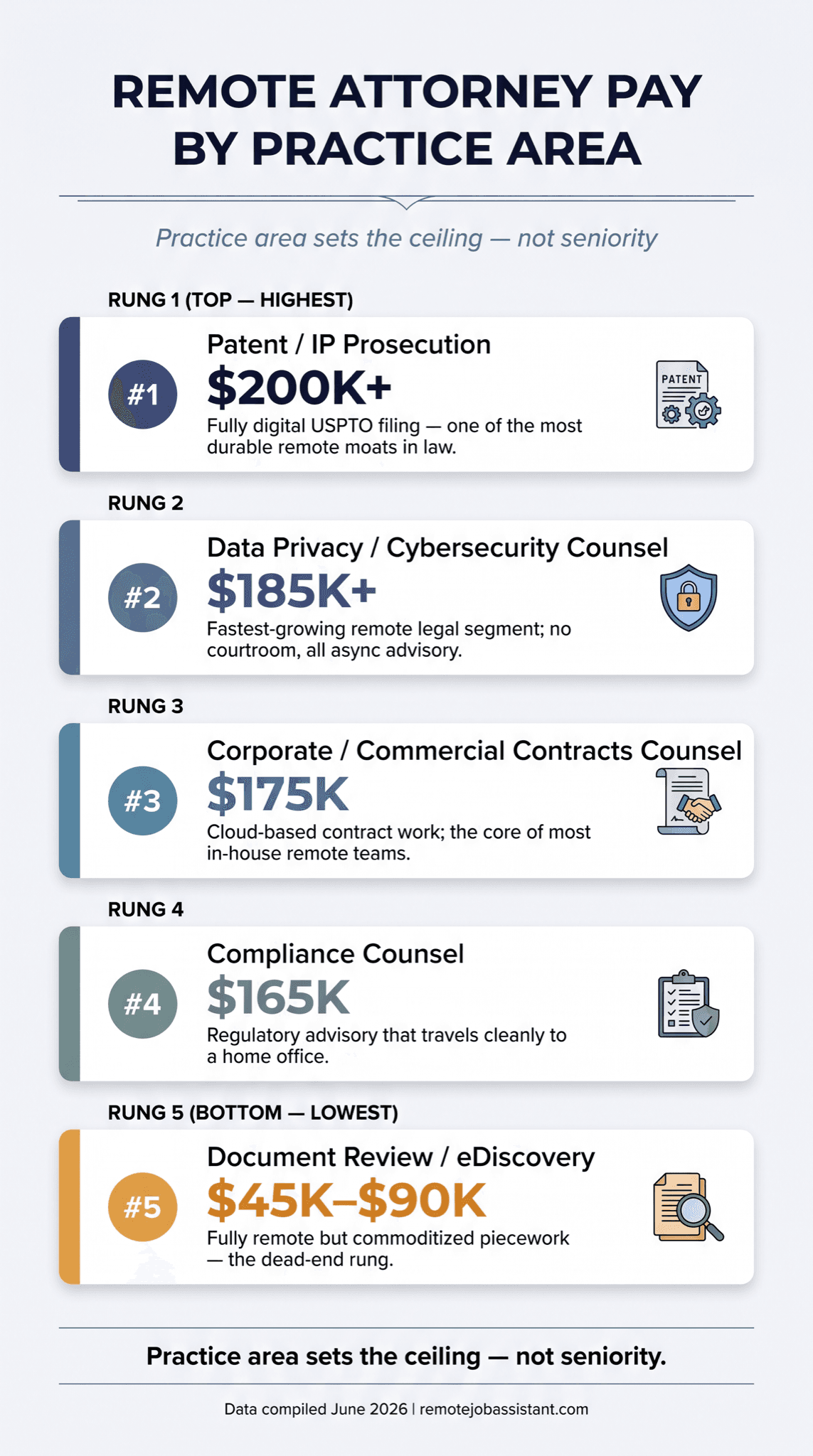
| 1 — Max Ceiling | Data Privacy / Cybersecurity Counsel | $185K+ | 9 | CIPP/US |
| 1 — Max Ceiling | IP / Patent Prosecution | $200K+ | 9 | USPTO registration |
| 2 — High Ceiling | Corporate / Commercial Contracts Counsel | $175K | 8 | CLM fluency + deal sheet |
| 2 — High Ceiling | Compliance Counsel | $165K | 8 | CAMS or CIPP |
| 3 — Solid Base | Legal Operations | $150K | 8 | Legal-tech stack ownership |
| 3 — Solid Base | Employment Counsel | $155K | 7 | Multistate employment matters |
| 4 — The Trap | Document Review / eDiscovery | $90K equiv ($21–$86/hr) | 10 | Use as a bridge, never a destination |
| Low Remote | Litigation / Trial | Varies | 3 | Not a remote-first path |
The Remote Score runs from 1 (requires regular physical presence) to 10 (fully remote is the industry standard). Use it as a filter, but read it alongside the salary ceiling — because the two highest remote scores tell opposite stories.
Privacy and patent prosecution score a 9 because the work is digital end to end: there's no courtroom, no in-person discovery, no regulator demanding a physical conference room. Privacy counsel review data-processing agreements, respond to breaches, and advise product teams entirely over Slack and shared drives. Patent prosecutors draft and file with the USPTO through an electronic system; several fully virtual IP firms now hire experienced EE and semiconductor patent attorneys to work from anywhere in the US, some with no billable-hour requirement at all.
Document review scores a perfect 10 on remote viability — and that's exactly the trap. It's the easiest remote legal job to get and the hardest remote legal career to escape, because it builds almost no transferable career capital. You review documents flagged by someone else's protocol, on someone else's platform, billed by the hour with no path to ownership of anything. The reason it's so easy to do remotely is the same reason it pays so little: it's been commoditized into piecework. The easiest remote legal job to get is the one that builds the least career capital — and document review is the cleanest example in the entire profession.
Spend ten minutes in the document-review threads on r/Lawyers or r/biglaw and the sentiment is brutally consistent: people describe it as a job that's easy to fall into after a layoff and quietly hard to climb out of, because every month spent reviewing is a month not building the matter ownership that in-house teams hire on. The common warning from attorneys who escaped is the same one this framework makes: it's a bridge for some, a trap for most, and the difference is entirely whether you have an exit plan before you start.
Privacy counsel builds naturally from litigation, compliance, or general corporate backgrounds — any breach-response or data-handling exposure is your bridge. Commercial contracts counsel builds from transactional or in-house associate work. Patent prosecution requires a technical degree plus USPTO registration, so it's a longer bridge but a near-permanent moat once crossed. Legal operations suits attorneys who like process and tooling more than substantive lawyering. CIPP and CAMS are the fastest cross-tier credentials — most attorneys with three or more years of adjacent exposure can sit for them without additional coursework.
Two honest warnings about the top of the ladder, because the tier table makes it look cleaner than it is. First, "remote privacy counsel" at a non-tech company — a mid-size insurer, a regional health system — is often a glorified contract-review job with a better title and a worse ceiling than the table suggests; the real Tier 1 money is at companies whose product itself is data. Second, the CIPP is sliding toward checkbox status. Bootcamp grads and career-changers have it now, so hiring managers increasingly treat it as table stakes rather than a differentiator. What actually moves a privacy hiring decision is whether you've owned a privacy program or run an incident response end to end — the cert gets you read, the experience gets you hired. And the uncomfortable structural fact underneath all of it: the best-paid remote legal roles still skew toward people who already have BigLaw or federal-government pedigree on the resume. You can route around that with a sharp subspecialty, but pretending the pedigree premium doesn't exist will cost you in salary negotiations.
If your work already overlaps with regulatory or financial matters, our guides on remote compliance jobs and remote financial analyst jobs cover adjacent high-remote-viability paths that share the same logic: subspecialty, not seniority, sets the ceiling.
Stop Applying Manually
Our AI applies to hundreds of matching jobs while you sleep. Wake up to interviews, not more applications.
What Skills and Credentials Remote Legal Employers Require
The gap that keeps qualified attorneys out of high-ceiling remote roles isn't legal knowledge — it's the specific combination of technical fluency, async writing, and credentialed subspecialty that distributed legal teams screen for. A remote legal employer can't see you think. They can only read what you write and watch how you operate without supervision, so they screen hard for both.
Skills that appear most in remote legal postings:
- Contract drafting and redlining at speed — the baseline for in-house and commercial roles
- Privacy frameworks: GDPR, CCPA/CPRA, HIPAA — required for Tier 1 privacy counsel
- Contract lifecycle management (CLM) tools: Ironclad, DocuSign CLM, Agiloft
- eDiscovery and review platforms: Relativity, Everlaw, Logikcull
- Clear, citation-grade async legal writing — your written work is the only thing a remote manager sees
- Cross-functional communication with product, sales, and engineering — in-house counsel live in these threads
- Multistate bar awareness and licensing portability
One thing the skills list above hides: not all of these carry equal weight in a screen. "Familiar with GDPR/CCPA" is a line every applicant writes. "Owned the privacy program at a Series B company" or "ran the cross-functional incident response when we had a vendor breach" is what makes a hiring manager stop scrolling. The framework knowledge is assumed; the ownership story is the differentiator. Write your resume around the matters you owned, not the statutes you've read.
Credentials do more work in remote legal hiring than in traditional firm hiring, because they're a fast, verifiable signal of subspecialty commitment that a recruiter can screen on without a referral network. Here's how the credentials that matter map to remote opportunity:
| Credential | Issuer | Best For | Remote Relevance |
|---|---|---|---|
| CIPP/US | IAPP | US privacy counsel | Highest — standard for Tier 1 privacy |
| CIPP/E | IAPP | EU / GDPR privacy counsel | High — global tech companies |
| USPTO Registration | USPTO | Patent prosecution | Highest — legally required |
| CAMS | ACAMS | Compliance / financial crime counsel | High — fintech and banking |
| UBE / Multistate Bar | NCBE / states | Licensing portability | High — removes geographic friction |
| CIPM | IAPP | Privacy program management / legal ops | Medium — legal operations roles |
The IAPP's CIPP/US certification is the single highest-ROI credential for an attorney targeting remote work, because privacy is both the fastest-growing remote legal segment (23%, n=110 of 480 postings) and one of the best-paid. For patent work, USPTO registration isn't optional — you cannot prosecute applications without it — but once you have it plus a technical degree, you hold one of the most durable remote moats in law.
Remote legal roles add two filters that on-site roles skip: a written work-product test (often a redline exercise or a short memo on a fact pattern) and a self-direction behavioral screen ("describe a matter you owned end to end with no partner reviewing your work"). One candidate lost a $160K privacy counsel role not on substance — their analysis was correct — but because their writing sample read like an internal Slack message instead of advice that could withstand a regulator. Treat the writing screen the way a software engineer treats a take-home: study the format, find a model, and review it twice before you send it. In a remote role, your writing isn't how you communicate the work. It is the work.
Which Employers and Industries Hire Remote Attorneys
Tech and fintech dominate remote legal hiring for a structural reason: they built their legal functions after distributed work was already normal, so their contracts, approvals, and board materials live in the cloud by default. Litigation-heavy firms and insurance-defense shops didn't, which is why their "remote" roles so often turn out to be hybrid in disguise.
| Industry | Share of Remote Postings | Avg Range | Remote Maturity |
|---|---|---|---|
| Technology / SaaS | approx. 26% | $140K–$210K | Remote-first standard |
| ALSP / Legal Staffing | approx. 21% | $60K–$140K | Fully remote, variable comp |
| Fintech / Crypto | approx. 18% | $150K–$220K | Remote-first standard |
| Healthcare / Insurance | approx. 15% | $130K–$185K | Increasingly remote |
| IP Boutiques | approx. 11% | $150K–$220K | Remote-friendly |
| Other (nonprofit, gov, media) | approx. 9% | $95K–$150K | Varies by employer |
Alternative legal service providers (ALSPs) and legal staffing firms account for roughly a fifth of remote postings, and they're worth understanding precisely because they're a double-edged category. They offer the most genuinely flexible remote work in law — but their comp is the widest and least predictable, ranging from commoditized document review at the bottom to specialized secondment work at the top. An ALSP role can be a smart bridge or a salary trap depending entirely on whether you're doing substantive matter work or piecework. Read the actual scope, not the "remote, flexible" headline. And know the resume optics: some in-house teams read a long ALSP stint as a signal that you couldn't land a direct in-house seat, fairly or not. A six-month Axiom secondment that gave you real product-counsel reps reads as experience; two years of rotating short engagements can read as a holding pattern. Use ALSPs to acquire a specific, nameable matter, then get out before the label sets.
Companies that hire remote legal talent
- GitLab — all-remote by design; hires commercial counsel, privacy, and employment roles across the US
- Coinbase — regulatory, privacy, and product counsel; built crypto-native legal operations for distributed teams
- Automattic — fully distributed; commercial and IP counsel roles
- Stripe — financial regulatory, commercial, and privacy counsel; remote roles across the US
- Optum / UnitedHealth Group — one of the largest remote healthcare privacy and HIPAA counsel employers
- Cloudflare — privacy, product, and commercial counsel with strong remote infrastructure
- Axiom — the largest ALSP; remote secondment and in-house support roles across practice areas
What separates a genuinely remote legal employer from a remote-flexible one is whether substantive decisions happen in writing or in a room. At GitLab and Automattic, everything is documented because there is no room — the entire company operates async. At a litigation boutique that "supports remote," the real decisions still happen in the partner's office on Tuesday, and you'll feel that gap within a quarter. Ask any interviewer directly: "Where do the most important legal decisions on this team actually get made — in a document, or in a meeting?" The hesitation tells you more than the answer.
For a broader view of where these roles are posted, see our guides on remote accounting jobs and the best remote job boards, and browse current legal and compliance openings filtered to explicitly remote, US-eligible roles.
Stop Applying Manually
Our AI applies to hundreds of matching jobs while you sleep. Wake up to interviews, not more applications.
How to Break Into (or Move Up In) Remote Legal Work
The bottleneck to high-earning remote legal work isn't years on the bar — it's practice-area positioning, and that's the part you can actually control. Most $150K+ remote counsel roles list "5+ years" on paper, but three years in a Tier 1 specialty with the right credential routinely beats seven years of general practice without one.
The fastest lateral move in remote law right now is litigation or general practice into privacy counsel — but the path forks depending on how much privacy work you've actually touched, and the generic "get a CIPP" advice ignores the fork. Here's the honest version:
- Zero privacy matters on your resume? Get the CIPP/US, then take a 3–6 month contract role doing data-subject access requests (DSARs) or vendor privacy reviews — the kind of project work staffed through ALSPs like Axiom or legal-staffing arms like Robert Half Legal, typically billing in the $60–$90/hour range. Yes, it's a step sideways in pay. It's also the only way to get the one line of real privacy experience that converts the cert from a checkbox into a hire.
- One or two privacy matters already? Skip the contract step. Lead with those matters, get the cert in parallel, and apply directly to in-house roles. You're closer than you think.
Either way, you're not starting over — you're renaming experience you already have in the language privacy hiring managers actually search for.
The second-fastest is the document review escape plan. If you're stuck in eDiscovery, the move is to treat it as a bridge, not a destination: volunteer for the privilege-log and protocol-design work that sits one rung above pure review, then reframe that experience as "managed an eDiscovery workstream" rather than "reviewed documents." Pair it with a CIPP or a compliance credential and you have a credible pivot into Tier 1 or Tier 2. The attorneys who escape document review are the ones who stop describing what they reviewed and start describing what they decided.
An associate who moved from insurance-defense litigation to remote privacy counsel described the transition this way: "I thought I'd have to go back to school. I didn't. I'd handled exactly one data-breach matter as a junior associate, hated it at the time, and forgot about it. When I got my CIPP and rewrote my resume around that one matter plus the regulatory research I'd done, I had three remote interviews in a month. The first six weeks in-house were humbling — I was advising product teams on questions with no case law yet, which is the opposite of litigation. But I haven't set foot in a courtroom in two years, and I make more than the partners who told me privacy was a fad."
The part that catches people off guard isn't the law — it's the isolation. In a remote in-house role you're often the only lawyer in the Slack thread, expected to make a judgment call in twenty minutes with no partner to hide behind and no associate to delegate the research to. The same privacy counsel above described her third week: "Sales had a deal worth a quarter of the quarter's number stuck because the customer's DPA had a data-localization clause we couldn't meet. Eleven people in the channel, a VP typing 'legal?', and I had maybe fifteen minutes before the customer's counsel logged off for the weekend. At a firm I'd have circulated a memo and waited two days. Here I had to write 'we can accept this with these two redlines, my confidence is high on the first and medium on the second, here's why' and own it. That sentence — confidence high on one, medium on the other — is the whole job. Nobody teaches it in a firm because in a firm someone senior always absorbs the risk." Attorneys who came up in a tiered review structure feel that absence hard for the first quarter. Budget for it.
One more red flag worth pricing in before you accept: a meaningful share of "remote" legal roles quietly convert to hybrid six to twelve months in, usually after a reorg or a new GC who "likes the team together." Ask directly whether the remote arrangement is in the offer letter or just a current practice, and ask how many people on the legal team have kept fully remote status past their first year. A vague answer is the answer.
The attorneys who get recruited into six-figure remote roles don't have the longest resumes — they have the sharpest subspecialty in a domain that's actually hiring remotely. Multistate licensing is the one logistical friction worth handling early: if your target employers span states, pursue the Uniform Bar Exam portability or registered in-house counsel status before it becomes the reason a remote offer falls through.
To run a targeted search across high-ceiling employers at once — instead of refreshing job boards and landing in the document-review pile — Remote Job Assistant's auto-apply tool handles application volume across 20+ in-house, privacy, and IP employers while you focus on positioning. For comp benchmarks across the senior end of the market, see our high-paying remote jobs guide and the directory of roles paying $150K+.
Stop Applying Manually
Our AI applies to hundreds of matching jobs while you sleep. Wake up to interviews, not more applications.
Frequently Asked Questions
I'm a litigation associate burned out on the courtroom — can I go remote without taking a pay cut?
Yes, and privacy counsel is the most common path. Litigation skills — fact analysis, regulatory research, persuasive writing — transfer directly to privacy and compliance work, which scores 9 of 10 on remote viability and pays $130K–$185K. The move is a CIPP/US plus reframing any breach-response or data matter you've touched. Most litigation associates who make this transition hold or increase their base, and they trade billable-hour pressure for async product advisory work.
Is remote document review attorney work worth it, or is it a dead end?
It's the cleanest example of the Tier 4 trap in our framework: fully remote (a perfect 10 on viability) but commoditized at $21–$86/hour with no equity and no advancement. It's a reasonable bridge if you're between roles or newly barred, but it builds almost no transferable career capital. The attorneys who escape it volunteer for protocol design and privilege work one rung up, then pivot to privacy or compliance with a credential. Use it to pay rent, not to build a career.
Which legal practice areas are the most remote-friendly in 2026?
Data privacy/cybersecurity counsel, patent prosecution, commercial contracts counsel, compliance counsel, and legal operations all score 8–9 of 10 on remote viability because none require physical presence. Privacy is the fastest-growing — 23% (n=110 of 480) of the remote postings we analyzed. Litigation and trial work score lowest (around 3) because court appearances and in-person discovery can't be fully remote.
Do I need to be barred in a specific state to take a remote attorney job?
Almost always yes — 91% (n=437 of 480) of the remote postings we analyzed required active bar admission in at least one US state, and many require admission in the state where the company is headquartered. The friction-reducer is Uniform Bar Exam portability or registered in-house counsel status, which lets you work in-house in a state where you're not separately admitted. Sort out licensing before you're deep in an interview loop, because it's a common late-stage dealbreaker.
How do I use The Remote Practice-Area Ladder to pick my next move?
Map your actual day-to-day work — not your title — to a tier. Then identify the adjacent higher tier closest to your existing experience, and get its bridge credential before you apply. The goal is to move one tier at a time, not to jump from document review straight to senior privacy counsel. A litigation associate with one data matter moves to Tier 1 privacy via a CIPP; a contracts attorney moves to Tier 2 compliance via a CAMS. The transition is the lever, not the destination.
What's the realistic remote salary for in-house counsel vs a contract attorney?
Remote in-house counsel averages about $144K base, with most roles between $118K and $172K (ZipRecruiter, 2026). Remote contract attorneys span a far wider range: litigation contract roles reach $125K–$175K, while document review contracts pay $21–$86/hour with no benefits or equity. Across our dataset of 480 postings, in-house roles (38%, n=182) clustered well above contract roles on total compensation once benefits and equity were counted.
Is the CIPP certification worth it for remote legal jobs?
For anyone targeting privacy, tech, or healthcare counsel, it's the highest-ROI credential available. Privacy was 23% (n=110 of 480) of the remote postings we analyzed and one of the best-paid segments, and CIPP/US is a baseline expectation for most of those roles. Most attorneys with three or more years of adjacent experience can sit for it without coursework. If you're choosing one credential to open remote doors, start there.
Which companies hire the most remote attorneys?
GitLab, Automattic, Coinbase, Stripe, and Cloudflare lead for tech, fintech, and privacy counsel. Optum/UnitedHealth Group leads for healthcare privacy and HIPAA volume. Axiom and other ALSPs offer the most flexible remote arrangements, though comp varies widely by scope. For current openings filtered to explicitly remote, US-eligible roles, check RemoteJobAssistant.com's legal and compliance directory, updated daily.
Start Your Remote Legal Career
The Remote Practice-Area Ladder is the framework that makes everything else in this guide actionable. Every salary range, credential, and company profile maps back to one decision: which tier are you in, and which adjacent tier are you moving toward? That choice sets your remote earning ceiling — not your next performance review, and not how many years you log.
Use Remote Job Assistant's auto-apply tool to run targeted applications across 20 or more in-house, privacy, and IP employers at once, filtered by practice area, salary, and remote policy. While most attorneys are sending a handful of applications a month and ending up in the document-review pile, the ones getting offers are running volume against the right tier. For broader market context, see our best remote job boards guide and our high-paying remote jobs guide.
The law travels. The only question is whether the practice area you chose lets it. Pick the tier, earn the credential, and run the volume — the bar card already did the hard part.
Ready to Find Your Remote Job?
Browse thousands of curated remote jobs or let AI apply for you.
Browse Remote JobsRelated Job Guides
Remote Physician Jobs: 2026 Salary and Career Path Guide
Remote physician jobs in 2026: six career paths from telemedicine to medical director, real pay from $150K to $300K+, licensing strategy, and who's hiring.
23 min read
Remote Event Planning Jobs: What Actually Goes Remote
Only 12% of event job postings are fully remote and none were titled Event Planner. See which titles actually go remote, what they pay, and how to pivot.
24 min read
Remote Insurance Jobs: Pay, Top Roles, and How to Get Hired
Remote insurance jobs pay $62K-$130K+ by specialty. Real 2025 wage data for adjusters, underwriters, and actuaries — plus which roles are truly remote.
22 min read