
Last reviewed: October 2026
You track the budget. You chase the three stakeholders who haven't replied to the same Monday update. You keep a timeline alive that someone else designed, and when a deadline slips, you're the one who has to explain why — even though you didn't set it. Every salary page you've found says "project coordinator" tops out around $75K. Most of them are quoting an average, not a ceiling.
Here's the part that doesn't show up in that average: two "project coordinator" postings with near-identical duty lists can be $20K apart, and the gap isn't random. It's the word in front of "coordinator," who signs your paycheck, and whether the listing puts contract money in your hands (burn reports, forecasts, invoices) or just a status tracker. Read those three signals and you can tell a $60,000 seat from a $90,000 one before you apply, without waiting for a title change.
Get Remote Job Tips in Your Inbox
Weekly strategies, salary data, and new opportunities
Unsubscribe anytime. No spam.
We pulled 29 live remote project- and program-coordinator postings and checked them against our own earlier analysis of 847 remote project-management postings from project coordinator vs. project manager to find exactly what separates a $62K coordinator seat from a $90K one. This guide covers what the data shows, how to score any posting you're looking at, and how to move your own role up a tier without starting over.
Based on our pull of 29 live remote(-labeled) project/program coordinator postings (October 17, 2026):
- 52% (n=13 of 25 postings with disclosed pay) had a salary range topping out at $75,000 or higher
- 20% (n=5 of 25) had a posted range whose floor sat at or above $75,000. Only 3 of those 5 are remote coordinator jobs on an employer's payroll: one was on-site, and one (AuraOne Human Data, $45-$55 an hour) is a contractor track for grading AI outputs that promises "at least 10 hours per week"
- 80% (n=4 of 5) of postings with a "senior," "PMO," or "program" qualifier in the title cleared $75,000 at the top of the range, versus 52% for unqualified "project coordinator" titles
- $92,500 vs. $71,760 — median top of the posted range for federal-contractor coordinator listings (n=8 with pay) versus all other employers (n=48), from a second read of 82 full posting texts on October 18, 2026
- 96.6% (n=28 of 29) of sampled postings were genuinely remote-labeled; one surfaced on a remote filter but was on-site
- $78,440 — 25th percentile annual wage for Project Management Specialists (BLS OEWS, May 2025), the broader occupational code that includes coordinators, managers, and directors
- $77,460 — median pay for project coordinators with 7+ years of experience, versus $54,923 for those with under a year (Built In, live US data)
How We Collected This Data
Start with what we can't see. Indeed, Glassdoor, and LinkedIn block direct reads, so roles posted only there or filled by referral are missing. Clearance-gated seats also rarely print pay: 4 of the 12 federal-contractor listings below published no number, including both that ask for a Secret clearance (LaunchTech and ActioNet). The federal pay figures here come almost entirely from Public Trust seats (6 of the 8 with pay).
What we could see came from two pulls of SimplyHired's Indeed-network listings. On October 17, 2026, three searches gave us 29 remote-labeled project and program coordinator postings at 29 employers, deduplicated by employer and title, with internships, offshore business-development roles, and non-project coordinator titles (training, records) removed. That sample is behind the headline percentages. On October 18 we re-ran the searches plus "PMO coordinator" and read the full text of 82 coordinator listings, after dropping two internships, five offshore business-development listings, one Mexico-based seat, and cross-posted duplicates. The counts on budget wording, clearances, residency rules, travel, and employer lanes come from that read. Pay comparisons use the 56 listings with a usable range, excluding two AI-review contractor listings and one commission sales role.
For federal billing rates we pulled every "Project Coordinator" labor category in GSA's CALC+ rate database: 794 awarded schedule rates from 383 vendors. We cross-referenced all of it against our 847-posting coordinator-to-manager salary comparison, collected January 2025 through April 2026, and against the Bureau of Labor Statistics' May 2025 Occupational Employment and Wage Statistics for Project Management Specialists.
The Crossover Score: Which Coordinator Postings Are Actually Tier 2 Jobs
Our sibling analysis already drew the line between "Coordinator Scope" ($50K-$75K) and "Junior PM Scope" ($75K-$100K) roles. What that framework didn't answer is: looking at one specific coordinator posting, how do you tell which side of that line it's really on before you apply? That's what the Crossover Score measures.
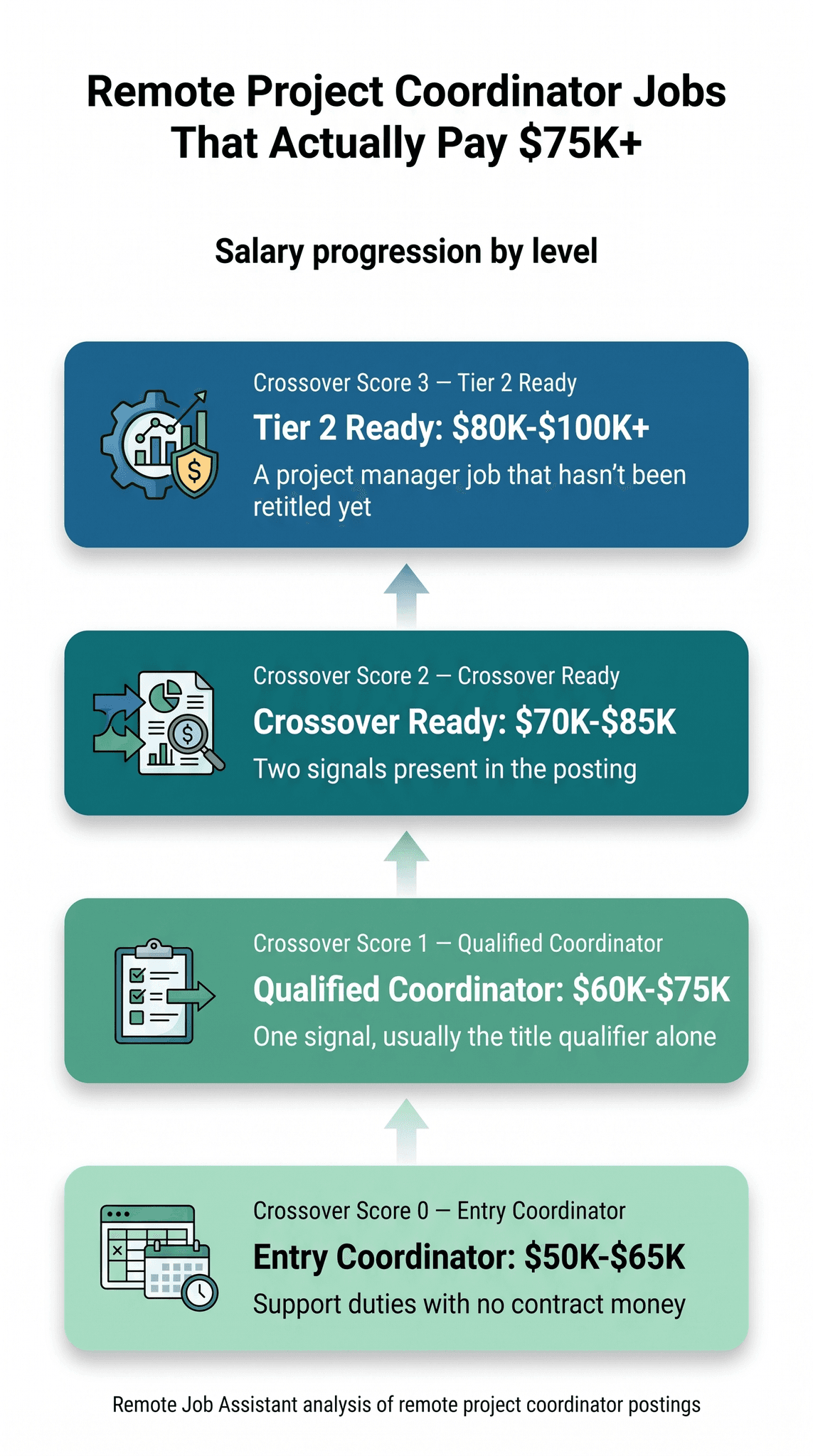
The Crossover Score is a 0-3 rubric scored directly from the text of a single job posting, using the three signals most correlated with clearing $75K in our sample.
Scoring:
- 0 — Entry Coordinator ($50K-$65K): No seniority qualifier in the title. Generic corporate employer. Duty list is "assist with," "schedule," and "maintain documentation," with no contract money anywhere in it — verbs that describe support work, not ownership.
- 1 — Qualified Coordinator ($60K-$75K): One signal present, usually the title qualifier alone. Homeworks Energy's "Project Coordinator, Sr." is a temporary seat at $25-$30 an hour that asks for "1+ years of experience in administration or related roles preferred." The word "senior" is doing all the work there.
- 2 — Crossover Ready ($70K-$85K): Two signals present — a title qualifier plus either a federal/government-consulting or healthcare-IT employer, or a title qualifier plus contract-money language (defined below).
- 3 — Tier 2 Ready ($80K-$100K+): All three signals present. This posting is a project manager job that hasn't been retitled yet. Guidehouse's "Senior Project Coordinator/Supervisor" listing in our sample ($98,000-$163,000, remote) scored a 3. It also asks for five years of experience and puts "direct reports and subcontractors" under you.
What counts for the third signal. The word "budget" isn't enough, and the counts show why. In the 82-listing read, only 4 paid postings hand the coordinator a budget outright ("manage," "control," "responsible for"), and their median top of range is $67,000, with 1 of 4 reaching $75K. The 8 paid postings that ask you to track, monitor, or assist with a budget post a median top of $77,498, and 5 of 8 reach $75K. JDS Consulting's listing says "Manage scope, schedule, and budget of each project assignment" and pays $40,000-$50,000. Control of a budget nobody bills against doesn't price up.
What does price up is the vocabulary of a billable contract: burn reports, forecasts or Estimate at Completion updates, charge codes, invoice approvals, change orders, subcontractor costs. Guidehouse's senior listing asks you to monitor "funding, labor, burn rates, forecasts, charge codes, invoices, timesheets, and resource data." That earns the point. "Help ensure projects are delivered on time, on budget" doesn't.
How to use it: before you apply, score the posting, not the title. A Crossover Score of 2 or 3 is worth your time even if a salary-aggregator site told you "project coordinator" averages $65,000. A score of 0 is a real $50K-$65K job, and no amount of resume polish changes that — the posting itself is telling you the band.
When a posting sends mixed signals, use these rules:
- Senior title, entry-level asks: score the duties. The Homeworks Energy seat above is a 1, not a 2.
- Bare title, project manager requirements: Cantata Health Solutions' "Project Coordinator" asks for "At least 4 years of project management experience, preferably with EHR implementations," and lists "Experience as an EHR Project Manager" and a PMP as preferred. Score it a 2 or 3, send a PM resume, and negotiate from the $85,000 top of its range.
- Federal employer, tracker duties: Broadway Ventures wants you to "Maintain and update project trackers, status reports, and deliverable logs" for $45,000-$60,000, and Govcio asks for "0-2 years relevant experience" at $60,000-$65,000. The employer signal doesn't fire on its own. Those are 1s.
- A range wider than $50,000: Vertex's senior listing runs $63,000-$208,000, and Surge Electrical's $25,000-$100,000 sits on top of an "$18–$22/hour guaranteed base, depending on experience, plus commission." Ask which level the requisition is budgeted at and what's guaranteed, then score it.
- "Contingent upon contract award": 3 of 82 listings say it (PCI Professional Services, Knowesis, Broadway Ventures). Apply, but ask whether the bid has been submitted and when the award is expected, and don't resign from anything until the award is confirmed.
Stop Applying Manually
Our AI applies to hundreds of matching jobs while you sleep. Wake up to interviews, not more applications.
Where the $75K+ Coordinator Jobs Actually Cluster
Employer type predicts pay better than the title does. In our October 17 sample, the postings that cleared $75K clustered in federal and government-adjacent consulting (Guidehouse, PCI Professional Services) and healthcare IT (Cantata Health Solutions). Sorting all 82 listings from October 18 by employer lane adds a third group, construction and energy, and it's the biggest:
| Employer lane (October 18 read) | Listings (with pay) | Median top of range | Reach $75K at top | What it costs you |
|---|---|---|---|---|
| Federal contractor | 12 (8) | $92,500 | 5 of 8 | Public Trust or a clearance in 9 of 12; 3 are contingent on a contract award |
| Construction, energy, utility, and facilities | 21 (19) | $75,000 | 12 of 19 | Site travel, a residency rule, or both in 14 of 21 |
| Everyone else | 46 (29) | $70,000 | 9 of 29 | Mostly support scope; Cantata (healthcare IT) is the standout |
Construction and energy listings reach $75K more often than any other lane (12 of the 26 paid listings that get there), but their median top sits right at the line, and the money comes with site time. Framatome's $102,000-$133,000 BWR Project Coordinator "Requires travel to a variety of remote job sites." SYNERGY FIBER puts you in the field about half the time. If you'll travel, count a construction, energy, or utility employer as your employer signal on the Crossover Score. If you won't, federal is the lane where the travel lines mostly say "occasional."
| Full sample (n=25 with disclosed pay) | Senior/PMO-qualified subset (n=5) | |
|---|---|---|
| Clears $75K at top of range | 13 (52%) | 4 (80%) |
| Floor at or above $75K | 5 (20%) | 2 (40%) |
| Genuinely remote-labeled | 24 of 25 | 4 of 5 |
A senior-qualified coordinator posting clears $75K at the top of its range 80% of the time; a bare "project coordinator" posting clears it only 52% of the time — and that gap is the title qualifier doing the work, not a different job underneath it.
Guidehouse posted a Senior Project Coordinator/Supervisor role at $98,000-$163,000, listed as remote with a Washington, D.C. location. Cantata Health Solutions posted a straight "Project Coordinator" — no seniority qualifier — at $75,000-$85,000, remote. PCI Professional Services posted a Program Coordinator at $70,000-$95,000, remote. Govcio, by contrast, posted a standard remote Project Coordinator role at $60,000-$65,000 — a real coordinator-scope job, correctly priced for that scope. Remote operations and project-management openings on our board skew toward the same pattern: employer type moves the number more than title alone.
According to the Bureau of Labor Statistics' Occupational Outlook Handbook for Project Management Specialists (SOC 13-1082.00, May 2025 wage data), the median annual wage is $102,320, with the 25th percentile already at $78,440. That code lumps coordinators in with managers and directors, so it's not a coordinator-only number — but it's informative precisely because of that: the broader "project management specialist" career family clears $75K by its first quartile, which tells you the ceiling on the coordinator title specifically is an artifact of the title, not the occupation.
What the Federal Coordinator Seat Actually Involves
The federal postings that pay are contract-administration jobs. Guidehouse's senior seat creates and reviews "proposals, cost estimates, burn reports, statements of work" and wants "Advanced skills in Microsoft Excel, including experience developing or maintaining burn reports and tracking tools." Knowesis ($80,000-$90,000) asks for experience "supporting Indefinite Delivery/Indefinite Quantity (IDIQ) contracts and multiple Task Orders." If you've never read a task order, learn that vocabulary before the interview.
Three things in these postings never show up on a salary page:
- The background check is the real gate. 9 of 82 listings ask for a Public Trust or a security clearance. APTNEXUS spells out what Public Trust eligibility means: "U.S. citizenship or lawful permanent residency, federal tax compliance, Selective Service registration (if applicable), a credit check, and fingerprinting." Check those before you spend an evening on the application.
- The contract sets your pay. Broadway Ventures says compensation is "contingent upon award of the contract" and its terms, "including any government-approved labor rates," and that for Service Contract Act positions "pay is also governed by the applicable Department of Labor wage determination." The range is tied to a labor-category rate in the contract as much as to your experience.
- Travel, not a D.C. office, is the friction. None of the 12 federal-contractor listings writes a D.C.-area office day into the body. Broadway Ventures won't even consider applicants in D.C., Maryland, and 14 other states. LaunchTech lists "Up to 20% Travel," and Akima, Knowesis, and APTNEXUS write in occasional or client-driven travel.
The labor categories are public. In GSA's CALC+ database, the leveled "Project Coordinator" categories climb like this:
| GSA labor category | Awarded rates | Median ceiling rate | Median minimum experience |
|---|---|---|---|
| Project Coordinator I | 94 | $76.49/hr | 2 years |
| Project Coordinator II | 92 | $93.27/hr | 3.5 years |
| Project Coordinator III | 49 | $97.81/hr | 5 years |
| Project Coordinator IV | 17 | $100.82/hr | 8 years |
Those are the most a contractor can bill the government per hour, not wages. Govcio's $60,000-$65,000 works out to $28.85-$31.25 an hour. What the ladder gives you is the question for the first call: which level does this seat bill under? If you have five years and they're slotting you as a Project Coordinator I, you're priced two rungs low, and that's the number to negotiate, not the salary.
Red Flags: When "Project Coordinator" Covers Something Else
Four patterns in the 82-listing read change what the job is, and none of them shows up in the title:
- AI-review contract work. Both AuraOne Human Data listings describe "a remote review track for evaluating AI outputs," with "Employment type: CONTRACTOR" and "Reliable async availability for at least 10 hours per week." The $45-$70 an hour is real. The $93,600 annualized figure assumes 40 hours a week that nobody promised, and there's no project to coordinate.
- Commission sales. Surge Electrical's "Remote Sales & Project Coordinator" asks for "At least two years of experience personally closing sales." You coordinate the jobs you sell.
- Remote with a map attached. 11 of 82 listings limit where you can live or how far you can be from a site. Homeworks Energy explains the usual reason: it is "registered as an employer only in specific states," and it lists 23. Others are tighter. SYNERGY FIBER wants you "within approximately 40 minutes of the Ann Arbor area" and puts about half your time in the field. Barrow Wise Consulting's $80,000-$130,000 program seat says "Work remotely, must be able to visit the banks in Montgomery County, MD."
- Travel that turns it into a field job. 10 of 82 listings put a number on travel, and 4 of those ask for 30% or more: UMI Stone/Opustone (50-70%), Wayfair (up to 50%), SYNERGY FIBER (up to 40%), and Alpha Phi (30-40%).
Walk from the first two unless that's the job you wanted. Ask about the last two on the screening call, before the interview loop: which states, what share of the time is travel, and whether the field days are in the range they quoted.
Why Your Title Lags Your Actual Scope
If your day-to-day already looks like Tier 2 — you own a vendor relationship, you flag budget overruns before your manager asks, you're the one stakeholders escalate to — and your title still says "coordinator," that's not an oversight. It's structural.
Compensation bands are usually tied to job titles in the HR system, not to the actual scope a manager has handed you over the past year. Reclassifying a title requires a formal band review, which usually means a new requisition approval, a comp-committee sign-off, or both — work most managers would rather avoid mid-cycle. It's organizationally cheaper to let someone's scope quietly expand under an existing title than to open the paperwork for a new one. That's why Built In's live US salary data for project coordinators shows coordinators with 7+ years of experience earning a $77,460 median. Seven years in, that's still about $24,900 under the $102,320 BLS median for the occupation family the title sits in.
Responsibility for contract money, not years of experience, is what the third Crossover point measures — which is why two coordinators with the same tenure can score completely differently on the same rubric.
Stop Applying Manually
Our AI applies to hundreds of matching jobs while you sleep. Wake up to interviews, not more applications.
Moving From a 0 or 1 to a 2 or 3 — Without Changing Employers First
If your current role scores low, the right first move depends on what your work already touches:
- If a client is billed for your project (agency, consultancy, contractor): ask to own the money reporting — the burn report, the monthly forecast, or invoice reconciliation against the contract. "I own the monthly burn report and invoice reconciliation for our largest client contract" is a resume line a hiring manager can score, and it's the contract-money language that earns the third Crossover point. A vague "managed budgets" line doesn't.
- If nothing you touch is billed (internal PMO, university, nonprofit): budget control there won't price up on its own. The 4 paid listings that hand a coordinator a budget outright have a $67,000 median top. Use the seat to build a project log instead: for each project, the decision you made and what happened. That log is your PMP application and your interview stories. Then apply out, because internal title changes are slow for the structural reasons above.
- If you want a federal seat: check Public Trust eligibility first (citizenship or permanent residency, tax compliance, a credit check), then match your years to the GSA ladder above so you know which level to ask for.
- If you'll travel: construction, energy, and utility coordinators reach $75K at the top in 12 of 19 paid listings. Ask for the travel percentage in writing before you accept.
When an offer comes, negotiate the level before the number. If the posting asked for project management experience you have, ask for the top of the range. If the offer is contingent on a contract award, don't resign until the award is confirmed. If "remote" turned out to mean 30% travel or more and you need remote, walk.
Certifications matter less at this specific transition than most advice suggests. Ten of the 82 listings name a PMP or CAPM, and the federal ones we checked put it under "preferred" or "nice to have," never as a hard requirement. Our sibling analysis found a 33% pay premium for PMP-certified professionals (PMI, across 21 countries), and PMI's PMP page puts the U.S. median for PMP holders at $135,000. Those numbers describe people already working at project-manager scope, not a shortcut past the coordinator-to-Tier-2 line.
Two PMI rules matter more to a coordinator than the premium does:
- PMP experience has to be managing, not assisting. PMI asks for 3 years of experience managing projects with a bachelor's degree (4 with an associate's degree, 5 with a high school diploma), counted as time "taking responsibility for planning, decisions, delivery and outcomes" within the last 10 years. It also says "Don't double-count time for projects that overlapped." Three years of "assist with" duties may not add up to three years on the application. That's why the project log above should be written in PMI's terms: planning, decisions, delivery, outcomes.
- CAPM is cheap and needs no experience. The CAPM costs $225 for PMI members or $300 otherwise and requires a secondary degree plus 23 hours of project management education. An active CAPM also satisfies the PMP's 35-hour training requirement later. One date to know: from December 1, 2026, live PMP prep classes count toward those 35 hours only if a PMI Authorized Training Partner or an accredited program teaches them.
Take the CAPM if you're aiming at federal-contractor seats, because Guidehouse, Knowesis, and Broadway Ventures all name it. Otherwise skip it, keep the project log, and spend the effort on ownership language. A PMP on a resume with a Crossover Score of 0 job underneath it won't move the number.
Stop Applying Manually
Our AI applies to hundreds of matching jobs while you sleep. Wake up to interviews, not more applications.
A "Senior Project Coordinator" posting that lists contract-money ownership is not a bigger coordinator job — it's a project manager job that HR hasn't repriced yet. Cantata's listing is the cleanest example in our read: four years of project management experience, a preferred background as an EHR project manager, a preferred PMP, and a coordinator title at $75,000-$85,000. Even the $85,000 top of that range sits $23,896 below the $108,896 remote project manager median our sibling comparison reported.
That kind of listing is rarer than the cynical version of this story suggests. Only 5 of 82 coordinator listings ask for multi-year project management experience or a PMP specifically (Cantata, INFO ORIGIN's Atlanta contract, VIATechnik, Alpha Phi, and Michigan State University). The 4 of them that print pay post a median top of range of $84,100, about $24,800 under that PM median. Most coordinator listings are honest about being support jobs. The underpriced ones are easy to find, because they say "project management" in the requirements. Apply to those as the PM roles they actually are, with a resume that leads with what you own, not what you track.
Frequently Asked Questions
Is "project coordinator" a dead-end title, or can it lead to $75K+?
It can, but the title alone doesn't get you there. 20% (n=5 of 25) of the postings we tracked had a salary floor at or above $75,000, and only 3 of those 5 were remote coordinator jobs on an employer's payroll (Cantata Health Solutions, Carlisle Utility Contractors, and Guidehouse). The other two were an on-site role and an AI-output review contract. Score the posting with the Crossover Score before assuming the title caps the pay.
I've been a project coordinator for 3 years — should I wait for a promotion or apply out as a PM?
Applying out is usually faster. Title reclassification inside most companies requires a formal comp-band review that managers tend to delay, which is part of why Built In's data shows coordinators needing 7+ years to reach a $77,460 median rather than catching up immediately when scope expands.
What's the real difference between a project coordinator and a junior project manager if the job posting reads almost the same?
Usually budget and approval authority, not task complexity. Our sibling post's Tier 1-to-Tier 2 framework draws the line at who owns the budget and who's accountable when a project misses — not at who does more work day to day.
Do I need a PMP certification to get a remote project coordinator job that pays $75K or more?
No. PMP certification carries a real 33% pay premium once you're operating at project-manager scope (PMI data, across 21 countries), but PMI only counts time spent managing projects, not assisting on them, so many coordinators don't qualify yet. Ten of the 82 listings we read name a PMP or CAPM, and the federal ones list it as preferred. If you're targeting federal-contractor seats, the CAPM ($225 for members, $300 otherwise, no experience required) is the cheap signal. Everywhere else, documented ownership of contract money moves a posting's Crossover Score more than a certification does.
How do I know if a "remote" project coordinator posting is actually remote, or just remote-flexible?
Read the body of the listing, not the search card. In our October 17 sample, 1 of 29 postings surfaced on a remote-filtered search but was explicitly on-site (Irvine, California). In the 82-listing read a day later, 11 limited where you could live or how far you could be from a site, usually because the employer is "registered as an employer only in specific states" (Homeworks Energy's wording). Look for a state list, a commute radius, a time-zone schedule, and a travel percentage before you apply.
What does a Crossover Score of 2 actually mean for whether I should apply?
A score of 2 means two of the three signals are present — usually a title qualifier plus either a higher-paying employer type or contract-money language (burn reports, forecasts, charge codes, invoices) — and in our sample, postings matching that profile clustered toward the $70,000-$85,000 range. It's worth applying to even if a generic salary page quoted a lower average for the bare title.
Why do government-contractor and healthcare-IT companies pay project coordinators more than generic corporate PMOs?
Federal-contractor coordinator listings in our 82-listing read posted a median top of range of $92,500 (n=8 with pay), versus $71,760 for everyone else (n=48). The higher-paying federal seats are contract-administration jobs (burn reports, charge codes, IDIQ task orders), and their pay is tied to labor-category rates in the contract. Federal isn't automatic, though: Govcio's 0-2-year seat paid $60,000-$65,000, and Broadway Ventures' tracker-heavy seat paid $45,000-$60,000. Healthcare IT works the same way: Cantata's $75,000-$85,000 coordinator asks for four years of project management experience, preferably on EHR implementations.
Is a program coordinator job the same as a project coordinator job?
Not quite. Glassdoor reports a remote program coordinator average of $56,815, versus roughly $67,000-$75,000 for project coordinator, while "PMO Coordinator" outperformed both with a Glassdoor-reported average of $77,462. In our 82-listing read, program titles ran from $36,712-$52,104 (CLEAResult Consulting) to $80,000-$130,000 (Barrow Wise Consulting, which asks for five or more years in commercial banking, energy analysis, or community development). Read the actual duty list rather than assuming the two titles are interchangeable.
Start Your Remote Project Coordinator Career
If you're evaluating a coordinator posting today, score it before you apply: title qualifier, employer type, contract-money language. A 2 or 3 is worth the application even if a salary aggregator quoted you a lower number for the bare title. If your current role already scores a 2 or 3 and your title hasn't caught up, that's your resume headline, not your title.
Start by comparing your current scope against our coordinator-to-manager breakdown, then browse remote project manager jobs once you've confirmed you're already doing Tier 2 work. Our remote operations and project-management job board surfaces project coordinator and project manager openings together, so you can compare scope side by side instead of guessing from the title. If budget lines, Asana, Jira, or Notion ownership already show up on your plate, lead with that — and if you're ready to apply broadly across the $75K+ board rather than one posting at a time, that's exactly what Auto-Apply is built for.
The title on your badge says coordinator. The posting you're looking at right now is either telling you the truth about that, or it's a project manager job that just hasn't been repriced yet.
Ready to Find Your Remote Job?
Browse thousands of curated remote jobs or let AI apply for you.
Browse Remote JobsRelated Job Guides

Remote Brand Manager Jobs: What 829 Postings Pay (2026)
Remote brand manager jobs: we analyzed 829 US postings. Classic CPG roles paid $125K and rarely went remote; software and health roles paid about $170K.
23 min read

Remote UX Researcher Jobs: What 211 Postings Pay (2026)
Remote UX researcher jobs: we read 211 US postings. Remote seats paid $144K vs $176K hybrid; employer type, statistics and AI work set the $190K+ band.
38 min read
Remote Solutions Architect Jobs: Pay by Seat Type (2026)
Remote solutions architect jobs: we read 1,079 US postings. Vendor pre-sales seats post $205,000 and say remote 81% of the time. AWS listed 4 of 269 remote.
42 min read