
Last reviewed: October 2026
You can retouch a jewelry campaign from your kitchen table. You can't shoot one there, and you can't scan a three-bedroom listing for a real estate site from it either. If you're a working photographer, photo editor, retoucher, or producer with a few years behind you and a portfolio worth more than the $44,660 national median, that difference decides how far a remote search will get you.
Search for remote photography jobs and LinkedIn's page promises "1,000+ Remote Photographer Jobs in United States." On that page, "remote" is a search keyword, not a filter. We read the full text of its 40 still-photography listings, and not one was a fully remote job. The only article on the first page of Google comes from a company that sells AI training data. It calls remote photography "thriving" and doesn't give a single salary figure.
Get Remote Job Tips in Your Inbox
Weekly strategies, salary data, and new opportunities
Unsubscribe anytime. No spam.
So we built the denominator ourselves. Remote Job Assistant read 499 US photography postings from 274 employers in full, all of them live on October 1, 2026, and 451 of the 498 with a date first listed in June 2026 or later. They came from LinkedIn, from 30 Workday career boards including CoStar, Nexstar, National Geographic, and Gap, from SmartRecruiters, and from a sweep of 835 startup and tech job boards. Two of the 499 were fully remote, and both were hourly contracts. This post covers where the remote work in photography actually is, what each kind pays, and a simple score that tells you how far your job sits from the camera.
Based on our analysis of 499 US photography postings at 274 employers (all live October 1, 2026):
- 0.4% (n=2 of 499) were fully remote, and both were hourly contracts: a 15-hour-a-week retouching job at $40–$45 an hour and a $26-an-hour AI photography contract
- 0% (n=0 of 384) of photographer postings were remote; the only remote work sat in the editing, retouching, and AI image band (n=2 of 59)
- 29.7% (n=148 of 499) were field jobs where you drive to the subject; 43 of them came from one employer whose postings say its photographers "are managed remotely"
- 7.4% (n=37 of 499) were hybrid; of the 18 that state office days, 10 require three and 7 require four
- 0 of 43 postings whose pay range starts at $75K or more were remote (19 onsite, 11 hybrid, 11 office city only, 2 field)
- $50K–$55K median posted range for photographers (n=79), against $85K–$105K for editors and retouchers (n=19) and $120K–$152K for producers and photo directors (n=16)
- 67% of US photographers are self-employed, according to the Bureau of Labor Statistics, so most remote photo work never appears in a job posting
If you want $75K or more and as little commuting as possible, the postings point to three realistic bets, and none of them is a fully remote staff job.
A hybrid editor, retouching, or producer seat at a publisher or brand studio pays $80K–$162K in these postings and asks for three or four office days. AI image-evaluation contracts for experienced photographers pay $26–$90 an hour at most of the companies we checked, fully remote, with no benefits and no guarantee of work. Retouching and post-production contracts pay $35–$86 an hour in our data, and the ones that pay best want color authority and generative-AI compositing.
The Shutter Distance Score: Why the Camera Never Goes Remote
Three things keep photography work in a building, and each one hits a different part of the job.
The subject is somewhere. A listing, a lipstick, a quarterback, a newborn: the thing you photograph sets your location. Of the 384 photographer postings we read, 148 (38.5%) were field jobs where you travel to the subject, and 203 (52.9%) asked for a driver's license, reliable transportation, or your own vehicle. Video appeared in 195 of them (50.8%). The staff photographer of 2026 drives to the shoot and comes back with stills and footage.
The samples and the color are in the studio. Retail and e-commerce studios keep the product samples, the calibrated monitors, and the people who sign off on color in one room. West Elm's senior digital retoucher works "onsite Monday-Thursday in our Industry City photo studio." Rooms To Go's retoucher posting says "The position is 100% onsite and in studio not a work from home position." Williams-Sonoma wants its senior digital tech able "to perform work full-time, onsite in the Richmond office." Color management or color correction appears in 62.7% of the editing, retouching, and imaging postings (n=37 of 59). When the job is matching a pixel to a sweater, the sweater has to be nearby.
The file can travel, and that cuts both ways. Anything that can be uploaded can also be sent to a cheaper editor. The one fully remote retouching job in our data was a 15-hour-a-week contract. On Himalayas, a remote-only job board listing 98,835 jobs, the full-time remote retouching and photo-editing seats were offshore staffing roles paid and scheduled for other markets. Remote post-production exists, but clients price it as a commodity unless you own something they can't send overseas: approvals, brand standards, or AI compositing that gets past a creative director.
Put those together and a pattern falls out. The further a job sits from the moment of capture, the more it can leave the building and the more it pays. Employers just haven't let it leave yet.
The Shutter Distance Score: A 0–10 rubric for how far a photography role sits from the moment of capture, and so how much of it could be done from home.
Score the role on three observable criteria:
- Where capture happens (0–4): you press the shutter or run capture on set scores 0; you plan, staff, and direct shoots you attend scores 1–2; you receive files after the shoot scores 3–4.
- What you physically touch (0–3): products, samples, talent, vehicles, properties, or gear scores 0; samples or set days on some weeks scores 1–2; nothing but files scores 3.
- What the posting says (0–3): a territory, studio, or office with no flexibility ("100% onsite," "not a work from home position") scores 0; set office days scores 1; remote offered as an option scores 2; remote stated, with no travel, scores 3.
Scoring:
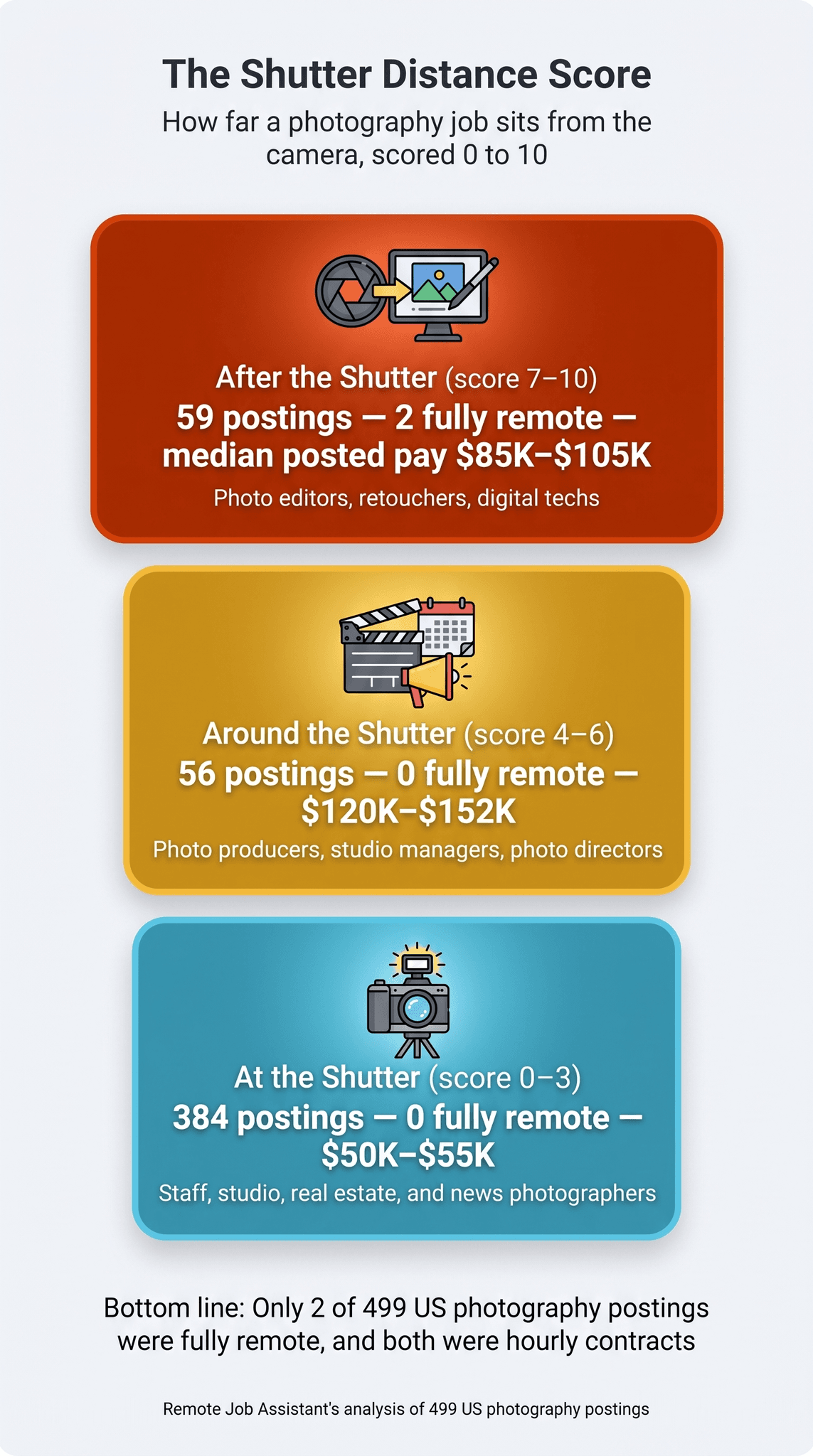
- 0–3 At the Shutter ($50K–$55K median posted range): Staff, studio, e-commerce, real estate, vehicle, and news photographers. This is 77.0% of the market (n=384 of 499), and none of it was remote. 148 of these postings were field jobs and 24 were hybrid. Weighted so each employer counts once, the median posted range rises to $65K–$82K (34 employers), because one company posted 43 near-identical field jobs, mostly at $49K–$50K.
- 4–6 Around the Shutter ($120K–$152K): Photo and art producers, studio managers, photo directors and managers. This is 11.2% of postings (n=56), with 0 remote and 4 hybrid. Pottery Barn's Creative Director, Photo posts $140,000–$175,000 onsite. The New York Times' Deputy Director, Photo posts $140,000–$160,000 with four office days a week.
- 7–10 After the Shutter ($85K–$105K): Photo editors, retouchers, digital techs, post-production specialists, and AI image roles. This is 11.8% of postings (n=59), and it's the only band with remote work: 2 postings (3.4%), both hourly, plus 9 hybrid. Photoshop is named in 81.4% of these postings (n=48 of 59), and generative AI is named as a skill in 22.0% (n=13 of 59).
How to use it: Score the work and the posting separately. If your work scores 7 or higher but the posting scores 0, the remote ask is a negotiation, not a fantasy: ask in the first screen which days need you in the studio and why. If your work scores 0–3, stop searching "remote" and decide between a field job and a hybrid studio seat. To raise your score, split off the parts of your work that are already files, such as retouching, color, asset management, and AI image review, and sell them as a role or a contract of their own.
| Shutter Distance band | Typical roles | Postings | Fully remote | Hybrid | Field | Median posted range |
|---|---|---|---|---|---|---|
| 0–3 At the Shutter | Staff, studio, e-commerce, real estate, vehicle, and news photographers | 384 (77.0%) | 0 | 24 | 148 | $50K–$55K (n=79) |
| 4–6 Around the Shutter | Photo and art producers, studio managers, photo directors | 56 (11.2%) | 0 | 4 | 0 | $120K–$152K (n=16) |
| 7–10 After the Shutter | Photo editors, retouchers, digital techs, post-production, AI image roles | 59 (11.8%) | 2 | 9 | 0 | $85K–$105K (n=19) |
The pay column climbs as you move away from the camera, and the remote column barely moves at all. In photography, distance from the shutter buys you money long before it buys you remote.
With 2 remote postings in 499, qualifying isn't the hard part. The hard part is finding the few hybrid seats and contracts across hundreds of retailer, publisher, and agency career sites before they close.
Stop Applying Manually
Our AI applies to hundreds of matching jobs while you sleep. Wake up to interviews, not more applications.
How We Collected This Data
The figures in this post come from 499 unique US photography postings at 274 employers, collected on October 1, 2026, and read in full. 399 came from LinkedIn's public job search, where we ran 23 keyword searches (seven of them with "remote" in the query) and fetched the full text of 979 postings. 75 came straight from 30 Workday career boards, including CoStar, Nexstar, Disney's National Geographic and ABC stations, Gap, Uline, eBay, Dow Jones, Condé Nast, and Reuters. Another 21 came from SmartRecruiters' public search, 3 from a sweep of 835 startup and tech job boards on Greenhouse, Lever, Ashby, and SmartRecruiters, and 1 from Amazon's jobs site. Of the 498 postings with a date, 451 were first listed in June 2026 or later.
We kept titles where still photography is the job or the thing being managed: photographers and photojournalists, photo editors, retouchers, digital techs, imaging and post-production specialists, photo producers and studio managers, and photography directors. We excluded internships, volunteer roles, models, photonics and photo-ID jobs, retail photo counters, and 40 generic "content producer" titles with no photo duty in the title. We also collapsed 77 per-city copies of the same requisition. Pay was posted on 198 of the 499 postings (114 annual ranges, 84 hourly).
LinkedIn ignores its remote filter for public searches, so every work model here comes from the job text. Remote means you can work from home full time. Hybrid means required office or studio days. Field means you travel to the subject. Onsite means a named studio or office every day. We read every posting that mentioned remote work, read every hybrid posting, and checked samples of the rest by hand.
Pay was cross-referenced with the Bureau of Labor Statistics' Occupational Outlook Handbook for photographers and its May 2025 wage survey. The gaps are real: Indeed, ZipRecruiter, FlexJobs, Glassdoor, and Reddit block automated reading, so none of their data appears here. Freelance work, which is most of photography, never shows up in a job posting at all. Every figure reflects postings that were live on October 1, 2026.
What Remote Photography Jobs Pay in 2026
Our photographers' numbers land close to the government's. BLS puts the median for photographers at $44,660 for May 2025, and the median posted range for the 79 photographer postings with an annual figure in our data is $50K–$55K. The pay gap opens up once you leave the camera behind.
Salary ranges here are base pay as published in 114 postings with an annual range, collected October 1, 2026. Because one employer posted 43 near-identical field jobs, we also report a median that counts each employer once. BLS figures cover salaried photographers only, 51,760 of them, and leave out the self-employed majority.
| What you do | Postings with annual pay | Median posted range | Highest posted ranges in our data |
|---|---|---|---|
| Shoot (photographers) | 79 | $50K–$55K (employer-weighted $65K–$82K) | Kalman & Company photographer/videographer $110K–$175K, onsite; TYR Sport $110K–$120K |
| Edit and finish (editors, retouchers, digital techs) | 19 | $85K–$105K | The Washington Post senior photo assignment editor $110K–$160K, onsite; Michael Kors lead retoucher and AI imaging specialist $100K–$120K |
| Produce and direct (producers, photo directors) | 16 | $120K–$152K | Netflix photo studio and campaign managers $169K–$281K; Pottery Barn creative director, photo $140K–$175K |
The national spread shows the same thing from a different angle:
| BLS measure (May 2025) | Annual pay |
|---|---|
| Photographers, 10th percentile | $30,820 |
| Photographers, 25th percentile | $36,050 |
| Photographers, median | $44,660 |
| Photographers, 75th percentile | $62,740 |
| Photographers, 90th percentile | $91,810 |
| Photographers in motion picture and video (1,300 employed) | $120,470 median |
| Photographers at corporate headquarters (600 employed) | $75,420 median |
| Photographers in broadcasting and content (2,930 employed) | $73,800 median |
| Photographers in photographic services (28,710 employed) | $39,190 median |
| Editors, all fields | $77,920 median |
| Art directors | $114,850 median |
The causal story sits in that last block. The biggest employer of salaried photographers is photographic services, the school-portrait chains, event companies, and real estate media firms, with 28,710 photographers at a $39,190 median. Those businesses sell the photograph, so they scale it by territory and appointment. Pay climbs where the photographer works inside a company that sells something else: a film studio, a corporate headquarters, a broadcaster. There the image is part of a bigger product, and the person who approves it is paid like a manager.
Work model tells the same story. Hybrid postings had a median posted range of $90K–$110K (n=15), onsite $82.5K–$97K (n=28), and field $49K–$50K (n=52). The remote postings published only hourly rates: $26 an hour and $40–$45 an hour. Hybrid pays more than onsite here, but not because you're home two days a week. The hybrid seats are the senior ones at publishers and brand studios. If you're targeting remote jobs paying $75K or more, the photo market's version is mostly a studio seat with two home days, not a home office.
Where the Remote Work Actually Is: Four Lanes
If 2 of 499 postings are remote, where do remote photographers come from? Mostly from four places that don't look like a normal job search. Each pays differently, and each has a catch.
| Lane | Pay in our sources | How you're paid | What gets you in | The catch |
|---|---|---|---|---|
| AI image evaluation and capture | $26–$90 an hour | Hourly or per task, contract | A portfolio and 2–10 years of experience | Talent pools with no open project; rates set by where you live |
| Retouching and post-production contracts | $35–$86 an hour | Hourly, often part-time | Color work, compositing, generative AI | Offshore competition; many are onsite |
| Hybrid salaried seats | $80K–$162K a year | Salary and benefits | Editorial judgment, approvals, budgets | Three or four office days |
| Your own business | Day rates, usage fees, licensing | Client by client | Clients who trust you | The shoot is still in person |
Lane 1: AI image evaluation and capture. AI companies pay experienced photographers to judge images, label footage, and shoot reference sets, and they publish the rates. micro1 lists a "Photographer" contract at "$50 - $90/hour" to "Review video footage of robotic arms performing a variety of tasks" and judge "image clarity, composition, and relevance." Mercor's current "Arts & Design Expert" listing, which names photography, says its creative listings "have posted at $60 to $80 an hour," and its archived "Visual Quality Reviewer" paid $60–$90 an hour for 7 to 10 years of high-end visual evaluation. Handshake AI's "Photo Editing Expert" pays "Up to $50/hr" and asks for five years in Photoshop or photo editing. Invisible's "Photographer Specialist" pays "$6 to $65 per hour," set by "experience, expertise, and geographic location," and you supply your own camera. The one AI contract in our core data, an "AI Photographer (Japanese)" role through Crossing Hurdles, pays $26 an hour for 20 or 40 hours a week. Two catches matter. First, some listings are pools, not openings: Mercor's says outright that it "does not accept or reject candidates." Second, some pay per task. Mercor's photographer listing pays "$120 per task," estimates two hours, and adds, "This is a per-task payment, not an hourly payment." Third, the work ends. Of the 11 Mercor photography and image listings we loaded, 6 were already archived, micro1's earlier "Photographer - AI trainer" listing is marked closed, and Turing's photographer contracts run "Up to 16 weeks." Treat this lane as a bridge or a side income, prefer hourly or W-2 setups over per-task ones, keep a log of your effective hourly rate, and plan for months with no project at all.
Lane 2: Retouching and post-production contracts. The single fully remote retouching posting in our data came through Creative Circle, a creative staffing agency, for "a Michigan-based home builder": a "FULLY-REMOTE position" for "a Photo Retoucher with generative AI experience," "(15 hours per week)," at $40–$45 an hour. That's $600–$675 a week, which is the honest answer to the "$1,000 a week from home" question. Other agency retouching rates in our data were $35–$40 an hour (24 Seven, Los Angeles), $50–$75 an hour and $85–$86 an hour for an "AI Artist & Retoucher" (Aquent, Corte Madera, California), and $59–$64 an hour for an onsite senior retoucher (Creative Circle). The ceiling is set offshore. Upwork's own page says photo editors there "can earn $10–$25/hr," and on Himalayas the full-time remote retouching and photo-editing seats tagged "United States" were offshore staffing roles: one listed HMO coverage, "leave credits," and Australian time zones, and another offered "Attractive AUD remuneration." Read agency postings closely. Creative Circle's "Junior Retoucher" pays $25–$30 an hour and asks for "3-5 years of professional experience." Robert Half's Irvine "Photo Retoucher" posting, at $22–$25 an hour, carries the same job description as a photo-editor posting on Boot Barn's own board, which suggests the agency is filling the employer's own opening at an agency rate. Agency contracts are W-2 with thin benefits: Creative Circle's remote retoucher posting offers eligibility for a "Minimum Essential Coverage (MEC) medical plan." And the agency rates above $70 an hour in our data were onsite: Creative Circle's jewelry product photographer in Coppell, Texas, at $84–$85 an hour and its Seattle photographer at $70–$80. What protects a senior retoucher is authority, not speed: owning color, brand standards, and AI compositing. Michael Kors' "Lead Retoucher & AI Imaging Specialist" posts $100,000–$120,000 in New York. If you're weighing words against images, our guide to remote editing jobs covers the text side of the same craft.
Lane 3: Hybrid salaried seats. This is where the $75K+ money is. Of the 18 hybrid postings that state office days, 10 require three and 7 require four. The New York Times' Staff Photo Editor ($113,945–$115,000) and Deputy Director, Photo ($140,000–$160,000) both require "regular attendance in the office four days each week," and add, "There may be some flexibility to work remotely per your departmental guidance." HYBE America's Senior Photo Specialist ($95,000–$125,000) is "in-person collaboration 3 days per week and remote work 2 days per week." National Geographic's Senior Features Photo Editor ($95,500–$128,000) and Manager, Photo – Special Projects ($121,000–$162,200) carry Disney's "Primarily On-Site / Occasionally from Home" label. Macy's Photo Art Director Specialist ($81,120–$135,120) "requires an on-set presence four days per week." At the other end, The Washington Post's Senior Photo Assignment Editor ($110,000–$160,000) says "we work on-site five days a week," and KITH's Senior Photographer ($90,000–$110,000) is "Full-time/100% on-site." You can't win a remote seat here, but you can choose your days.
Lane 4: Your own business. BLS counts 67% of photographers as self-employed, and it notes that "Most photographers do their own postproduction work." That's the remote half of a freelance business: editing, retouching, licensing, client work, and admin. The shoot is still in person. Pricing is on you: ASMP, the trade group for working photographers, says "Due to anti-trust laws, ASMP cannot set or suggest prices," but its pricing guides share members' real estimates and licensing fees, and APA publishes business documents for estimates and billing. One market anchor: ASMP's Colorado chapter put 2025 first-assistant day rates at $400–$700 in New York and Los Angeles.
Pick your lane by what you can't give up:
- Benefits: Lane 3. You trade home time, three or four studio days a week, for the only salaried seats in the $80K–$162K range.
- Home time: Lanes 1 and 2 together. You trade stability: hourly pay, no paid leave, and listings that close. Keep three months of expenses as a buffer.
- Control of your rate: Lane 4. You trade a steady paycheck for day rates and usage fees, and you still travel to every shoot.
- The camera itself: At the Shutter work is field or studio. Choose the road or the room, because remote isn't on the menu.
Very few photographers live in only one lane. The remote photography job of 2026 isn't a job. It's a stack of contracts.
The stack only works if you see the openings while they're open. A retouching contract or a hybrid photo-editor seat fills in days, and the employers posting them are spread across hundreds of studio, publisher, and agency sites.
Stop Applying Manually
Our AI applies to hundreds of matching jobs while you sleep. Wake up to interviews, not more applications.
Why Most "Remote Photographer" Listings Make You Drive
Field work is the largest stated work model in photography: 148 of 499 postings (29.7%), at 65 employers. Real estate leads with 69 of them, followed by news and broadcast (20), portraits, events, and schools (17), and car dealerships (16).
When "remote" appears on a photographer posting, it usually describes your manager or your home base, not your workplace. You start the day at home and spend it in your car.
CoStar is the clearest case. It posted 43 associate photographer jobs for its home and apartment listing sites, located as "Field Based" (36) or "Home-based" (3) in a metro area, mostly at $49,000–$50,000 a year. Each photographer "is given a core territory," and the physical requirements read "Repetitive and frequent sitting in a car, standing and walking for up to 8 hours per day." The remote part is the management: "Photographers are managed remotely by a Photography Manager located in local markets." Full Package Media's real estate photographer job in Austin ($50,000–$70,000) is just as plain: "On a daily basis you will drive to your appointments, capture the media based on what was ordered, deliver a great experience, and upload the media you captured at the end of the day." A Phoenix real estate posting carries a "Contractor Remote" header above "Autonomous field work across Phoenix metro." Lifetouch's event photographers "upload images from home" after the event.
The cause is dispatch. These companies sell the photograph by the appointment, so they hire by territory and route the work to whoever is closest. The only part of the job that happens at home is the upload. On a photographer posting, "remote" usually means your car is the office. That can be a fine job if you like the road and want steady bookings. Just don't count it as remote, and don't expect it to pay like the editing desk: the field median in our data was $49K–$50K.
How to Search for Remote Photography Jobs Without Wasting Applications
The word "remote" works against you here. 220 of our 399 LinkedIn postings came up through searches with "remote" in the query, and only 2 of those 220 were remote. Search by title and skill instead, starting from your Shutter Distance Score:
- 0–3: search staff, product, and studio photographer titles by city, and drop the word remote.
- 4–6: search producer and studio operations titles at retailers, publishers, and streaming studios, then sort by office days.
- 7–10: search retoucher, digital tech, photo editor, and post-production titles for salary, and AI evaluation listings for contract income.
Then read the work-model paragraph before you apply.
Titles that surface after-the-shutter work: retoucher, digital retoucher, digital tech, photo editor, post-production specialist, digital imaging specialist, and "photography expert" or "image evaluation" for AI contracts. For producer and director roles: photo producer, art producer, studio operations manager, and photo director. Job boards built for remote work help less than you'd think. Our review of the best remote job boards explains which ones check their remote tags, and on Himalayas' 98,835 listings, a 12-term search found 16 photo-related jobs and no salaried US staff seats. Retailer and publisher career sites, and design roles filed under creative and design jobs, are where the hybrid seats get posted first.
Red flags in "remote" photo postings. Walk away, or at least ask:
- "Remote" plus "reliable transportation." That's a field job with a home base. 203 of 384 photographer postings asked for a car or a license.
- Pay quoted per task with an "effective" hourly rate. You carry the risk if the task takes four hours instead of two.
- A listing that "does not accept or reject candidates." That's a talent pool. Apply, but don't stop searching.
- A US tag with foreign benefits or currency. Leave credits, HMO plans, or "AUD remuneration" mean an offshore staffing seat priced for another market.
- An unpaid test edit longer than one image. A five-image test is free retouching. Ask for a paid test or offer an existing before-and-after.
Three questions to ask in the first screen: Which days do you need me in the studio, and for what? Who signs off on color, and where do they sit? Is post-production done in-house, by an agency, or offshore? The answers tell you your Shutter Distance Score faster than the posting does.
For your portfolio, show the work the job is paid for. After-the-shutter roles want before-and-after pairs, color-critical product work, and composites, labeled with what you did. Producer roles want shot lists, budgets, and schedules from real shoots. If your applications go nowhere, our breakdown of why you're not getting interviews covers the screening mistakes that sink senior candidates.
When a posting does pass these checks, speed matters more than polish. When we read them, The New York Times' staff photo editor posting and HYBE's senior photo specialist posting each showed "Over 200 applicants" on LinkedIn.
Stop Applying Manually
Our AI applies to hundreds of matching jobs while you sleep. Wake up to interviews, not more applications.
Is AI Replacing Photographers? What the Postings and Policies Say
Partly, and in a narrow way. BLS projects photographer employment to fall 1% from 2025 to 2035, and it names the cause: "some kinds of photography, such as stock photos, are projected to be partially replaced by artificial intelligence (AI)-generated images, dampening demand for these workers." It still expects about 10,700 openings a year, all from people leaving the field, and it projects the number of self-employed photographers to grow while demand for portraits and commercial work holds.
The big image buyers have drawn hard lines. Getty Images' contributor rules say "We don't accept content created by generative AI" and cap AI retouching: "Do not retouch more than 10% of the content's total pixels in an image/frame." The Associated Press says, "we do not allow the use of generative AI to add or subtract any elements." Shutterstock "will not allow AI-generated content to be submitted by contributors for licensing." Adobe Stock accepts generative-AI images if they're labeled. So for news and premium stock, a real photographer behind a real capture is the product.
The postings show where AI is landing instead: in the edit. Generative AI is named as a skill in 22.0% of editing, retouching, and imaging postings (n=13 of 59), against 1.8% of photographer postings (n=7 of 384). Pottery Barn Kids wants its color retoucher to have "Working knowledge of AI image manipulations using Firefly, Chat GPT, Gemini and other emerging technologies." Catalyst Brands asks for "AI-based image QA or generative tools (e.g., Firefly, Midjourney, Caimera, Runway)." Rooms To Go wants "AI-assisted compositing and scene reconstruction." Colony Brands posted an "AI Image Production Specialist" job, and it requires "working onsite 5 days a week." Even the AI jobs aren't remote.
The take: AI is shrinking stock and simple cleanup. Some of the best-paid remote work open to photographers right now, at $45–$90 an hour, is grading images and footage for AI companies, and some of that work trains the image models that are cutting into stock demand. Take the money if you want it, but treat it as a bridge, because the listings close. The skill those companies pay for, telling a good image from a plausible one, is worth more inside a studio that ships real product photos than inside a labeling queue.
Frequently Asked Questions
Can a photographer actually work fully remote, or are all "remote photography jobs" really field or hybrid jobs?
Almost all of them are field, onsite, or hybrid. In our October 2026 analysis, 0.4% of US photography postings (n=2 of 499) were fully remote, and both were hourly contracts, while 29.7% (n=148) were field jobs and 7.4% (n=37) were hybrid. None of the 384 photographer postings was remote. Fully remote photo work exists mainly as contracts and self-employment, not staff jobs.
I'm a product photographer making $60K. Which photo job could get me to $90K or more, and will it be remote?
The clearest step up is senior in-house work or moving behind the camera: senior e-commerce and brand photographers posted $90K–$125K (American Eagle, HYBE, True Religion, Michael Kors), and senior retouchers and digital techs posted $85K–$115K (West Elm, Williams-Sonoma). Expect onsite or hybrid with three or four studio days. None of the 43 postings starting at $75K or more was remote.
Are AI training jobs for photographers legit, and what do they really pay?
Many are real contracts with published rates: micro1 lists $50–$90 an hour, Mercor's creative listings $60–$80, Handshake AI up to $50, and Invisible $6–$65 depending on where you live. Check whether the listing is a talent pool or a live project, and whether you're paid hourly or per task. Expect no benefits and uneven hours.
What does a Shutter Distance Score of 5 mean for my job search?
A 5 puts you Around the Shutter: you plan or direct shoots you still attend, like a photo producer or studio manager. Expect onsite or hybrid seats; none of the 56 producer and director postings in our data was remote, though they posted the highest pay, a $120K–$152K median. To reach 7 or higher, move toward work that's reviewed as files, such as retouching, color, asset management, or AI image review.
How do I become a remote photo editor or retoucher in 2026?
Start with skills that can't be sent offshore cheaply: color management, named in 62.7% of editing, retouching, and imaging postings, and generative-AI skills, named in 22.0%. Build a before-and-after portfolio, take hourly retouching contracts through creative staffing agencies, and target hybrid in-house seats for salary. Expect contracts first: the only fully remote retouching posting we found was 15 hours a week.
Is AI replacing photographers and retouchers?
AI is cutting into stock photography and simple cleanup, and BLS projects photographer jobs to fall 1% from 2025 to 2035 partly for that reason. But Getty, the AP, and Shutterstock refuse AI-generated images, and retailers are hiring retouchers who use AI tools. The work is moving from removing dust to judging and directing images.
Why do so many "remote photographer" listings require a car?
Because they're field jobs that dispatch you to the subject from home. Field work was 29.7% of the US photography postings we read (n=148 of 499), and the biggest field employer, CoStar, says its real estate photographers "are managed remotely" while describing "frequent sitting in a car" for up to 8 hours a day. If a remote photography posting mentions reliable transportation or a territory, plan on driving.
Start Your Remote Photography Job Search
Two remote postings in 499 is the market telling you something: in photography, remote is something you assemble, not a job title you apply for. Score your work on The Shutter Distance Score first. If you're After the Shutter, go after the hybrid editor and retouching seats for salary and stack hourly retouching or AI-evaluation contracts around them. If you're Around the Shutter, pick the studio whose office days fit your life, and read our guide to remote creative director jobs for the next rung up. If you're At the Shutter, decide whether you want the road or the studio, because no employer in our data offered you the couch. Photographers changing lanes should also look at remote UX designer roles and remote social media jobs, where visual skills carry over and remote work is more common. For the broader market, our guide to high-paying remote jobs and the remote jobs paying $100K or more board are good next stops. When you find the seats worth applying to, Auto-Apply gets your applications in fast, while the few remote and hybrid photo roles are still open.
The camera stays where the subject is. Your career doesn't have to.
Ready to Find Your Remote Job?
Browse thousands of curated remote jobs or let AI apply for you.
Browse Remote JobsRelated Job Guides

Remote Architecture Jobs: What 1,574 Postings Show
Remote architecture jobs are rare: 25 of 1,574 postings. See which roles go remote, what they pay, and why most firms still want you at the pin-up wall.
35 min read
Remote Civil Engineering Jobs: What 4,770 Postings Show
Remote civil engineering jobs are rare: 165 of 4,770 postings. See which specialties hire remote, what they pay, and why most seats stop at a state line.
33 min read
Remote Electrical Engineering Jobs: What 2,220 Postings Show
Remote electrical engineering jobs are mostly power jobs: 56 of 127 remote postings were grid roles. See who hires, what they pay, and what gates apply.
34 min read