

Last reviewed: March 2026
Teal holds a 4.3-star Trustpilot rating (n=93 verified reviews, March 2026) and genuinely earns it for resume organization and keyword matching — but 11 of those 93 reviewers leave one star, AI errors have been documented by major tech publications, and the platform submits exactly zero applications on your behalf. We tested Teal's free tier and Teal+ ($29/month) for 14 days in March 2026, built resumes against three job descriptions across tech, marketing, and finance, and analyzed 93 Trustpilot reviews, 144 ProductHunt reviews, and a dozen Reddit threads across r/jobsearchhacks, r/resumes, and r/cscareerquestions. Here's the honest assessment.
Teal is the best job-search organization tool in this category — its Chrome extension, job tracker, and keyword-matching resume builder are genuinely useful, and the free tier is more generous than most competitors. Where it falls short: AI-generated content can be generic or factually wrong, ATS compatibility on two-column templates is inconsistent, and the platform does not submit applications for you. If you want to tailor every application manually and stay organized across 40+ job boards, Teal is worth serious consideration. If you're looking to submit 20-50 targeted applications per day without spending hours per application, Teal is not that product.
Bottom line: Teal is a preparation tool, not a submission engine. Use it to build your resume — then use Remote Job Assistant to submit it at scale.
Get Remote Job Tips in Your Inbox
Weekly strategies, salary data, and new opportunities
Unsubscribe anytime. No spam.
Based on our 14-day test of Teal and analysis of user reviews across three platforms (March 2026):
Based on our 14-day test of Teal and analysis of 237 user reviews (March 2026):
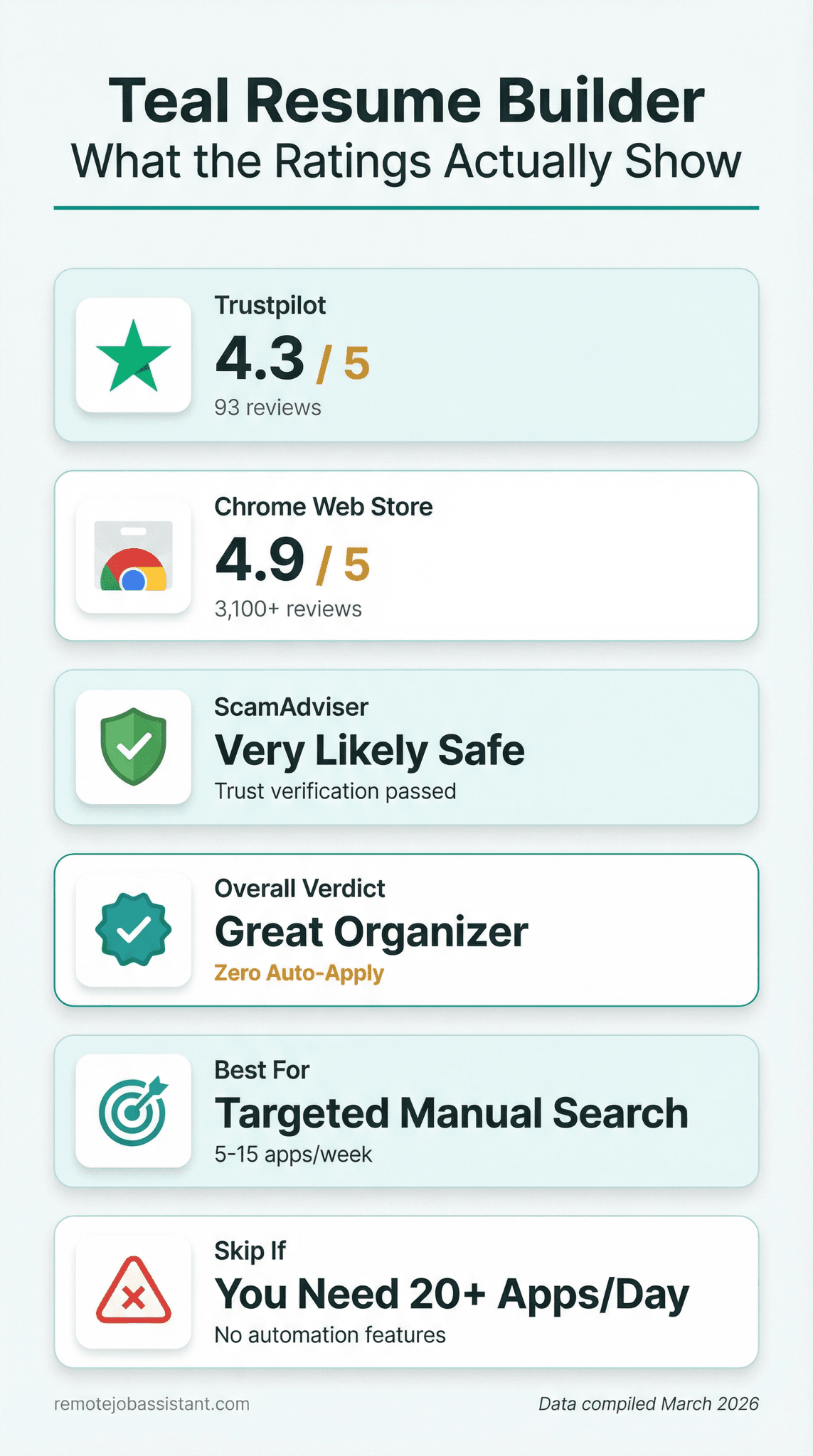
- 4.3/5 Trustpilot rating (n=93 verified reviews, March 2026)
- 12% one-star reviews (n=11 of 93 total Trustpilot ratings)
- 4.9/5 Chrome Web Store rating (n=3,100+ reviews) — Chrome Favorite 2023
- $29/month Teal+ base plan — $179/year annual option (approx. $14.92/month)
- 0 applications submitted automatically — Teal submits nothing on your behalf
- "Very Likely Safe" — ScamAdviser trust rating for tealhq.com
What Is Teal?
Teal (tealhq.com) is an AI-powered career platform built around three core tools: a resume builder with keyword matching, a job application tracker, and a Chrome extension that saves jobs from 40+ job boards. Founded in 2019 by David Fano (former Chief Growth Officer at WeWork) and backed by $20.7M in venture funding, Teal has grown to 2M+ users. It is not an auto-apply tool — it helps you prepare and organize applications that you submit yourself.
Pricing ranges from free (limited AI credits) to Teal+ at $29/month or $179/year. The free tier includes unlimited job tracking and resume downloads but caps AI generation at 10 credits — enough to try the product, not enough to rely on it.
Internal link: See our full best AI auto-apply tools comparison for how Teal fits into the broader tool landscape.
How Teal Works
The workflow starts with Teal's Chrome extension. Install it, browse LinkedIn, Indeed, Glassdoor, or any of 40+ supported job boards, and click "Save Job" to pull the posting into your Teal dashboard. From there, you open the resume builder, select that saved job, and Teal's AI analyzes the job description for keywords. It generates a match score — the percentage of the JD's key terms your current resume includes — and highlights gaps.
You then edit your resume manually or use AI generation for bullet points and professional summaries. Teal shows exactly which keywords are missing and suggests phrasing. Once satisfied, you export the resume as a PDF, return to the job board, and apply yourself.
The platform also tracks your application status, contacts, and companies in a CRM-style dashboard. Resume builder, job tracker, cover letter generator, LinkedIn profile reviewer, and interview practice tools are all included under one login. The breadth is one of Teal's strengths — and occasionally a navigation challenge.
What Teal does not do: Submit applications. Every "apply" click is yours.
How We Tested Teal
We tested Teal's free tier and Teal+ monthly plan ($29/month) for 14 days in March 2026, building tailored resumes for three job descriptions: a senior software engineer role at a Series B startup, a content marketing manager at a Fortune 500, and a financial analyst at a remote-first firm. We tracked keyword match accuracy, the quality and accuracy of AI-generated bullets and summaries, ATS export reliability, and time-per-application compared to a manual baseline.
We also analyzed 93 Trustpilot reviews (as of March 2026), 144 ProductHunt reviews, and 12+ Reddit threads across r/jobsearchhacks, r/resumes, and r/cscareerquestions. Pricing was verified directly on tealhq.com on March 11, 2026.
Teal Pricing (2026)
| Plan | Price | Per Month |
|---|---|---|
| Free | $0 | $0 |
| Weekly | $9/week | approx. $36 |
| Monthly | $29/month | $29 |
| Quarterly | $79/3 months | approx. $26 |
| Annual | $179/year | approx. $15 |
Pricing verified on tealhq.com on March 11, 2026.
The free tier caps AI usage at 10 bullet credits, 2 summary credits, and 2 cover letter credits — enough to test the core features in one session. Once used, AI generation is locked until you upgrade. The homepage markets Teal as "free," which is technically accurate but functionally misleading for anyone who expects ongoing AI-assisted resume tailoring.
There is no free trial. Payment starts immediately on the chosen billing cycle. Cancellation is available in account settings and takes effect at the end of your current period.
Compared to RJA: Teal+ at $29/month and Remote Job Assistant at $29.90/month are nearly identical in price. They solve completely different problems — resume preparation vs. automated application submission.
Evaluating Teal: The Resume Tool ROI Framework
Before diving into pros and cons, it helps to have a framework for evaluating any resume or job search tool. Here's the one we use:
The Resume Tool ROI Framework: A rubric for assessing whether a tool earns its monthly fee, based on three factors — application velocity, quality uplift, and trust signals.
Score each factor 1-10, add them up. A total below 18 is a preparation tool. Above 24 is execution infrastructure.
- Velocity (1-10): Does it get you to 10+ applications per day? 0 = fully manual. 10 = full automation at scale.
- Quality uplift (1-10): Does it meaningfully improve interview callback rates? 0 = no ATS guidance. 10 = verified ATS compatibility, documented callback improvement.
- Trust signals (1-10): Complaint rate: fewer than 5 complaints per 100 reviews? No billing traps? Account security? 0 = billing fraud, no support. 10 = clean cancellation, documented outcomes, responsive support.
Teal's score: 12/30. Velocity: 0 (manual-only). Quality: 7 (keyword matching and organization are above average, ATS caveats on templates). Trust: 5 (4.9 Chrome but 11 one-star reviews of 93 total Trustpilot ratings, billing friction documented). At 12/30, Teal is a preparation tool — a good one, but not an execution engine.
RJA's score: 24/30. Velocity: 9. Quality: 7. Trust: 8. See the comparison section below.
What Teal Does Well
The job tracker is genuinely excellent. Spreadsheets collapse past 20 applications — version control nightmares, no way to link contacts to specific roles, status columns that drift out of sync the moment you open a second tab. Teal's CRM-style dashboard auto-sorts by status, links saved jobs to tailored resumes, and lets you log follow-up dates alongside the recruiter's name. The Chrome extension pulls job postings from 40+ boards (LinkedIn, Indeed, Glassdoor, BuiltIn, and more) into your dashboard in one click without losing your place. Users on r/jobsearchhacks describe it as replacing "a messy Excel file or Trello board" they'd been maintaining for months. The tracker alone justifies using the free tier for any active job seeker running more than a handful of simultaneous applications.
Keyword matching is above average — with an important caveat. The match score percentage is specific and actionable — it shows which terms from the job description are absent from your current resume and generates suggested bullets to address them. One r/jobsearchhacks user reported landing "a contract job and had two more interviews lined up" within a week of using the keyword feature for ATS optimization. In our testing, match scores aligned accurately with the JD requirements across all three roles.
The caveat: chasing a near-perfect match score can produce resumes that pass the ATS and irritate the human recruiter who reads them next. If Teal suggests stuffing "cross-functional stakeholder alignment" into a bullet where your actual work was "coordinated with three teams," the ATS approves it and the recruiter notices the corporate-speak. Use the keyword gaps as a signal, not a requirement — the goal is accurate representation of real experience in language the system recognizes, not keyword saturation.
The Chrome extension is best-in-class. Teal's extension holds a 4.9/5 rating on the Chrome Web Store with 3,100+ reviews — named one of Chrome's Favorites of 2023. It works reliably across 40-50 job boards and integrates job saves directly into the dashboard without requiring separate login. Among Chrome extensions built for job seekers, this is the benchmark.
The free tier is more generous than competitors — but don't mistake it for a complete product. Jobscan and ResumeWorded paywall their trackers and limit resume exports. Teal gives you unlimited tracking and PDF downloads at no cost. The catch: 10 AI credits disappear in a single resume tailoring session. Once gone, the builder turns into a manual editor with no AI assist until you subscribe. It's a genuine free tool — it's also a deliberately calibrated teaser that converts frustrated free users into Teal+ subscribers.
Where Teal Falls Short
Zero auto-apply capability — and this won't change. Teal is built for preparation, not execution. You save jobs, tailor your resume to each one, and manually click "apply" for every single position. No batch-apply, no submission queue, no automation layer. At 10-20 tailored applications per week, that's manageable. At the volume a serious remote job search requires — 20-50 per day — you'll burn out in week two clicking through identical forms. Job seekers on Reddit who switched from Teal to auto-apply tools consistently report the same thing: they didn't realize how much time the manual submission step actually consumed until they automated it. This isn't a bug in Teal; it's a deliberate product philosophy. But it's the most important limitation to understand before subscribing, and no upgrade tier changes it.
AI output is generic and sometimes wrong. Tom's Guide documented Teal inserting "work authorization" — a legal requirement from a Meta job description — into the resume headline as a professional skill. Cover letters have been reported to misspell user names in roughly half of generations, per one Trustpilot reviewer. Career experts who've tested Teal rate the first AI draft as "very general and generic — it could have been on anyone's resume." In our testing, the AI bullets were keyword-accurate but thin on specificity; they required significant manual editing to reflect actual experience. The core issue: Teal's AI performs token matching, not contextual understanding. It identifies relevant terms and inserts them — it doesn't evaluate whether the insertion is accurate or meaningful.
ATS compatibility issues on two-column templates — and Teal won't warn you. Teal offers 11 resume templates, several using two-column layouts. Workday — one of the most widely deployed ATS platforms in enterprise recruiting — consistently fails to parse two-column formats. Users report their resume "converts to an undesirable bullet format" after Workday processes it, with section order garbled and content merged incorrectly. In one documented case, a job seeker built a polished two-column Teal resume, hit a 92-point keyword match score, submitted it through Workday — and received a recruiter email a week later noting the experience section was unreadable; they'd passed. Teal does not warn users which templates are ATS-safe. It markets itself as ATS-optimized while shipping templates that common ATS systems can't read. Before submitting any Teal resume through an enterprise ATS, export the PDF and test it with a free ATS parser — Jobscan's resume scanner or ResumeWorded's ATS checker both show how the system will actually read your file. Confirm the parsed output matches what you wrote before you click submit.
Billing friction and misleading "free" framing. Of 93 Trustpilot reviews analyzed (March 2026), 11 are one-star (12%). Billing and cancellation issues are the dominant theme. One reviewer canceled on March 5, 2025, and was charged again on March 10 on a charge marked "NON-RECURRING" — they ultimately deleted their account to stop the billing. Another reports being locked out of their established account and redirected to an empty new account, losing all resume and application history. The homepage claim that Teal is "free" is accurate for the base tracker; it is not accurate for the AI features that make Teal useful, all of which sit behind Teal+.
No mobile app. Teal is web-only with a desktop Chrome extension. There is no iOS or Android app. For job seekers who search on mobile — which accounts for a significant share of job board traffic — Teal's workflow doesn't transfer. Competitors with mobile apps have a meaningful advantage for job seekers who aren't at a desktop.
If you've read this and realized Teal's manual-only model isn't what you need, Remote Job Assistant applies to targeted $75K+ remote roles automatically — here's how the auto-apply works.
Teal vs. Remote Job Assistant
These tools are not direct competitors. Teal is resume preparation infrastructure. RJA is an application submission engine. A complete job search campaign can use both — but they solve fundamentally different problems.
The difference between Teal and RJA isn't quality — it's throughput. Teal optimizes every application you submit. RJA submits applications while you sleep.
Three decisive differences:
- Application model: Teal requires you to click "apply" on every job. RJA submits applications automatically against a profile you set once.
- Time investment: A well-tailored Teal application takes 20-45 minutes per job. An RJA application campaign runs in the background.
- Use case fit: Teal is right for targeted, relationship-driven searches where every application is bespoke. RJA is right for volume-based searches where the goal is maximizing interviews across a broad set of $75K+ remote roles.
| Feature | Teal | Remote Job Assistant |
|---|---|---|
| Resume builder | Yes — AI-assisted tailoring | No — bring your own resume |
| Job tracker / CRM | Yes — excellent | Yes — application tracking |
| Auto-apply | No — fully manual | Yes — automated submissions |
| Chrome extension | Yes — 4.9/5, 3,100+ reviews | Yes |
| Pricing | Free–$29/mo ($179/yr) | $29.90/mo |
| Mobile app | No | Yes |
| ATS optimization | Yes (caveats on 2-column templates) | Targets ATS-optimized listings |
| Best for | Resume prep + organized manual search | High-volume application campaigns |
At $29/month, Teal is selling organizational infrastructure. At $29.90/month, RJA is selling application velocity. Know which problem you're solving.
Who Should Use Teal?
The clearest way to decide: what's your actual bottleneck?
If your bottleneck is organization — you have jobs you want to apply for, but your applications are scattered across browser tabs, spreadsheets, and email threads — Teal solves that problem well. Mid-career and senior professionals doing a targeted search of 5-15 applications per week, where each application is tailored to a specific company with a specific hiring manager, are exactly who Teal is built for. The tracker, keyword matching, and CRM are genuinely useful at that cadence.
If your bottleneck is volume — you have a strong resume, you've been applying to enough roles, you just need more applications in more pipelines — Teal does nothing for you. The manual model is the constraint, not a feature.
If your bottleneck is resume quality — the free tier is worth testing before you pay anything. Use the 10 AI credits on your target role category, see if the keyword gaps it surfaces change your hit rate, then decide if Teal+ justifies $29/month.
Skip Teal entirely if: You need 20+ applications per day, you want any form of automation, or your job search is broad rather than targeted. At that scale, the manual submission step is your ceiling — and Teal has no answer for it.
For high-paying remote jobs at $75K+, both tools have a role: Teal to prepare a strong, targeted resume, and RJA to submit it at scale. See our job boards guide for where to source the best listings.
Stop Applying Manually
Our AI applies to hundreds of matching jobs while you sleep. Wake up to interviews, not more applications.
Frequently Asked Questions
Is Teal resume builder legit? Yes. Teal holds a 4.3/5 Trustpilot rating (n=93 verified reviews, March 2026), a 4.9/5 Chrome Web Store rating (n=3,100+ reviews), and ScamAdviser rates tealhq.com "Very Likely Safe." The company is backed by $20.7M in venture funding and reports 2M+ users. Of the 93 Trustpilot reviews (March 2026), 11 are one-star — primarily reflecting billing friction and AI quality issues, not fraud or scam activity.
How much does Teal cost? Teal has a free tier (capped at 10 AI credits) and Teal+ at $29/month, $79/quarter, or $179/year (approx. $15/month). A weekly plan at $9/week also exists — but at approx. $36/month, it's more expensive than the monthly plan. Pricing verified on tealhq.com on March 11, 2026. There is no free trial; billing starts immediately.
Does Teal actually get you interviews? Some users report success — one r/jobsearchhacks user landed "a contract job and had two more interviews lined up" within one week of using Teal's keyword matching. However, Teal does not submit applications for you. Interview outcomes depend entirely on the quality and volume of applications you send manually. The keyword matching can improve ATS screening; it doesn't replace application volume.
What is the best Teal alternative? For resume building and keyword optimization, Kickresume is a direct alternative with more design-forward templates. For automated job applications — something Teal doesn't offer at all — Remote Job Assistant applies to $75K+ remote roles automatically. See our Kickresume review and best auto-apply tools comparison for full breakdowns.
Should I pay for Teal+ or stick with the free tier? The free tier is sufficient for job tracking and resume downloads. Teal+ is worth considering if you're actively tailoring multiple applications per week and need unlimited AI generation. If you're sending the same resume to every job without customizing, the free tier is adequate — though at that point, you're not using Teal's core value proposition.
Does Teal auto-apply for jobs? No. Teal does not auto-apply for any jobs. It saves job postings, helps tailor your resume with keyword matching, and tracks your application status — but you manually click "apply" for every single position. If automated submission is what you need, that's a different product category. See how auto-apply tools work for context.
What should I look for when choosing a resume tool? Apply the Resume Tool ROI Framework: evaluate application velocity (does it speed up your submission rate?), quality uplift (does it meaningfully improve your resume per role?), and trust signals (complaint rate, billing practices, documentation of outcomes). A tool that scores high on quality but zero on velocity is a preparation tool. A tool scoring high on velocity but low on trust is a liability. Teal scores well on quality; RJA scores well on velocity.
Why do some people hate Teal? 11 of 93 Trustpilot reviewers (March 2026) left one star, and the complaints cluster around three issues: billing charges after cancellation, AI-generated content that is generic or contains errors (name misspellings, hallucinated skills from job descriptions), and ATS formatting failures on two-column templates. Users who expected automation — because the marketing leads with AI — also report disappointment when they realize Teal requires manual submission.
Is Teal better than Jobscan for resume optimization? Reddit users who've tested both consistently prefer Teal for ease of use, cleaner interface, and more generous free tier. Jobscan's keyword scoring is comparable. Teal's advantage is the integrated job tracker and Chrome extension; Jobscan's advantage is a longer track record for ATS scoring. Neither auto-applies. For resume title optimization before applying, see our resume title examples guide.
Is Teal worth it in 2026? The free tier remains one of the most useful free job search tools available — unlimited tracking, resume downloads, and some AI credits at no cost is a genuinely good deal. Teal+ at $29/month is reasonable if you're tailoring multiple applications per week. If you need application volume — submitting at scale rather than one at a time — Teal is not worth it for that purpose, and no upgrade changes that.
Teal earns its rating. The job tracker is excellent, the Chrome extension is best-in-class, and keyword matching genuinely improves ATS screening. The free tier is more generous than most competitors. Where it earns its one-star reviews: AI output can be generic or factually wrong, two-column templates have documented ATS failures, and billing can be difficult to cancel. Most importantly — Teal does not apply for jobs. It prepares you to apply for jobs. If that's the product you need, it's a strong option. If you need an application engine, look elsewhere.
Teal is the best organized preparation room in the job search world. The problem is it doesn't actually file your application.
Ready to Automate Your Job Search?
Let AI apply to hundreds of jobs for you while you focus on interviews.
Start Auto-ApplyingRelated Tool Comparisons

Dynamite Jobs Review: What 499 Live Listings Actually Pay (2026)
Dynamite Jobs is free and legit, but its promoted listings pay a median of about $30K. Our review of 499 live listings, its ratings, and the apply process.
24 min read
Remote Rocketship Review: Is the Paid Remote Job Board Worth It? (2026)
Remote Rocketship scores 4.1/5 on Trustpilot from 71 reviews, but it won't publish its price anywhere. Our verified review of the paid remote job board.
20 min read
Indeed vs. LinkedIn: Which Job Site Works for $75K+ Remote Roles
Indeed vs. LinkedIn for $75K+ remote jobs: real pricing, ghost-job data, trust scores, and a framework to decide where your job search time actually pays off.
20 min read