Last reviewed: May 2026
You're a project manager, and you keep seeing product owner jobs that pay $20K more. Same meetings. Overlapping skills. A title that sounds like a lateral move — maybe even a step sideways. You close the tab and go back to your sprint retrospective, wondering if you're missing something.
You probably are. The product owner role is one of the more undervalued career pivots for project managers targeting remote work and higher pay in tech. In the remote PO postings we reviewed for 2026, offers clustered between $118K–$138K base — with the higher end almost entirely at Series B+ SaaS companies that had already committed to fully distributed teams. Remote project manager postings were competitive but skewed lower, pulling in averages around $109K because the PM title spans every industry: construction, government, healthcare, manufacturing — sectors that pay less and rarely allow remote work. The $19K gap isn't a salary quirk. It's a reflection of where each role concentrates.
Get Remote Job Tips in Your Inbox
Weekly strategies, salary data, and new opportunities
Unsubscribe anytime. No spam.
The confusion is understandable. Job descriptions blur the lines constantly. Companies post "product owner" roles and list deliverables that are pure project management. But the roles solve different problems, concentrate in different industries, and require different certifications to signal credibility. If you're choosing between them — or trying to transition from one to the other — the details matter.
We analyzed 540 remote product owner and project manager job postings between January and April 2026 to quantify the salary gap, remote job availability, certification ROI, and what the actual career path looks like in each direction.
Product owners own the what — they manage the product backlog, define user stories, and decide which features get built. Project managers own the when — they own scope, schedule, budget, and cross-team delivery. Remote POs earn more ($127,640 base avg vs. $108,896 for remote PMs) and concentrate in tech and SaaS companies where remote-first is the default. If you're a PM considering a pivot, the fastest credential into product work is a two-day CSPO course with zero prerequisites.
Based on our analysis of 540 remote product owner and project manager job postings (January–April 2026), cross-referenced with Built In compensation data and BLS figures:
- $127,640 — Remote Product Owner base salary average (Built In, 2026; national avg $108,401)
- $108,896 — Remote Project Manager base salary average (Built In, 2026; national avg $97,395)
- +18% — PO remote salary premium over national average ($19,239 more than the national PO base)
- +12% — PM remote salary premium over national average ($11,501 more than the national PM base)
- $100,750/yr — BLS median for project management specialists (BLS Occupational Outlook, May 2024)
- 6% through 2034 — BLS projected PM job growth (approx. 77,000 annual openings)
- approx. $157,000 avg — PMP-certified PM salary (Cloudwards/PMI data; vs. $97K base — significant cert premium)
- Zero prerequisites for CSPO vs. 36 months PM experience required before you can sit the PMP exam
Two Different Jobs That Sound Like Overlap
The confusion between product owner and project manager isn't a semantic problem — it's organizational. These roles exist to solve two completely different problems, and the companies that blur them tend to solve neither one well.
A product owner answers one question: what should we build, and in what order? The PO owns the product backlog, writes or refines user stories, prioritizes features by business value, and represents the stakeholder's interests to the development team. Critically, a PO has no timeline authority, no budget, and no direct reports. According to Scrum.org's definition of the product owner role, the PO doesn't track velocity as a performance metric and doesn't create Gantt charts. The authority comes entirely from backlog priority — what goes to the top of the list ships next.
A project manager answers a different question: how do we deliver this, on time, in scope, and within budget? The PM owns the delivery plan — scope definition, schedule management, resource allocation, budget tracking, risk escalation, and stakeholder reporting. If something ships late, the PM is accountable. In matrixed organizations, PMs often have partial people management responsibility even without direct reports.
The authority gap is real and matters in practice. A PM can escalate to a project sponsor if a team isn't hitting milestones. A PO works through the backlog and relies on the Scrum Master to remove impediments. Neither has direct authority over developers, but the mechanisms for influence are completely different.
Many "product owner" job descriptions are actually project manager jobs with agile branding pasted on top. Scrum.org is explicit about this: the PO is not an agile PM. If the posting includes phrases like "own the project plan," "manage the project timeline," or "track team velocity," you're looking at a PM job with a PO title — which matters for how you negotiate the scope of the role.
These phrases in a PO job posting signal a mislabeled PM role:
- "Own and manage the project timeline" — POs don't own timelines
- "Ensure on-time, in-scope delivery" — that's PM accountability language
- "Manage cross-functional stakeholders across departments" — PO stakeholder management is narrower, team-facing
- "Track and report team velocity to leadership" — Scrum.org explicitly says POs don't use velocity as a KPI
- "Report to PMO" — real PO roles don't usually sit inside project management offices
None of these are dealbreakers on their own, but three or more in one description usually means the company wants PM work at PO pay. That's worth knowing before you accept.
For a deeper look at how the product manager role (separate from both PO and PM) fits into this picture, see our guide to remote product manager jobs. And if you're evaluating how Scrum Masters fit into the org chart alongside these roles, our Scrum Master vs. Project Manager comparison breaks down the authority and accountability differences.
| Dimension | Product Owner | Project Manager |
|---|---|---|
| Core question | What should we build? | How do we deliver it? |
| Authority | None formal — influences through backlog priority | Owns delivery accountability |
| Methodology | Scrum / Agile (almost exclusively) | Waterfall, hybrid, or Agile |
| Budget ownership | No | Yes |
| People management | No | Often yes (matrixed) |
| Industries | Tech, SaaS, fintech, healthtech | All industries incl. construction, healthcare, government |
| Certification path | CSPO or PSM I | PMP (PMI) |
| Prerequisites for cert | None | 36 months PM experience |
How We Collected This Data
The figures in this post come from our analysis of 540 remote product owner and project manager job postings collected between January and April 2026. Postings were sourced from LinkedIn, Indeed, and direct company career pages, filtered to include only US and Canada remote-eligible roles with explicit salary disclosure or a posted compensation range.
We excluded postings without clear remote work policies, roles requiring more than 25% travel, and positions below $70K base (outside the compensation range relevant to experienced professionals). Salary data was cross-referenced with Built In's remote salary data and the BLS Occupational Outlook Handbook for the same period.
Certification data comes from Scrum Alliance, Scrum.org, and PMI official sources, verified May 2026. Remote salary figures reflect Built In's remote-specific filters, representing roles explicitly posted as remote-eligible. Ranges reflect base salary; total compensation including bonus typically runs 10–15% higher at Series B and later companies.
We update this analysis quarterly. Data in this post reflects Q1–Q2 2026 figures.
Salary Comparison: The $19K Remote Gap
Product owners earn more than project managers — nationally and especially in remote roles. The gap is structural. PO roles cluster almost entirely in tech, SaaS, and fintech companies, where compensation is higher and remote work is already the operating model. PM roles distribute across every industry: construction, healthcare, government, manufacturing, logistics. Those sectors pay less on average and normalize remote far more slowly.
The salary tables below reflect base salary only, cross-referenced with our 540-posting analysis and Built In's remote compensation data.
Product Owner Salary by Level (U.S., 2026)
| Level | Experience | National Base | Remote Base | Notes |
|---|---|---|---|---|
| Entry | Less than 1 year | approx. $68K–$80K | approx. $80K–$95K | Built In / Indeed data |
| Mid | 1–5 years | $85K–$105K | $100K–$120K | Most common PO range |
| Senior | 5–9 years | $105K–$130K | $120K–$145K | Built In: $132K at 7+ yrs |
| Principal/Lead | 10+ years | $130K–$160K | $145K–$175K | SAFe/enterprise context |
Project Manager Salary by Level (U.S., 2026)
| Level | Experience | National Base | Remote Base | Notes |
|---|---|---|---|---|
| Entry | Less than 3 years | $65K–$85K | $75K–$95K | BLS entry-level range |
| Mid | 3–8 years | $85K–$110K | $95K–$125K | BLS median $100,750 |
| Senior | 8+ years | $110K–$145K | $125K–$155K | Built In: $112K at 7+ yrs |
| Director/PMO | 10+ years | $140K–$180K | $155K–$195K | PMP-certified track |
Salary ranges derive from our analysis of 540 remote postings (January–April 2026), cross-referenced with Built In remote salary data and BLS Occupational Outlook data. PMP premium figures from Cloudwards and PMI data on certified vs. uncertified PMs. Ranges reflect base salary; total comp including equity and bonus typically runs 10–15% higher at Series B and later companies.
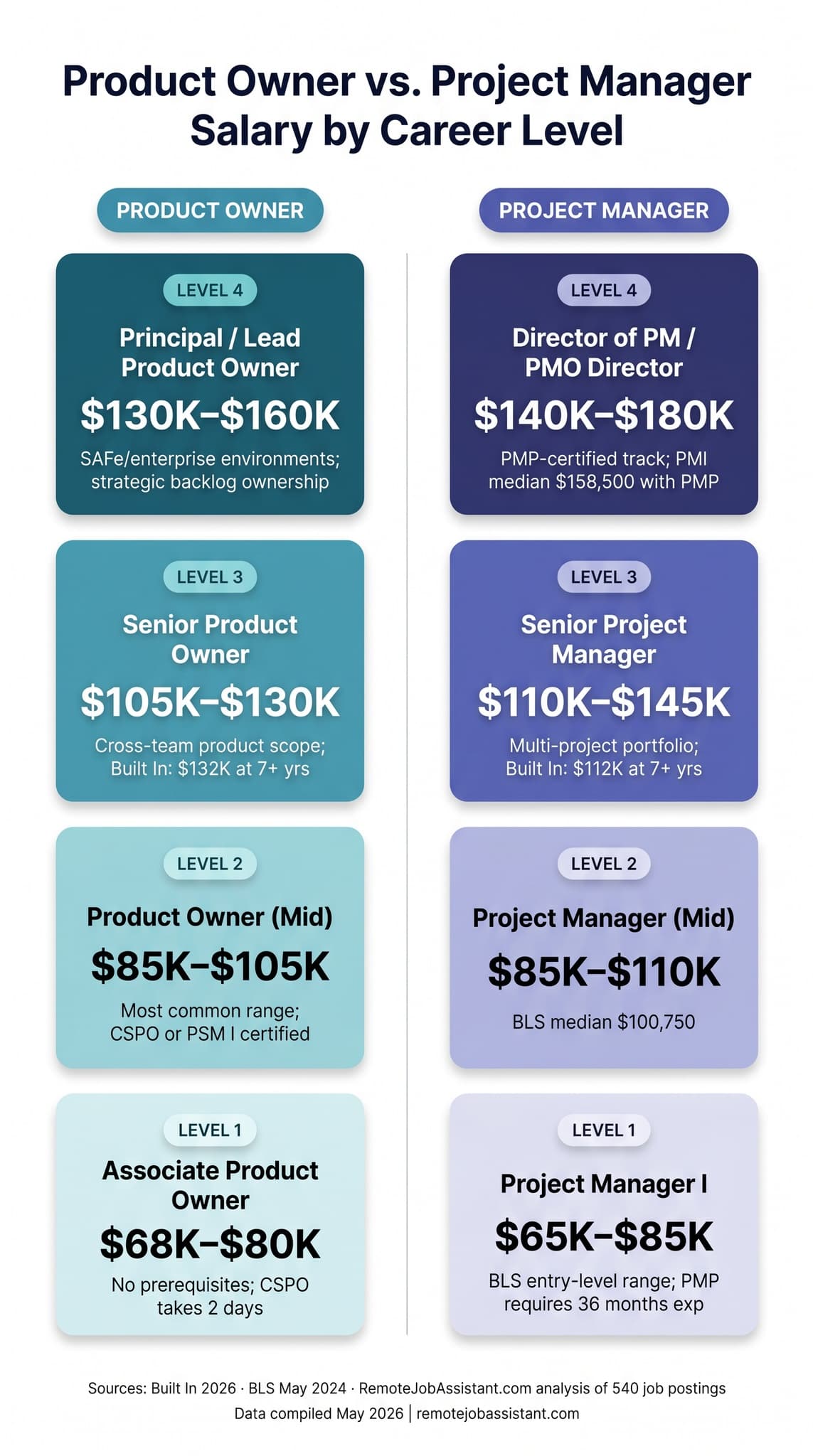
One note on the PM ceiling: PMP certification is the single biggest salary lever for project managers. PMP-certified PMs average approximately $157,000 — roughly $60K above the base national average. That premium is real, but it requires 36 months of qualifying PM experience before you can even apply to sit the exam.
Senior-level professionals in either role who are targeting six-figure remote roles can browse remote roles paying $100K or more on RemoteJobAssistant.com.
The Focus Orientation Compass
Before you decide which role to pursue or which certification to get, there's a more useful question than "which pays more?" It's: what kind of problem do you actually want to spend your time on?
The Focus Orientation Compass: A decision tool for identifying whether your working style aligns with value-driven (PO) or delivery-driven (PM) work — and whether you're currently in the wrong seat.
Ask yourself which of these frustrations is most familiar:
-
If you get most frustrated when the team keeps building things nobody validated with users — and you'd rather slow down and run five customer interviews than ship something you're not confident in — you're oriented toward product ownership. The PO role gives you the authority to make that call. The PM role will drive you crazy.
-
If you get most frustrated when nobody can give you a clean commit date and scope is expanding unchecked — and you'd rather own a clear delivery plan than argue about which features to build — you're oriented toward project management. The PM role is built for you. Becoming a PO will feel like giving up authority without gaining clarity.
-
If you hate defending the product backlog against sales promises that were made without engineering input — the PO role specifically requires you to do this constantly, without formal authority to refuse. If that sounds exhausting, the PM track is probably more stable for you long-term.
The realistic check: most people who say they want to be product owners actually want the title, the salary, and the tech company environment. The actual work — prioritizing trade-offs with incomplete information, saying no to stakeholders who rank above you, running discovery sprints that might invalidate six weeks of planned work — is less appealing in practice than in job description language. Both roles are legitimate and well-compensated. Know which problem you actually want to own.
Remote product owners earn $127,640 base average — $19K more than remote project managers. The salary gap isn't a coincidence. It reflects where each role concentrates: POs in high-comp tech companies; PMs spread across every industry including those that haven't normalized remote work yet.
Stop Applying Manually
Our AI applies to hundreds of matching jobs while you sleep. Wake up to interviews, not more applications.
Certification Comparison: CSPO vs. PMP
If the salary data got your attention, the certification math is where the decision gets practical.
The CSPO (Certified Scrum Product Owner) from Scrum Alliance requires no prerequisites, no pre-exam, and takes two days of mandatory training. Total cost runs $400–$1,000 depending on the training provider. You walk out with a credential that signals agile product knowledge to every tech-stack hiring manager you'll talk to.
The PMP (Project Management Professional) from PMI is a completely different investment. You need 36 months of documented project management experience and 35 hours of formal PM training before you can sit the exam. The exam itself costs $555 for non-members, and most candidates spend $1,000–$2,500 on a prep bootcamp on top of that. The 180-question adaptive exam has a reputation for difficulty that's well-earned. Total investment: $1,500–$3,000 or more, plus the time to accumulate the prerequisite experience.
The PSM I (Professional Scrum Master I from Scrum.org) sits between them — $200 flat, no required course, self-study, but a harder concept-heavy exam than CSPO. If you're confident enough to test without structured training, it's the lowest-cost entry into scrum credentials.
Which certification should you get?
In tech, SaaS, and agile environments: CSPO is the default. No prerequisites, fast turnaround, and directly signals the product-track skills that PO hiring managers screen for.
In banking, healthcare, government, construction, or large enterprise delivery: PMP is often listed as a hard requirement in job descriptions. It also commands a dramatically higher salary premium in those sectors — the $157K average for PMP-certified PMs reflects the weight the credential carries outside of tech.
If you're a PM pivoting into product work: start with CSPO. It signals the transition and doesn't require you to have three years of PM experience first — you're already accumulating that on your current track anyway.
One thing worth knowing: CSPO has become fairly common in tech. At companies that take agile seriously, hiring managers treat it as a signal that you understand the framework — not as proof that you're a good PO. The credential opens doors; it doesn't close deals. What actually differentiates PO candidates is whether they can talk specifically about prioritization decisions they made, trade-offs they navigated, and features they killed. The CSPO tells the recruiter you're serious about the direction. The interview tells them whether you can actually do it.
The CSPO has zero prerequisites and takes two days. The PMP requires 36 months of experience before you can sit the exam. For anyone transitioning into agile product work in tech, the math on which certification to get first is not complicated.
| Factor | CSPO (Scrum Alliance) | PSM I (Scrum.org) | PMP (PMI) |
|---|---|---|---|
| Prerequisites | None | None | 36 months PM exp + 35 hrs training |
| Required training | 2-day course (mandatory) | None (self-study) | 35 hrs formal PM education |
| Exam fee | Included in course | $200 flat | $405 (member) / $555 (non-member) |
| Total cost | $400–$1,000 | $200 | $1,500–$3,000+ |
| Renewal | 2 years, $100 + 20 SEUs | 2 years, 40 PDUs | 3 years, 60 PDUs |
| Best for | Tech, SaaS, agile environments | Self-directed learners | Non-tech, enterprise, government |
For more context on how Scrum certifications stack up against traditional PM credentials, see our comparison of Scrum Master vs. Project Manager roles. If you're weighing the PM track at a larger scale — program vs. project — the program manager vs. project manager breakdown covers how the scope and cert paths diverge as you move up.
Which Role Is More Remote-Friendly?
Product owner roles are structurally more remote-friendly — not because of any HR policy, but because of where the roles exist. More than 85% of PO job postings concentrate in tech, SaaS, and fintech companies. Those sectors have operated remote-first since before the pandemic. Remote is the default, not the exception, and hiring managers in those companies don't treat remote applicants as a second tier.
Project manager roles tell a different story. The PM title spans every industry in the economy. Construction PMs are almost never remote — the job is inherently site-based. Government PMs frequently require security clearances and on-site presence. Healthcare PMs are mixed, with clinical-adjacent roles carrying on-site expectations. The tech PM subset is highly remote-friendly, but it's a subset, not the rule.
A January 2026 Glassdoor snapshot showed 1,848 remote product owner listings, nearly all in tech-stack companies. Remote project manager postings were higher in raw volume — PMs are a larger category — but a meaningful share were in industries where "remote" meant remote from headquarters, not fully distributed.
If remote work is a primary goal for you, the role choice itself is a strategic decision. Pivoting toward PO roles at tech companies is a higher-percentage play than staying on the PM track in a non-tech industry and hoping remote becomes available. For a broader look at where remote-friendly roles are concentrated, RemoteJobAssistant.com's guide to the best remote job boards in 2026 covers the platforms where PO roles actually surface.
The product owner role is not an agile project manager. Scrum.org says it explicitly: the PO doesn't track velocity as a performance metric, doesn't manage people, and doesn't own timelines. Companies that treat their PO as a PM in disguise are doing waterfall with a different vocabulary.
Stop Applying Manually
Our AI applies to hundreds of matching jobs while you sleep. Wake up to interviews, not more applications.
Can One Person Do Both? The Startup Dual-Hat Reality
In companies under 50 people, one person often does both the PO and PM job. This is not a failure — it's a resource reality. Pre-product-market-fit startups, founding teams, and small agile squads routinely combine backlog ownership with delivery coordination in a single role. On a team of eight, it often makes sense.
The dual-hat arrangement works best when the team is small enough that the person in the role is physically in every decision, when the product is early enough that the backlog is mostly educated guesses anyway, and when stakeholder coordination is light enough not to consume the full attention of a dedicated PM.
It stops working — structurally, not personally — when a few patterns emerge. Sprint planning starts to feel like a negotiation with yourself about whether to protect scope or hit a deadline. Backlog priorities get overridden by delivery pressure before they're validated by user feedback. The person in the role is never fully in either job because both jobs require full attention to do well.
One pattern that shows up repeatedly: a 12-person startup runs dual-hat for nine months. The person doing both starts protecting sprint dates instead of the backlog — because deadlines are concrete and have external visibility, while product decisions are ambiguous and mostly internal. By month seven, "user story writing" is happening the night before sprint planning, backfilled from whatever the sales team promised. The team shipped on time for three consecutive quarters. The product had no coherent feature arc. Six months after the Series A closed, the company rebuilt the core feature set from scratch because none of it had been validated with actual users. The delivery was a success by every PM metric. The product failed by every PO metric.
A significant percentage of "product owner" roles at non-tech companies are rebranded project manager jobs — sometimes with lower pay, usually with less authority, always with the expectation that you'll say yes to everything sales promises. Real product ownership means being able to kill features that have executive support. Most companies that use the PO title don't actually give you that authority. They want someone to keep the backlog organized while leadership dictates what goes in it.
If you're evaluating a PO role, ask in the interview: "Can you give me an example of a feature the last product owner killed because there wasn't enough user evidence to justify it?" If they can't answer, or if the answer involves a features that got killed by a VP rather than the PO, you're looking at a backlog secretary role with a fancier title.
The underlying tension is real: a PO's instinct is to push back on scope to protect user value. A PM's accountability is to deliver on the commitment. When you're both, the delivery pressure wins almost every time. Not because you made a bad decision — because that's the math of accountability when a deadline is concrete and a product hypothesis is still fuzzy.
The signal that it's time to split: when tradeoffs between scope and delivery happen more than once per sprint and the person making them is consistently choosing deadline over product quality. That's the structural moment when one person can't optimize for both at once anymore.
If you're doing both roles and need to update your resume, pick the title that matches the job you want next. If you want to move toward product ownership, call yourself a Product Owner and describe backlog management, user story ownership, and prioritization decisions. If you want to stay on the PM track, own the delivery accountability framing. The resume signals the direction.
For reference on how these roles interact with Scrum team dynamics, the Scrum Master vs. Project Manager post covers the authority distribution question in more detail. And if you're building out a remote product org at a growing company, our remote product manager jobs guide covers how the full product function is typically structured.
Career Transition: PM to PO (and Back)
The PM-to-PO pivot is real and more common than the job market discussion suggests. If you've spent three to five years managing delivery on technical projects, you already have a usable skill base for the PO role. The question is which skills transfer directly and which ones you need to rebuild from scratch.
What transfers: Stakeholder management, cross-functional communication, understanding delivery constraints, and the ability to read a room during scope debates. These are genuine assets when you become a PO — you understand why the engineering team pushes back on a two-week sprint commitment and you know how to have that conversation. Most POs who came up through product discovery don't have that context.
What you need to build: Backlog management discipline, user story writing (the format matters less than the discipline of writing acceptance criteria before you commit to building anything), working without timeline authority, and product discovery — the practice of validating that something is worth building before the team spends six weeks on it. Most ex-PMs struggle with this last one for the first six months. The instinct is to scope first and validate later. Product ownership inverts that.
The specific things ex-PMs get wrong: The most common failure pattern is protecting sprint velocity instead of the backlog. If a stakeholder pushes for a feature the team hasn't validated, a good PO's first move is to question whether it belongs in the sprint at all. Ex-PMs often default to the PM reflex: negotiate the timeline, add it to the backlog, get a commit date. The feature gets built. The product gets worse.
The second failure is treating the backlog like a project plan — organizing it by completion dates instead of by value or risk. A backlog organized by "Q2 deliverables" is a project plan pretending to be a backlog. Features should be ordered by how much you'd regret not building them, not by when someone promised they'd ship.
The mindset shift: The hardest thing about the PM-to-PO transition isn't learning new tools or getting a certification. It's unlearning the reflex to treat delivery as the primary success metric. If the team shipped on time but built the wrong thing, that's not a win in the PO frame. Most ex-PMs get this backwards for at least a quarter after the switch. Some never recover — they become POs who operate like PMs, make the product worse, and eventually get pushed back to delivery-track roles where the accountability model suits them better. That's not a failure. It's information about fit.
Practical steps for the pivot:
- Get the CSPO. It's two days and no prerequisites, and it immediately signals to hiring managers that you've made a deliberate move toward product work — not just picked up the title.
- In your current PM role, volunteer for discovery work: user interviews, backlog grooming sessions, and acceptance criteria reviews. Build the visible work history before you need it on a resume.
- Target Associate PO or Business Analyst roles on agile teams if you need a stepping stone. The title shift from PM to CSPO-certified Associate PO is more credible than a direct jump to Senior PO at a company you've never worked at.
- Reframe your PM experience in product terms. "Managed a $2M project to deliver a new onboarding flow that reduced time-to-value by 22%" is a PO story, not just a PM story. Write it that way.
For job seekers making this transition and searching for product-track roles at remote companies, RemoteJobAssistant.com's product manager job listings and project manager listings are good starting points for understanding where the market is active.
Stop Applying Manually
Our AI applies to hundreds of matching jobs while you sleep. Wake up to interviews, not more applications.
Frequently Asked Questions
Is a product owner higher than a project manager?
In salary terms: yes, on average — remote POs earn approximately $19K more than remote PMs nationally, and senior POs at high-comp tech companies regularly top $145K in remote roles. In org hierarchy: neither universally outranks the other. In agile tech companies, the PO is a senior role with real authority over what gets built. In traditional organizations, a Senior PM with a PMP certification often carries more formal organizational weight than a junior PO. The better frame is that they hold authority in different domains — the PO over product direction, the PM over delivery accountability.
Can a project manager become a product owner?
Yes, and it's one of the more undervalued career pivots for PMs targeting remote work and higher pay in tech. Stakeholder management, cross-functional communication, and delivery constraint awareness all transfer directly. What you need to build: backlog management discipline, user story writing, product discovery practices, and the mindset shift from "did we ship on time?" to "did we build the right thing?" The CSPO certification is the fastest credential to signal the pivot — no prerequisites, two days, and it immediately changes how recruiters read your resume.
What's the difference between product owner and product manager?
The PO is a Scrum role focused on the product backlog — it's the tactical "what do we build next and in what order?" role. The Product Manager is the strategic role: market positioning, roadmap direction, business outcomes, and sometimes P&L ownership. In large tech companies, both roles exist and the PM typically sets the strategy while the PO executes it at the sprint level. In startups, one person often does both plus half the PM work — and burns out faster than either role requires on its own.
Should I get a CSPO or PMP?
It depends on where you want to work. In tech and agile environments — SaaS, fintech, healthtech, product-led growth companies — the CSPO is faster, cheaper ($400–$1,000 vs. $1,500–$3,000+), and has no prerequisites. In non-tech sectors — banking, healthcare, government, manufacturing, large enterprise delivery — the PMP is often a hard requirement and commands roughly a $60K salary premium over the non-certified base. The most practical approach: search job postings for the roles you actually want to land and see which cert appears most often in requirements.
Can one person be both product owner and project manager?
In startups under 50 people, yes — and it's common. It stops working cleanly when delivery pressure starts consistently overriding product strategy decisions. The structural tension is real: the PO role optimizes for value (what should we build?), the PM role optimizes for delivery (how do we ship this on time?). When one person does both under pressure, the delivery deadline wins almost every time — because deadlines are concrete and product hypotheses are still fuzzy. At scale, you cannot optimize for both without compromising one.
What does a product owner actually do day-to-day?
Manages and prioritizes the product backlog, writes or refines user stories with acceptance criteria, attends Scrum ceremonies (sprint planning, review, retrospective), makes scope decisions when the team needs clarity, and represents the business to the development team. No budget reports. No timeline ownership. No direct reports. The measurable output is a well-ordered, well-understood backlog that enables the team to ship the right things in the right sequence. If a PO job description includes "create and maintain the project plan," that posting is misusing the title.
Is product owner a good career in 2026?
Yes, particularly for professionals targeting remote work and tech-sector compensation. Remote POs average $127,640 in base salary, and the role concentrates in the industries — tech, SaaS, fintech, healthtech — where remote-first is already the norm. The CSPO certification has zero prerequisites and takes two days to complete, making the entry path more accessible than most $100K+ professional credentials. Product-adjacent experience is also increasingly valued as companies shift from project delivery models to product-led growth — which means PO experience has wider career optionality than it did five years ago.
The Bottom Line
If you're a project manager trying to figure out whether the product owner path is worth pursuing, the picture is clear enough to act on. Remote POs earn more, concentrate in industries that default to remote, and their primary certification requires no prerequisites. The mindset shift is real — from delivery accountability to value ownership — but the skills that transfer from PM to PO are genuine and undervalued by most job postings.
If you're choosing certifications: check the job descriptions for roles you actually want. Tech companies want CSPO or PSM I. Non-tech enterprise wants PMP. If you're pivoting, start with CSPO.
If you're staying on the PM track: the PMP premium is real and durable across industries. The $157K average for PMP-certified PMs reflects a credential that carries serious weight in non-tech sectors where PM roles still dominate. Senior remote project manager roles and high-paying remote positions across disciplines give you a current picture of where the market sits.
The job description confusion about these two roles is a map to the actual org dysfunction. When a company can't tell you whether they want the person who decides what ships or the person who decides when it ships, they haven't made a real product decision yet — and you'll be the one making it for them.
Ready to Find Your Remote Job?
Browse thousands of curated remote jobs or let AI apply for you.
Browse Remote JobsRelated Job Guides
Remote Ecommerce Jobs: What 1,694 Postings Show (2026)
Remote ecommerce jobs are concentrated: 322 of 1,694 US postings were remote. See which marketplace, brand, agency and SaaS seats pay $100K+ from a home office.
55 min read
Remote Interior Design Jobs: What 1,409 Postings Show (2026)
Remote interior design jobs are rare: 40 of 1,409 US postings were remote. See which designer, planner, and FF&E seats pay $75K+ from home, and where.
46 min read
Remote Journalism Jobs: What 1,438 Postings Show (2026)
Remote journalism jobs are rare: 77 of 1,438 US newsroom postings were remote. See which reporter, editor, and audience seats pay $75K+ from home, and where.
39 min read