Last reviewed: September 2026
You're not bad with people. You write the clearest design doc on your team, and you'll happily argue a trade-off in a comment thread for an hour. What empties the tank is the fourth video call of the day: the one with a customer you've never met, dropped on top of the two-hour block you'd saved for real work.
So you search for remote jobs for introverts, and the lists send you to bookkeeping, data entry, transcription and virtual assistant work. Those roles don't clear $75,000 (the 2025 median is $50,670 for bookkeeping clerks and $41,340 for data entry keyers), and in the 3,902 remote U.S. postings we read this month, not one carried any of those titles. At the professional level, the quiet job with nobody in it doesn't exist either: 1,913 of 2,737 postings paying $75K or more (69.9%) name stakeholders or cross-functional work.
Get Remote Job Tips in Your Inbox
Weekly strategies, salary data, and new opportunities
Unsubscribe anytime. No spam.
What does vary, and by a lot, is how the talking happens. When a $75K+ remote posting names only one communication channel, it names writing 171 times and speaking 21 times. Some roles do their arguing in documents. Others do it on a stage, on a customer call, or at 2 a.m. when a pager goes off.
This guide shows which remote roles carry the least live talk, what they pay, a five-question score you can run on any posting in two minutes, and the three interview questions that cover what the posting leaves out.
On September 26, 2026 we read every live posting on 689 employer job boards hosted by Greenhouse, Lever, Ashby and SmartRecruiters, 54,334 postings in all. We kept the fully remote U.S. roles with a posted base salary of $75,000 or more: 2,737 postings from 242 employers. We read each one's full text for five kinds of live talk: an external audience, presenting or facilitating, travel, fixed hours, and on-call duty. Then we checked the pattern against O*NET 31.0, the Labor Department's survey of how often people in each occupation talk face to face, by phone and in public.
- 1,605 of 2,737 remote postings paying $75K+ (58.6%) name none of the five live-talk requirements (RJA analysis of 242 employers, Sept 26, 2026)
- 618 of 2,737 (22.6%) name an external audience: customers, prospects, partners, candidates or patients
- 171 vs 21: postings that name only written communication vs only verbal communication
- 1,913 of 2,737 (69.9%) mention stakeholders or cross-functional work
- $162,000 vs $129,000: median posted base-salary floor for Heads-Down postings (n=1,798) vs Front-Stage postings (n=48)
- 77 of 563 (13.7%) heads-down software engineering postings require on-call
- 3.45% of software developers report face-to-face discussions every day, the lowest of 119 desk-based occupations paying $75K+ (O*NET 31.0, N=28, August 2025)
The rest of this guide explains where those numbers come from, what they miss, and how to use them on the next posting you open.
How We Collected This Data
Start with what this method can't see: calendars. Job postings describe collaboration, but almost never meeting load. Stand-ups appear in 13 of the 2,737 postings. So when a posting scores zero here, it means the employer didn't write any live-talk requirement into the job. It doesn't mean the job is silent. Reddit and Glassdoor block automated reads, and large employers that hire through Workday, iCIMS or Taleo have no open search endpoint, so the sample leans toward tech, fintech, health tech and life sciences.
On September 26, 2026, we tried 2,720 employer names against the public job-board APIs of Greenhouse, Lever, Ashby and SmartRecruiters. 689 boards had live postings, 54,334 in total. We kept U.S.-eligible, fully remote roles. We removed postings with office-day rules, "this is not a remote position" language, and city-only listings whose only remote signal was a checkbox. Then we removed duplicates by employer, title and pay. That left 3,902 remote U.S. postings from 299 employers, and 2,737 from 242 employers with a posted base floor of $75,000 or more (Greenhouse 1,794, Ashby 634, Lever 309). 95.5% were published or updated in 2026.
Each posting's full text was pattern-matched for the five live-talk signals, and we hand-audited samples of every signal. A sales title (account executive, business development, partnerships) counts as an external audience on its own. Boilerplate was excluded: AI-screening notices, E-Verify text, company-wide values statements, and phrases like "customer-facing experiences" that describe the product rather than the job. Role families come from job titles. Pay is posted base only, and 153 of 305 sales postings mention commission or on-target earnings on top.
For an outside check we used O*NET 31.0 Work Context ratings, matched to the 2025 median wages O*NET publishes from BLS data. We re-run this analysis quarterly.
The Airtime Score: Rate Any Remote Job's Talk Load
Introverts don't need a job with no communication. They need to know, before accepting, how much of the week happens live and in front of whom. That breaks into five parts, and a posting usually tells you enough to score four of them.
The Airtime Score is a 0–10 rating of how much of a role's work happens as live, synchronous talk, scored from what the posting commits you to.
Scoring: five questions, 0–2 points each
- Audience (0–2): 0 = your audience is your own team. 1 = senior leaders and other internal teams outside your group. 2 = customers, prospects, partners, candidates or patients are named as the people you'll work with.
- Stage (0–2): 0 = no presenting or facilitating asked for. 1 = you run recurring meetings or team ceremonies. 2 = you present to executives, customers or conferences, "executive presence" is a requirement, or the interview reveals 15+ hours of recurring meetings a week.
- Travel (0–2): 0 = none mentioned. 1 = under 25%, or scheduled trips to headquarters or offsites. 2 = 25% or more, or travel to customer sites.
- Clock (0–2): 0 = no hours stated. 1 = a time-zone or core-hours requirement. 2 = a fixed shift or a set hour window.
- Interrupts (0–2): 0 = none. 1 = an on-call rotation. 2 = 24/7, weekend or off-hours coverage.
How to use it: Score the posting before you apply. Anything at 4 or above deserves a hard look unless the pay jump is worth the energy. Then use the interview questions later in this guide to score what the posting didn't mention, which is almost always the meeting load.
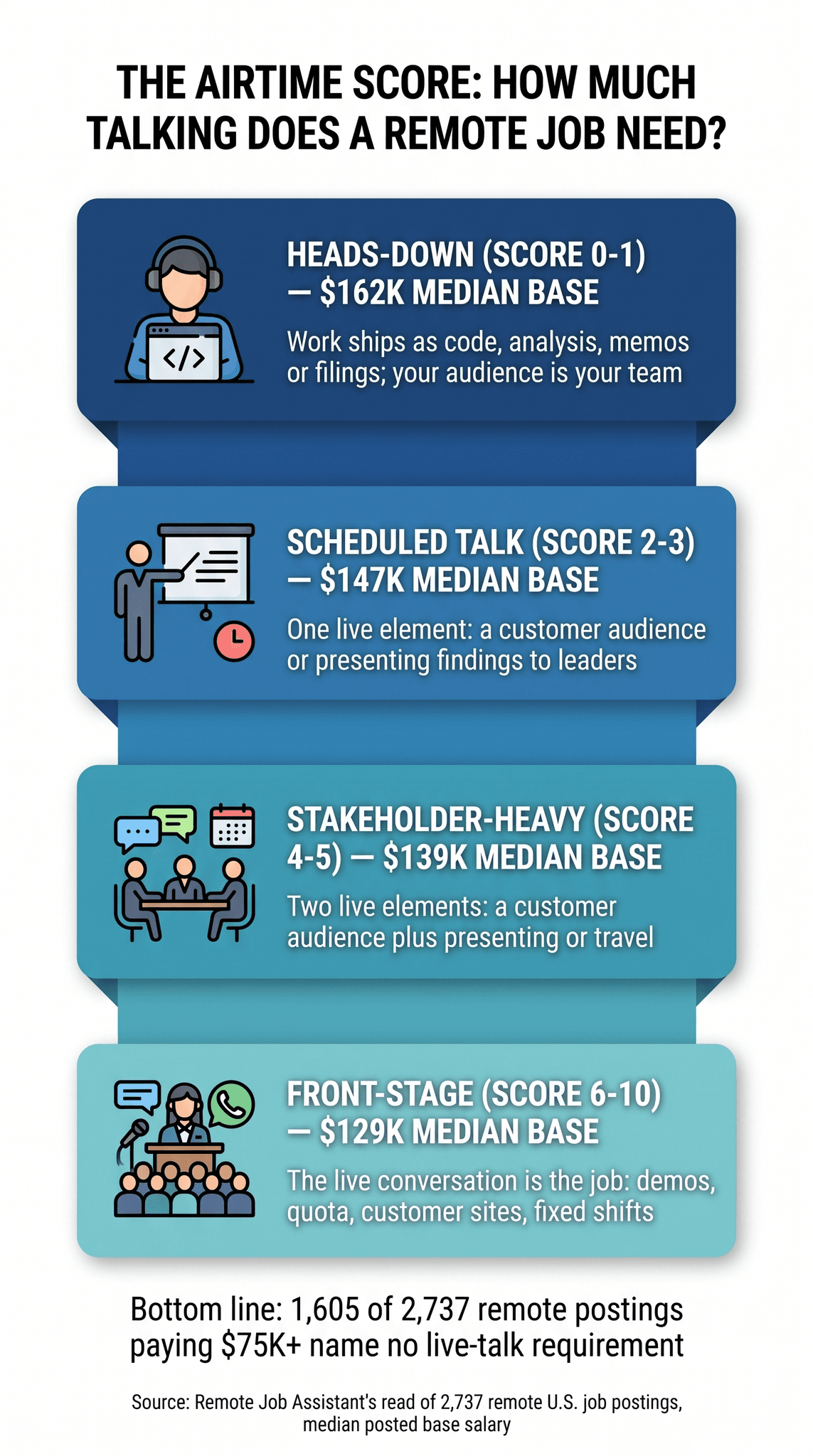
We scored all 2,737 postings the same way. We scored only what the text states, so Audience never gets a 1 in the dataset. The postings fall into four bands:
| Airtime Score | Band | What it looks like in the posting | Postings | Median posted base floor | Middle 50% of floors |
|---|---|---|---|---|---|
| 0–1 | Heads-Down | Work ships as code, analysis, memos or filings; your audience is your team | 1,798 (65.7%) | $162K | $129K–$197K |
| 2–3 | Scheduled Talk | One live element, usually a customer audience or presenting findings to leaders | 673 (24.6%) | $147K | $115K–$189K |
| 4–5 | Stakeholder-Heavy | Two live elements, such as a customer audience plus presenting or travel | 218 (8.0%) | $139K | $110K–$180K |
| 6–10 | Front-Stage | The live conversation is the deliverable: demos, quota, customer sites, fixed shifts | 48 (1.8%) | $129K | $100K–$171K |
The observable criteria for each band are simple. Heads-Down postings describe pull requests, tickets, models or documents as the output, name no outside audience, and include no travel line. Scheduled Talk adds one live element, like "present findings to leadership" or "work directly with customers." Stakeholder-Heavy postings stack an external audience with presenting or 10%+ travel. Front-Stage postings carry a quota or book of business, demos, heavy travel or a shift schedule.
One caveat on the pay column: it's base salary. Front-Stage sales roles pay commission on top, so their total pay runs higher than the table shows. The point holds anyway. Two-thirds of the postings sit in the Heads-Down band, and that band carries the highest median base of the four.
Stop Applying Manually
Our AI applies to hundreds of matching jobs while you sleep. Wake up to interviews, not more applications.
Scores are useful only if you know where the low ones cluster, so here's the breakdown by role family.
Which $75K+ Remote Jobs for Introverts Are Quietest?
Talk load clusters by what the work produces. When the deliverable is an artifact (code, a model, a detection rule, a contract redline), the audience stays internal and the score stays low. When revenue depends on a live conversation, the score climbs, and no amount of async culture can write it away.
| Role family | Postings | Score of 0 | External audience | Presenting | Travel | On-call | Median posted base floor |
|---|---|---|---|---|---|---|---|
| Security | 124 | 83.9% | 1.6% | 4.8% | 0.0% | 8.1% | $178K |
| Data & ML | 258 | 79.8% | 4.7% | 12.4% | 2.3% | 4.3% | $174K |
| Legal & compliance | 71 | 78.9% | 8.5% | 7.0% | 5.6% | 0.0% | $156K |
| Software engineering | 609 | 75.7% | 4.1% | 4.1% | 4.6% | 13.1% | $176K |
| Design & research | 65 | 72.3% | 3.1% | 18.5% | 6.2% | 0.0% | $168K |
| Finance & accounting | 163 | 71.8% | 4.3% | 20.9% | 5.5% | 0.0% | $140K |
| Product management | 152 | 71.7% | 10.5% | 13.2% | 4.6% | 0.0% | $180K |
| Marketing & content | 179 | 68.2% | 13.4% | 15.1% | 7.3% | 0.0% | $140K |
| Recruiting & people | 52 | 63.5% | 21.2% | 13.5% | 3.8% | 0.0% | $133K |
| Operations & program management | 180 | 60.0% | 14.4% | 19.4% | 8.9% | 1.7% | $135K |
| Clinical & care | 69 | 50.7% | 23.2% | 8.7% | 5.8% | 7.2% | $120K |
| Customer success & support | 72 | 34.7% | 44.4% | 19.4% | 13.9% | 13.9% | $110K |
| Customer-facing technical | 274 | 28.5% | 54.4% | 31.0% | 26.6% | 0.0% | $141K |
| Sales | 305 | 5.2% | 87.5% | 32.5% | 18.0% | 0.3% | $147K |
Pay figures are the median posted base-salary floor from the 2,737 postings read September 26, 2026, taken from employer-published pay ranges, not self-reported surveys. Sales and customer-facing roles add commission or bonus that isn't shown. Families are assigned from the job title.
Security tops the list for a structural reason. A detection engineer's work is judged in writing: the rule, the runbook, the incident write-up. The people who read it are other engineers. Only 1.6% of security postings name an external audience, and the talk that does happen is incident response, which shows up in the on-call column instead. The same logic covers remote cybersecurity roles broadly: the work product carries the argument.
Legal and compliance surprises people. Postings for product counsel and compliance leads scored zero 78.9% of the time, because the core work is the redline, the memo and the policy. Data and ML roles follow the same pattern. A model or pipeline gets reviewed in a pull request, which is why remote data engineer roles sit among the quietest well-paid work in the sample.
At the other end, customer success, customer-facing technical and sales roles score high because pay is tied to conversations: renewals, demos, quota. That's not a culture problem a better manager can fix. It's the job.
Product management scored zero on 71.7% of postings, and that number is the least trustworthy in this guide. PM postings list outcomes (ship the roadmap, grow activation) and say nothing about the roadmap reviews, stakeholder syncs and customer interviews it takes to get there. O*NET's closest occupation, Project Management Specialists, reports face-to-face discussions every day for 51.5% of workers. Treat a quiet PM posting as unscored, not low.
That blind spot is the reason the score comes with interview questions. The pattern underneath the table is worth saying plainly.
At $75K+, the introvert question isn't how much you communicate. It's whether you do it in writing or out loud.
What Government Data Says About Quiet, Well-Paid Work
Job postings show what employers ask for. ONET shows what people in each occupation say their days involve. ONET 31.0 rates every occupation from 1 to 5 on how often workers have face-to-face discussions, phone conversations, public speaking and dealings with external customers. We averaged those four into a live-talk index. Then we kept the 119 desk-based occupations with a 2025 median wage of $75,000 or more, meaning workers sit more than half the day and don't work in close physical proximity.
| Occupation | Live-talk index (1–5) | Face-to-face every day | Median wage (2025) |
|---|---|---|---|
| Software Developers | 2.50 | 3.5% | $135,980 |
| Writers and Authors | 2.70 | 11.1% | $76,910 |
| Database Administrators | 2.88 | 35.8% | $104,620 |
| Data Scientists | 3.10 | 42.9% | $120,230 |
| Actuaries | 3.28 | 55.9% | $130,000 |
| Information Security Engineers | 3.49 | 42.1% | $116,580 |
| Project Management Specialists | 3.62 | 51.5% | $102,320 |
| Accountants and Auditors | 3.67 | 65.5% | $83,680 |
| Sales Engineers | 4.15 | 55.5% | $124,900 |
| Sales Managers | 4.27 | 70.0% | $148,270 |
According to O*NET's August 2025 survey of software developers, 3.45% have face-to-face discussions every day and 74.9% use email every day. That combination is exactly what the postings show: plenty of communication, most of it written.
The pay finding matters more. Split the 119 occupations into quarters by talk load, and the quietest quarter (29 occupations) has a median wage of $114,850. The loudest quarter (29 occupations) sits at $98,700. Across all 119, the correlation between talk load and wage is close to zero (0.02). Written communication outscored live talk in 114 of the 119 occupations, which says the same thing another way: at this pay level, nearly everyone lives in email. The difference is what fills the rest of the day.
Three caveats. O*NET covers every work setting, not only remote jobs. Each rating comes from a small panel of workers or occupational experts, 17 to 34 per occupation for the ones above. And Technical Writers, the job every introvert list recommends, hasn't had its work-context survey updated since July 2012, so we left it out of the table. Our posting data tells a similar story: 10 of the 2,737 postings carried a writing title, and none said "technical writer." If documentation work is still your pull, our guide to remote technical writer jobs covers where it's actually hiring.
Do Quiet Jobs Pay Less? Only in Three Families
The worry behind a lot of "introvert jobs" searches is that choosing quiet means choosing less money. Within each role family, we compared postings scoring 0–1 with postings scoring 2 or more.
| Role family | Median floor, score 0–1 | Median floor, score 2+ |
|---|---|---|
| Software engineering | $178K (n=557) | $162K (n=52) |
| Data & ML | $176K (n=218) | $164K (n=40) |
| Security | $180K (n=113) | $161K (n=11) |
| Design & research | $171K (n=49) | $143K (n=16) |
| Marketing & content | $140K (n=131) | $137K (n=48) |
| Operations & program management | $139K (n=123) | $125K (n=57) |
| Legal & compliance | $163K (n=59) | $126K (n=12) |
| Product management | $176K (n=119) | $185K (n=33) |
| Finance & accounting | $140K (n=122) | $144K (n=41) |
| Customer-facing technical | $133K (n=85) | $149K (n=189) |
Sales isn't in the table because only 19 of 305 sales postings scored 0–1. Nearly every sales job names an external audience, which is the point of the job.
In engineering, data and security, the talkier postings are a mixed group: engineers who join customer calls and escalations, deployment and go-to-market engineers, reliability engineers with 24/7 coverage, and a few engineering leaders who represent the company to customers. Their median floor still came in lower than the heads-down roles around them. In customer-facing technical work it runs the other way: base pay rises with the size of the room you can hold. The small cells (security, design and legal at 2+) are directional, not definitive.
In seven of the ten job families we could compare, the quiet remote postings paid the same or more than the talkative ones.
Here's how to turn that into a decision:
- Engineering, data, security, design or legal: don't trade airtime for pay. The quiet version of your job paid at least as well in our sample, so the only reason to take a loud one is that you want the work.
- Product or finance roles: the talkier postings paid roughly $4K to $10K more base. Decide whether that's worth recurring stakeholder meetings before you negotiate.
- Customer-facing technical roles: the premium is larger, about $16K of base, because the talk is what the role sells. If you're already in one, the quieter versions (implementation work without demos or travel) pay less.
- Thinking about sales engineering or forward deployed work for the money: check the posted base floor against your current one before you look at on-target earnings. Engineer-titled customer-facing roles had a lower median floor than software engineering in this sample.
- Already in a Front-Stage role and burning out: the adjacent heads-down move is often an operations or analytics role on the same team, which keeps your domain knowledge and drops the quota.
- When two offers are close, price the airtime: divide the pay gap by the extra live hours. A $10,000 premium for five more hours of calls a week, over 50 working weeks, pays you $40 an hour for the part of the job that drains you. Some people take that deal. Decide on purpose.
If you're comparing offers in the upper range, the remote jobs paying $150K+ feed is where most Heads-Down postings in this sample sat. For a wider view of what pays at this level, see our guide to high-paying remote jobs.
Stop Applying Manually
Our AI applies to hundreds of matching jobs while you sleep. Wake up to interviews, not more applications.
The next trap is one engineers walk into on purpose, because the title looks like home.
The Engineer-Title Trap: Solutions, Forward Deployed and Sales Engineering
The fastest way for an introverted engineer to end up in a Front-Stage job is a title that says "engineer" and has a customer attached.
We found 145 engineer-, architect- or developer-titled roles in the customer-facing technical family: solutions engineers, forward deployed engineers, sales engineers, solutions architects. 57.9% of them (84 of 145) named an external audience and 26.2% (38) listed travel. Among 609 software engineering postings, those figures were 4.1% and 4.6%. The customer-facing roles also had a lower median posted base floor: $165,000 against $176,000.
O*NET agrees from the other direction. Sales Engineers score 4.15 on the live-talk index and 4.57 of 5 on dealing with external customers. Software Developers score 2.50 and 1.93.
The postings are blunt about it. Webflow's Senior Forward Deployed Engineer role ($158K–$190K) asks for "Willingness to travel to customer sites as needed for embedded engagements." Tanium's regional solution engineering leader ($210K–$322K) must be "located in CT time zone and will require 30-50% travel."
These roles exist to put an engineer in the room when a deal or a deployment needs one. The talk isn't overhead on top of the job. It is the job. That makes it a good move if you want faster scope and visibility and you're honest with yourself about running demos. It's a bad move if the draw is the title or the on-target earnings number. Read the travel line and look for "customer-facing role" before you read the pay line. If you want to stay on the build side, remote software engineer roles are where the low scores cluster.
The Talk That Postings Don't Call Talk: Pagers, Time Zones and Offsites
A low Airtime Score can still hide three energy costs that introverts tend to underrate, because none of them shows up as a "communication skill" in the posting.
Pagers. Of the 563 software engineering postings with no external audience and no presenting, 77 (13.7%) require on-call. Calendly's Senior Full Stack Engineer posting ($224K–$272K) asks for "participation in an on-call rotation, ensuring prompt and effective responses to business-critical alerts outside of regular working hours." GitLab's Support Engineer role ($86.5K–$146.4K) includes "weekday and weekend on-call coverage (daytime only)." A page isn't a meeting, but it's an unscheduled live demand on your attention, and for many introverts that's the worse of the two.
The quietest remote engineering jobs don't trade meetings for silence. They trade them for a pager.
The clock. Only 49 of 2,737 postings (1.8%) state required hours, but the ones that do are specific. Kin's Licensed Sales Manager posting says you "must be available to fulfill our 11:00 AM - 8:00 PM CST. A rotating Saturday shift will be required every 4–6 weeks." Distributed teams create a quieter version of the same problem. Microsoft's WorkLab research from June 2025 found that 30% of meetings now span multiple time zones, up 8 points since 2021, and meetings starting after 8 p.m. are up 16% year over year. A team spread across ten hours of time zones pushes the overlap meetings into somebody's evening.
Offsites. 430 postings (15.7%, from 44 employers) mention in-person gatherings, offsites or team meetups. Ashby is typical: "We also meet in person at least twice a year." That's not a red flag. It's a planning item: two in-person gatherings a year is a very different load from two hours of video calls a day.
How to Read a Remote Posting for Talk Load
A handful of phrases predict talk load better than the job title. The red flags each come with a mechanism. The green flags are rare, and that's what makes them useful.
Red flags:
- "Near a major airport." 28 postings from 7 employers, including Veeva, Carvana, Natera and Ultima Genomics. The employer doesn't care where you live because you'll be traveling. Veeva puts it plainly: "This is a customer-facing role and we have no work location requirement if you are in close proximity to an airport and able to meet future travel requirements."
- "Customer-facing role," "book of business" or "quota." The audience is external, and your pay depends on conversations with it.
- "Executive presence." 90 postings from 48 employers. You'll be evaluated live, in rooms with senior people, on how you come across as well as what you know.
- A named time zone or hour window. The job is synchronous with someone, whether customers, a shift or a team on another continent.
- "Comfortable presenting" or "facilitate workshops." Straight Stage points.
Green flags:
- Async-first or written-first language. 48 postings from 12 employers, and GitLab accounts for 35 of them. Supabase's product manager posting is the clearest: "Work async by default. Supabase is fully remote, so you make decisions in writing and move work forward without meetings." Bestow's Senior Data Scientist posting asks for "written-first, async-friendly communication," and Affirm names "asynchronous communication methods such as tech specs, RFCs, wikis, and project plans."
- A published calendar. Ashby's engineering posting shows the week of an engineer who has been there four years: "[roughly] 34 hours of focus time, 2.5h of interviews, and 3.5 hours of meetings." That's the most useful sentence we read in 2,737 postings.
- Protected no-meeting time. Clover Health's postings list "No-Meeting Fridays."
- Design docs, RFCs or tech specs named as deliverables. 119 postings from 46 employers. Decisions that get written down are decisions you can make in writing. If you haven't written one, Malte Ubl's guide to design docs at Google lays out the standard sections (context and scope, goals and non-goals, alternatives considered), and a short one in your portfolio is a strong interview signal for written-first teams.
The green flags come with fine print. First, async-first is rare outside one company: remove GitLab and we found 13 postings from 11 employers. Second, async rarely means no hours. Sprout Social's Staff PM posting asks how you'll handle "handoffs, async decisions, and the daily overlap window" with engineers in Poland, and Alloy's support team "covers an 8am–8pm US time zone window" with "dedicated blocks for queue coverage" alongside "time for focused async work." Ask how long the overlap window is, not whether the company is async.
Companies that run async put it in the posting for a reason. GitLab's handbook on all-remote meetings states "a bias toward asynchronous communication" and tells teams to "make meeting attendance optional." They advertise it because it's a hiring advantage with exactly the candidates reading this. If writing is your strongest channel, it's worth treating it as a skill you sell. See how employers describe remote writing skills.
| Phrase in the posting | What it usually means | Airtime Score effect |
|---|---|---|
| "Near a major airport" | Frequent travel | Travel +1 to +2 |
| "Customer-facing role," "quota," "book of business" | External audience, pay tied to calls | Audience +2 |
| "Executive presence," "comfortable presenting" | Live evaluation in senior rooms | Stage +2 |
| "Located in [time zone]," an hour window | Synchronous schedule | Clock +1 to +2 |
| "On-call rotation," "weekend coverage" | Unscheduled interrupts | Interrupts +1 to +2 |
| "Async-first," "written-first," RFCs, no-meeting days | Decisions made in writing | Supports a low score |
A posting that scores zero isn't a quiet job. It's a quiet posting, until you ask.
Three Interview Questions That Fill In What Postings Won't Say
Stand-ups showed up in 13 of 2,737 postings, and only one employer, Ashby, published an actual meeting count. So the interview is where you score the part the posting can't. Three questions cover it:
- "What did the last person in this role spend their week on? Roughly how many hours were in meetings?" A number is a good sign. A vague "it varies" is data too. More than 15 hours of recurring meetings a week means scoring Stage as a 2, even if the posting never mentioned presenting.
- "When the team disagrees on a technical or product decision, where does it get settled: a doc or a call?" "We write it up and comment" means a written-first culture. "We hop on a call" means the arguments happen live.
- "What does on-call look like here? How long is a rotation, and how many pages does a typical week bring?" One week in six with a couple of pages is a different job from one week in three with nightly alerts.
Frame each question around how you do your best work: "I do my best work in long focus blocks, so I like to understand the team's rhythm. Roughly how many hours a week does this role spend in meetings?" Interviewers hear a planner, not someone dodging collaboration.
If you only get one of these answers, get the first one from the hiring manager. Ashby publishes an engineer's actual week in its engineering postings, including the one for the manager who hires those engineers. A manager who can tell you the team's meeting hours without checking is usually the one protecting them.
Once you're in the role, the same habit keeps the score low. GitLab's handbook says "All meetings must have an agenda"; when an invite arrives without one, replying with a short written take and asking whether it covers the question settles more meetings than you'd expect.
Add what you learn back into the score. A posting that looked like a 1 with 20 hours of weekly meetings is really a 3. That's still workable, but it's a different job from the one you applied for.
Stop Applying Manually
Our AI applies to hundreds of matching jobs while you sleep. Wake up to interviews, not more applications.
Scoring the job is half of it. The other half is not burning your energy before you get to the interview.
An Introvert's Job Search: Spend Your Talk Where It Pays
For many introverts, the job search is the most talk-heavy stretch of the whole career change. There's outreach, recruiter screens, follow-ups, and the constant low-grade work of keeping dozens of applications moving. The conversations that actually decide an offer are a small share of that total.
Run the search the way you'd want the job to run: in writing first, live only when it counts.
- Replace the coffee chat with a note. A short written message to the hiring manager, with one specific observation about their product or team, does most of what a networking call does. Our hiring manager message templates give you the structure.
- Batch the live parts. Put recruiter screens on two afternoons a week instead of scattering them, and keep one well-chosen referral ask per target company.
- Hand off the repetitive part. Sending applications to every role that matches your filters is volume work, not judgment work. Remote Job Assistant's Auto-Apply applies on company career pages in the background, so your energy goes to the interviews.
If applications are going out and interviews aren't coming back, the problem is usually targeting or resume fit, not charisma. Our breakdown of why you're not getting interviews walks through the fixes. For Heads-Down roles in the six-figure range, start with remote jobs paying $100K+ and filter by the families at the top of the table above.
Frequently Asked Questions
I'm an introverted software engineer. Which remote roles have the fewest meetings?
Backend, platform, security and data-infrastructure individual-contributor roles scored lowest. 75.7% of software engineering postings (n=609) and 83.9% of security postings (n=124) named no live-talk requirement. Avoid titles with a customer attached, such as solutions, forward deployed or sales engineer, and ask about weekly meeting hours in the first interview.
What remote jobs pay over $100K where I don't have to talk to people all day?
Security, data and ML, software engineering and legal/compliance roles had median posted base floors between $156,000 and $178,000, and 76% to 84% of those postings named no live-talk requirement. In O*NET data, the quietest well-paid desk occupations (software developers, database administrators, data scientists and actuaries) had 2025 median wages from $104,620 to $135,980.
Is solutions engineering or forward deployed engineering a good move for an introvert?
Only if you want the talk. 57.9% of engineer-titled customer-facing postings (84 of 145) named an external audience and 26.2% listed travel, compared with 4.1% and 4.6% for software engineering. The median posted base floor was also lower, $165,000 against $176,000.
How can I tell from a job posting how many meetings a remote job will have?
Mostly you can't. Stand-ups appear in only 13 of 2,737 postings. Look for proxies such as async-first language, published calendars and no-meeting days, and for red flags such as "customer-facing role," "executive presence," "near a major airport" and named hours. Then ask directly in the interview.
Do introvert-friendly remote jobs pay less?
Not at $75K+. Heads-Down postings had a median posted base floor of $162,000 (n=1,798) against $129,000 for Front-Stage postings (n=48), and quiet postings paid the same or more in 7 of the 10 role families we could compare. Talk does pay a base premium in customer-facing technical, product and finance roles.
What does an Airtime Score of 4 mean day to day?
It means two live elements, typically a customer audience plus presenting or travel. That's the Stakeholder-Heavy band: 218 of 2,737 postings (8.0%), with a median posted base floor near $139,000. Expect recurring external calls on your calendar every week.
Is on-call worse than meetings for an introvert?
It's a different cost. Meetings drain energy on a schedule; pages interrupt without warning. 13.7% of heads-down software engineering postings (77 of 563) required on-call, so ask about rotation length and pages per week before you accept.
Find Remote Jobs for Introverts That Fit How You Work
The best remote jobs for introverts aren't the ones with no people in them. They're the ones where the people-work happens in a channel you're good at. At $75K+, that's most of the market: two-thirds of the postings we read landed in the Heads-Down band, and in most role families they paid at least as well as the loud ones.
Score the posting before you apply, ask the three questions before you accept, and put your limited appetite for live talk into the interviews that decide the offer. Browse remote data and analytics roles and legal and compliance roles, two of the quietest families in the data, or engineering and technical roles if you build software. When you're ready to apply at volume without spending your energy on it, let Auto-Apply handle the submissions.
The job doesn't have to be quiet. It just has to let you do the loud parts in writing.
Ready to Find Your Remote Job?
Browse thousands of curated remote jobs or let AI apply for you.
Browse Remote JobsRelated Job Guides
Remote Jobs for Military Spouses: Which Ones Survive a PCS
We tested 2,753 remote jobs paying $75K+ for PCS portability. 89.6% never say which states they hire in. Here's how to find remote work that follows orders.
35 min read
Fractional COO Jobs: Real Pay and Borrowed Authority
Only 9 of 73 fractional COO jobs we classified were paid part-time seats. Real 2026 rates, why posted pay runs low, and how to score authority before you sign.
29 min read
Fractional CTO Jobs: Real Rates and the Custody Test
Only 12 of 90 fractional CTO jobs we classified were paid part-time roles. Real 2026 rates, the listings to skip, and how to score custody before you sign.
27 min read