
You've seen the ads. "$15K-$30K months working from home." "No experience needed." "Just close warm leads on Zoom."
The remote closer space has exploded—and so have the scams. For every legitimate high-ticket sales role at a real company, there are dozens of commission-only "opportunities" from coaches selling dreams.
At Remote Job Assistant, we track thousands of remote sales positions monthly. Closer roles are among the highest-paying categories we see—but they're also one of the most polluted with misleading job posts. The term "closer" gets thrown around by Fortune 500 SaaS companies and Instagram gurus alike.
Get Remote Job Tips in Your Inbox
Weekly strategies, salary data, and new opportunities
Unsubscribe anytime. No spam.
This guide separates reality from hype. We'll show you what legitimate remote closer jobs look like, which industries actually hire them, realistic compensation ranges, and the red flags that signal you're about to waste your time.
What Is a Remote Closer?
A remote closer is a sales professional who specializes in the final stage of high-value deals—converting qualified prospects into paying customers over video or phone. Legitimate closer roles pay $60,000-$200,000+ annually, with compensation typically split between base salary and commission. However, this job category is heavily polluted with commission-only "opportunities" from coaching programs. Real closer jobs come from SaaS companies, real estate firms, and established sales organizations—not from Instagram ads promising "$30K months."
The closer role exists because high-ticket sales require specialized skills. When someone is deciding whether to spend $15,000 on executive coaching, $50,000 on enterprise software, or $200,000 on a real estate investment, they need more than a product demo. They need someone who can navigate complex objections, build trust quickly, and guide them through a significant financial decision.
Remote closers typically work with warm leads—prospects who have already expressed interest and been qualified by marketing or an SDR team. Your job isn't cold calling strangers. It's converting people who are already in the pipeline and ready to talk.
This differs from a standard Account Executive role in important ways. AEs often manage the entire sales cycle from prospecting to close. Closers are specialists brought in specifically for final-stage conversations. Think of it like a relay race: the SDR runs the first leg, the AE handles discovery and demos, and the closer sprints across the finish line.
Remote Closer vs. Account Executive: What's the Difference?
Understanding where closer roles fit helps you target the right opportunities—and avoid the wrong ones.
| Factor | Remote Closer | Account Executive |
|---|---|---|
| Primary Focus | Final-stage deal conversion | Full sales cycle management |
| Typical Deal Size | $3,000 - $100,000+ | $1,000 - $500,000+ |
| Lead Source | Pre-qualified warm leads | Mix of inbound and outbound |
| Common Industries | Coaching, info products, solar, real estate | SaaS, enterprise software, B2B services |
| Compensation | Often commission-heavy (10-20% per deal) | Base + commission (typically 50/50 split) |
| Employment Type | Mix of 1099 contractors and W2 employees | Usually W2 with benefits |
| Employer Type | Entrepreneurs, agencies, coaching businesses | Established companies with sales teams |
The key distinction: Account Executives at companies like Salesforce or HubSpot have base salaries, benefits, and structured career paths. Many closer roles—especially in the coaching and info-product space—are commission-only 1099 contractor positions with no benefits and no guaranteed income.
Neither structure is inherently bad. But understanding this difference protects you from expecting W2 stability in a 1099 hustle.
Decode Any Job Posting
Paste a job description and get instant insights: what they really want, red flags to watch, and how to stand out.
Industries That Hire Remote Closers
Remote closer positions cluster in industries where the product requires significant buyer consideration and the sale happens over video or phone. Here's where the legitimate opportunities actually are:
Coaching and Consulting — This is the largest market for remote closers, but also the most scam-heavy. Business coaches, executive coaches, and consultants sell programs priced $5,000-$50,000. Legitimate companies in this space include established firms with real track records—not solo operators running Facebook ads. Commission: 10-15% per sale. Watch for red flags (covered below).
SaaS and Software — Enterprise software companies hire closers for complex B2B deals. These are typically W2 positions with base salary plus commission. Companies like Close, Gong, and Outreach hire remote sales professionals. Deal sizes range from $10,000-$100,000+ annually. This is where you'll find the most stable closer opportunities.
Real Estate and Mortgage — Real estate investment companies and mortgage brokers hire closers to convert leads on property deals and refinancing. These roles require licensing in some states. Commission structures vary widely, but experienced closers earn $100,000-$250,000+ in strong markets.
Solar and Home Services — Solar installation companies hire closers to convert homeowners who've expressed interest in quotes. These are often high-volume roles with deal sizes of $15,000-$40,000. Many positions are 1099 with aggressive commission structures (8-12% per sale).
Financial Services — Insurance companies, wealth management firms, and financial advisors hire closers for high-value client acquisition. Many require licensing (Series 7, insurance licenses). Base salaries plus commission are common.
The common thread: legitimate closer roles exist where the product is expensive enough to justify a specialized sales professional, and the company has enough lead volume to keep closers busy.
What Do Remote Closers Actually Earn?
Let's cut through the "$30K month" claims and look at real numbers.
According to Glassdoor's 2025 salary data, the average high-ticket sales closer earns $113,738 annually. ZipRecruiter reports similar figures at $112,891 for sales closers generally.
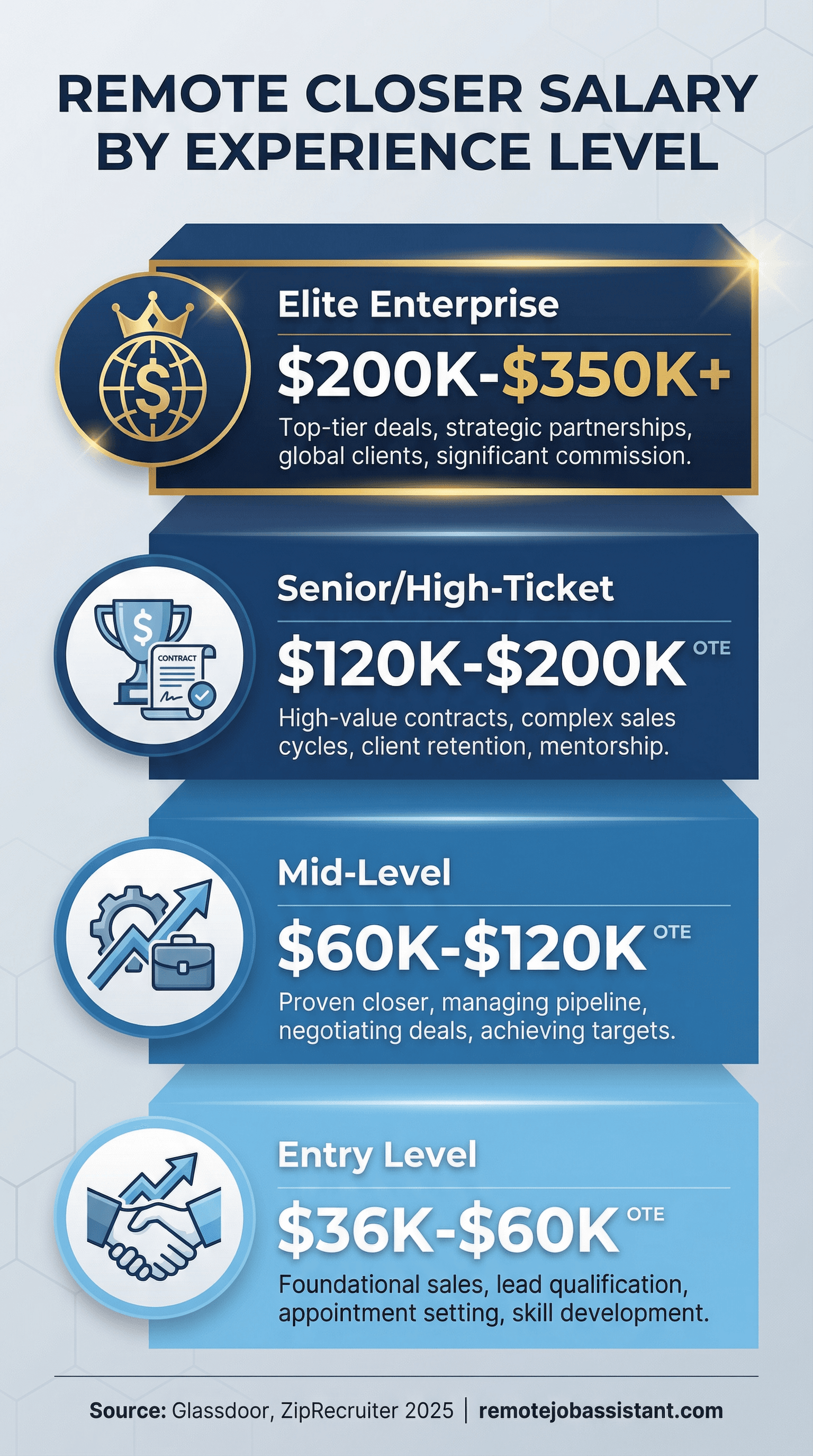
But averages hide massive variation. Here's what compensation actually looks like by experience level and industry:
| Experience Level | Annual Earnings | Monthly Range | Notes |
|---|---|---|---|
| Entry-Level Closer | $36,000 - $60,000 | $3,000 - $5,000 | Often 1099, learning the role |
| Mid-Level Closer | $60,000 - $120,000 | $5,000 - $10,000 | Consistent close rates, good leads |
| Senior/High-Ticket | $120,000 - $200,000+ | $10,000 - $20,000+ | Top performers, premium offers |
| Elite Enterprise | $200,000 - $350,000+ | $15,000 - $30,000+ | Complex SaaS, real estate, consulting |
Commission structures matter enormously. A closer earning 15% commission on a $10,000 coaching program makes $1,500 per sale. Close five deals monthly and you're at $7,500. But if you're earning 10% on $3,000 products, you need 25 closes to hit that same number—a very different workload.
Those "$30K month" screenshots you see? They're mathematically possible—but represent top 1% performers closing premium offers ($20K+ products) at high rates. The median closer earns $5,000-$8,000 monthly. Building to $15K+ months typically takes 2-3 years of skill development and finding the right offer.
The Scam Problem: Red Flags to Watch For
Here's what most "remote closer jobs" guides won't tell you: this job category is absolutely flooded with misleading opportunities.
The FTC shut down The Sales Mentor (also called Sales Closer Academy and Inbound Closer) in 2023 for deceptive practices. Dan Lok's High Ticket Closer program has faced extensive criticism for aggressive upselling and unrealistic income claims. These are just the high-profile examples.
Commission-only with no base salary — Legitimate sales roles typically offer at least a small base ($2,000-$4,000/month) while you ramp. 100% commission means the company has zero investment in your success.
"No experience needed" for high-ticket closing — Real closer roles require proven sales ability. If they'll hire anyone, the leads are garbage or the offer doesn't convert.
You must pay for training first — Legitimate employers train you for free. Programs charging $2,500-$30,000 for "closer certification" are selling you the dream, not a job.
Vague about the actual company or product — Real job postings name the employer. "Work with multiple 7-figure entrepreneurs" means they're a middleman placement agency.
Income claims without context — "$15K-$30K months" without mentioning this requires 18+ months of experience and top 5% performance is misleading.
Interview via WhatsApp or Telegram only — Legitimate companies use proper hiring processes with video interviews, not encrypted messaging apps.
Why Is This Category So Scam-Heavy?
The closer job market attracts predatory opportunities for specific reasons:
The "low barrier to entry" claim attracts desperate job seekers looking for quick income. Commission-only structures mean companies have zero financial risk—if you don't sell, they pay nothing. Training programs profit from selling the dream of high income, not from actually placing people in jobs. And vague job descriptions allow unrealistic claims that real positions couldn't support.
The honest truth: Becoming a successful closer takes 6-18 months of skill development. The people making $15K+ months have years of sales experience, work with premium offers, and have refined their craft through thousands of calls. It's a real career path—but not a get-rich-quick scheme.
Stop Applying Manually
Our AI applies to hundreds of matching jobs while you sleep. Wake up to interviews, not more applications.
What Legitimate Remote Closer Jobs Look Like
So what should you actually look for? Here are the markers of real opportunities:
Named employer with verifiable business — The job posting identifies the actual company, which has a real website, LinkedIn presence, and trackable history. You can research them independently.
Clear compensation structure — Base salary amount, commission percentage, and OTE (on-target earnings) are specified. Something like "Base: $48,000 + 12% commission, OTE: $95,000."
Defined product and deal size — You know what you're selling and at what price point. "Enterprise SaaS platform, average deal size $35,000 ARR."
Realistic requirements — They want 1-3+ years of sales experience, specific skills, or industry background. They're selective about who they hire.
Proper interview process — Multiple rounds including video interviews, role plays, and reference checks. They invest time in hiring decisions.
W2 employment option — Even if 1099 is available, legitimate companies often offer W2 with benefits for full-time closers.
Companies That Actually Hire Remote Closers
Rather than generic lists, here are the types of companies worth targeting:
SaaS companies with inside sales teams: Look for companies in the CRM, sales enablement, marketing automation, or HR tech spaces. Search their careers pages directly. Examples include Close, Outreach, Gong, and similar growth-stage software companies.
Real estate investment firms: Companies buying properties or offering investment opportunities hire closers for high-value transactions. Search for "acquisitions closer" or "investment sales" roles.
Solar and energy companies: The residential solar industry employs thousands of closers. Look for established installers with regional or national presence, not fly-by-night operations.
Established coaching companies: The legitimate end of the coaching market includes companies with long track records, published authors, and corporate clients—not someone who started their Instagram three months ago.
Sales development agencies: Companies like SalesLoft, Belkins, and CIENCE hire closers to work with their clients. These offer exposure to multiple industries and structured training.
Skills You Need to Succeed
Remote closing requires a specific skill set that goes beyond general sales ability. Here's what actually matters:
Consultative selling methodology — Top closers use frameworks like SPIN Selling, NEPQ (Neuro-Emotional Persuasion Questions), or Challenger Sale methodology. These aren't buzzwords—they're structured approaches to understanding buyer psychology and guiding decisions.
Objection handling — You'll hear "I need to think about it," "It's too expensive," and "I need to talk to my spouse" hundreds of times. Skilled closers have practiced responses that address the real concern behind each objection.
Virtual presence — Closing over Zoom requires different skills than in-person sales. Camera positioning, lighting, energy management, and reading digital body language all matter.
CRM proficiency — You'll live in tools like HubSpot, Salesforce, Close, or Pipedrive. Efficient pipeline management separates successful closers from those who lose deals in the chaos.
Emotional regulation — High-ticket closing involves rejection. A lot of rejection. The ability to stay motivated through a 20% close rate (meaning 80% of calls don't convert) is essential.
Skip the expensive certification programs. Instead: read "SPIN Selling" by Neil Rackham and "Never Split the Difference" by Chris Voss. Practice objection handling with roleplay partners. Study call recordings from experienced closers (many share these on YouTube). The fundamentals of sales psychology haven't changed—only the delivery method.
Decode Any Job Posting
Paste a job description and get instant insights: what they really want, red flags to watch, and how to stand out.
What to Expect in Your First 90 Days
If you land a legitimate closer role, here's the realistic ramp-up timeline:
Days 1-30: Learning the Offer
You'll spend the first month understanding the product, ideal customer profile, common objections, and sales process. Most companies have you shadow experienced closers before taking live calls. Expect minimal or no commission during this period—you're in training mode.
Days 31-60: Supervised Calls
You'll start taking calls with manager oversight. Close rates will be low (10-15%) as you find your rhythm. This is normal. Good companies provide call reviews and coaching during this phase. You might close 3-5 deals.
Days 61-90: Building Consistency
By month three, you should be hitting 20-25% close rates on qualified leads. You'll have developed your own talk track and handle common objections smoothly. Commission checks start becoming meaningful. Most companies evaluate fit at the 90-day mark.
The Reality Check: Many closers don't make it past 90 days. The combination of rejection, commission pressure, and skill requirements filters out people who aren't genuinely suited for the role. This is why legitimate companies invest in training and provide base salaries—they want you to succeed because hiring is expensive.
Remote Closer Career Path
Closing can be a career destination or a stepping stone. Here's how the progression typically works:
| Stage | Timeline | Role | Typical Earnings |
|---|---|---|---|
| Entry | Year 1 | Junior Closer / Sales Rep | $40,000 - $70,000 |
| Developing | Years 2-3 | Closer / Inside Sales | $70,000 - $120,000 |
| Experienced | Years 3-5 | Senior Closer / Team Lead | $120,000 - $180,000 |
| Advanced | Years 5+ | Sales Manager / Director | $150,000 - $250,000+ |
Alternative paths from closing experience:
Moving into Account Executive roles at larger companies—your closing skills transfer directly. Transitioning to sales management or training other closers. Starting your own agency that provides closers to companies. Or moving into sales operations and enablement if you prefer strategy over calls.
The skills you build—persuasion, objection handling, deal psychology—translate across industries and roles. Even if closing isn't your forever career, the experience is valuable.
Tools Remote Closers Use
Every closer needs proficiency with these categories of tools:
CRM Systems — Salesforce, HubSpot, Close, Pipedrive. You'll track every lead, log call notes, and manage your pipeline here. CRM discipline separates professionals from amateurs.
Video Conferencing — Zoom dominates the closer world. Professional setup (good lighting, clean background, quality audio) directly impacts close rates.
Sales Engagement Platforms — Tools like Outreach, SalesLoft, or Apollo for managing sequences and follow-ups. Many companies provide these.
Calendar Scheduling — Calendly, Chili Piper, or HubSpot meetings. Your calendar is your lifeline—protecting your call slots matters.
Conversation Intelligence — Gong, Chorus, or similar tools record and analyze calls. Great for self-coaching and review.
Most companies provide the tools you need. But familiarity with these platforms makes you more hireable and effective from day one.
Frequently Asked Questions
Are remote closer jobs legitimate?
Yes, legitimate remote closer positions exist across SaaS, real estate, solar, financial services, and other industries. However, the category is heavily polluted with commission-only "opportunities" from coaching programs and info-product businesses. Focus on roles with named employers, clear compensation structures, and proper interview processes.
How much do remote closers actually make?
According to Glassdoor, the average high-ticket closer earns $113,738 annually. Entry-level closers typically earn $36,000-$60,000, while experienced closers at premium companies can earn $150,000-$250,000+. The "$30K month" claims you see represent top performers, not typical results.
Do I need experience to become a remote closer?
Most legitimate closer roles require 1-3 years of sales experience. "No experience needed" claims are red flags—they usually indicate commission-only positions with poor leads or predatory training programs. Start with SDR or inside sales roles to build foundational skills before moving into closing.
What's the difference between a closer and an Account Executive?
Closers specialize in final-stage deal conversion with pre-qualified leads. Account Executives typically manage the full sales cycle from prospecting through close. AE roles are more common at established companies with structured sales teams, while closer roles appear more in coaching, solar, and real estate industries.
Should I pay for closer training or certification?
Generally, no. Programs charging $2,500-$30,000 for "closer certification" are often selling the dream rather than providing job placement. Learn fundamentals through books (SPIN Selling, Never Split the Difference), free YouTube content, and on-the-job training. Legitimate employers train you at no cost.
Is commission-only compensation normal for closers?
It's common but not ideal. Legitimate companies typically offer base salary ($2,000-$5,000/month) plus commission during ramp-up. Pure commission-only roles mean the company has zero investment in your success. These can work for experienced closers with proven skills, but are risky for beginners.
What industries pay closers the most?
Enterprise SaaS, real estate investment, and financial services typically offer the highest compensation for closers. These industries involve complex, high-value transactions where skilled closers directly impact revenue. Coaching and info-products can pay well but have more variable lead quality and company stability.
Start Your Search the Right Way
Remote closer jobs offer genuine opportunity for high earnings and career growth—if you find the legitimate ones. The key is approaching your search with clear eyes about what's real and what's hype.
Focus on companies with verifiable track records, clear compensation structures, and proper hiring processes. Build your skills through legitimate channels rather than expensive certification programs. And remember that sustainable success in closing takes months of development, not weeks.
Ready to find remote sales positions that match your experience level? Browse our curated listings—we filter out the scams so you don't have to. Or if you want to understand the full landscape of sales roles and career paths, start with our comprehensive guide.
The closer role isn't for everyone. But for those with the right skills and temperament, it's one of the highest-paying remote careers available—with no ceiling on what you can earn.
Ready to Find Your Remote Job?
Browse thousands of curated remote jobs or let AI apply for you.
Browse Remote JobsRelated Job Guides
Remote Ecommerce Jobs: What 1,694 Postings Show (2026)
Remote ecommerce jobs are concentrated: 322 of 1,694 US postings were remote. See which marketplace, brand, agency and SaaS seats pay $100K+ from a home office.
55 min read
Remote Interior Design Jobs: What 1,409 Postings Show (2026)
Remote interior design jobs are rare: 40 of 1,409 US postings were remote. See which designer, planner, and FF&E seats pay $75K+ from home, and where.
46 min read
Remote Journalism Jobs: What 1,438 Postings Show (2026)
Remote journalism jobs are rare: 77 of 1,438 US newsroom postings were remote. See which reporter, editor, and audience seats pay $75K+ from home, and where.
39 min read