
Last reviewed: March 2026
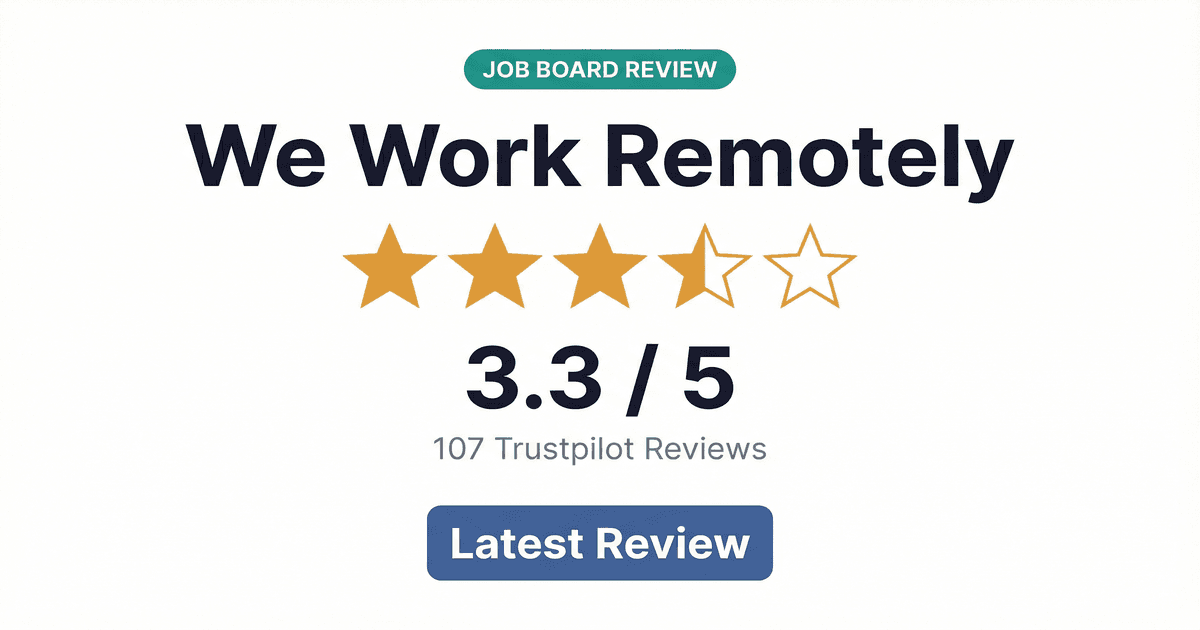
We Work Remotely has been posting employer-paid remote jobs since 2011 — real listings from real companies, no agency noise, no phantom roles — and its 3.3/5 Trustpilot rating (n=107 reviews, March 2026) has almost nothing to do with the listings. It has everything to do with one decision: adding a job seeker subscription with a 12-month lock-in that more than one in three reviewers found deceptive enough to post a public warning. We tested the Basic plan for 14 days in March 2026, analyzed all 107 Trustpilot reviews, and synthesized Reddit sentiment from r/remotework, r/jobsearchhacks, and r/GetEmployed. The verdict is straightforward: the free tier works, the paid tier doesn't justify itself.
We Work Remotely has been running since 2011 and has real employer listings from companies like Automattic, Buffer, and GitLab. The free Basic plan lets you browse and apply without paying a cent. The Pro subscription — $14.95/month locked to a 12-month annual commitment — is where users get burned. One in three reviewers on Trustpilot rates it one star, and the dominant complaint is billing, not listings.
Bottom line: Use the free tier if you're a senior tech or marketing professional who values curated listings over volume. Skip Pro. If you want to apply to more than a handful of roles per week, Remote Job Assistant's auto-apply searches the entire web and applies for you — no lock-in required.
Get Remote Job Tips in Your Inbox
Weekly strategies, salary data, and new opportunities
Unsubscribe anytime. No spam.
The data snapshot below summarizes what we found.
Based on our 14-day test of We Work Remotely's Basic plan and analysis of 107 user reviews (March 2026):
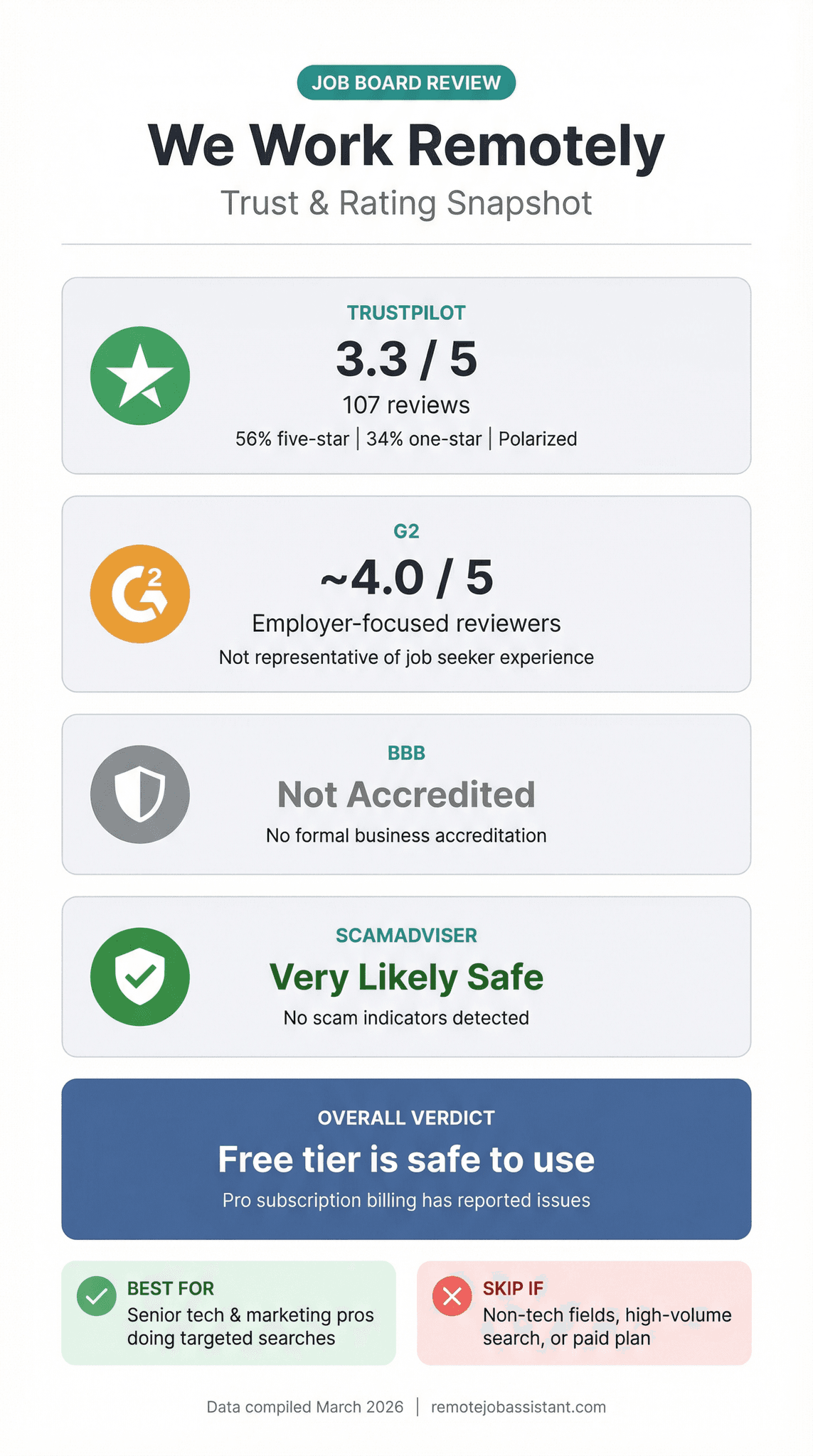
- 3.3/5 Trustpilot rating (n=107 verified reviews, March 2026)
- 34% one-star reviews (n=36 of 107) — majority cite billing and cancellation issues
- 56% five-star reviews (n=60 of 107) — cite legitimate listings and clean UX
- Free Basic tier: browse, apply, save jobs, upload resume, 1 job alert
- $14.95/month Pro tier — locked to a 12-month annual commitment (approx. $180/year total)
- $299/listing/month employer pricing — filters spam, explains listing quality
- 0 dedicated mobile apps, Chrome extensions, or AI matching features
What Is We Work Remotely?
We Work Remotely launched in 2011 as a Basecamp (then 37signals) side project — specifically built to support Basecamp's argument that async, location-independent work was viable for real companies, not just freelancers. That origin explains a lot about what's on the board today: it was designed for software teams and knowledge workers who operate the same way Basecamp does. A $299/month employer listing fee filters spam and agencies. Today it covers six categories — programming, design, marketing, customer success, operations, and HR — with roughly 1,000 active listings at peak. It is free to browse and apply. The audience skews toward experienced tech and marketing professionals; non-tech fields like accounting, legal, and healthcare administration have thin volume.
How We Work Remotely Works
Sign up free, browse by category, and apply directly through the employer's ATS or email — WWR has no native application portal. The Basic tier allows applying and resume uploads but caps you at one custom job alert. There is no AI matching, no salary filter, no auto-apply.
The Pro Plan UX (and the Catch)
Pro costs $2.95 for the first month, then $14.95/month — presented with monthly billing language. The 12-month annual commitment is disclosed, but it sits in the subscription terms rather than the checkout headline. Multiple Trustpilot reviewers report discovering the lock-in only when they tried to cancel. The account settings page shows an "expiration date" users read as end-of-month rather than end-of-year. One reviewer described it bluntly: "Why would you lock a job seeker in a 12-month contract?" Another reported being billed $14.95 after deleting their account.
The $2.95 intro price is not a one-month trial — it is month one of a 12-month annual contract at $14.95/month (approx. $180/year total). The cancellation flow shows an expiration date that reflects your annual term end, not your next billing date. If you are not ready to commit to a full year, stay on the free Basic plan.
How We Tested We Work Remotely
We tested We Work Remotely's Basic plan for 14 days in March 2026, browsing listings across six categories: programming, marketing, customer success, design, operations, and HR. We tracked active listing counts by category, the proportion of US-only versus global remote listings, and stepped through the Pro upgrade flow without completing the purchase to document where and how the 12-month commitment is disclosed.
Three things stood out during testing. First, the HR and operations categories had the thinnest active listings — single digits on several days, compared to 200+ in programming. The disparity isn't disclosed anywhere on the browse page; you only see it when you click in and start counting. Second, the US-only remote restriction is not surfaced as a browse-level filter; it only appears inside individual listing bodies, meaning you click in, read the full description, and then reach the fine print. Clicking through US-only listings for 20 minutes only to find the restriction in the last paragraph felt like a bait-and-switch — even on the free tier, it wastes time. Third, the Pro upgrade flow presents "$2.95" and "monthly" on the same visual tier, with the "12-month annual commitment" appearing in a smaller secondary line — easy to read past on a quick scroll.
We also analyzed all 107 Trustpilot reviews as of March 2026, coding each by primary complaint category (billing, listings, UX, support). Reddit sentiment from r/remotework, r/jobsearchhacks, and r/GetEmployed was synthesized via third-party aggregations. Pricing was verified directly on weworkremotely.com on March 21, 2026. For comparison context, we referenced our tests of FlexJobs, Wellfound, and Working Nomads.
We Work Remotely Pricing (2026)
| Plan | Price | Billing | Key Features |
|---|---|---|---|
| Basic | Free | N/A | Browse, apply, save jobs, resume upload, 1 job alert, ATS resume review (Toptal), LinkedIn verification |
| Pro | $2.95 month 1, then $14.95/month | 12-month annual commitment | Everything in Basic + unlimited applications, up to 5 custom job alerts, subscriber-only events and webinars |
Pricing verified on weworkremotely.com on March 21, 2026.
The employer side runs $299/month per standard listing with optional add-ons for candidate filtering ($199) and geographic restrictions ($99/listing). This is what keeps junk off the board. It also explains why g2.com rates WWR at approx. 4.0/5 — G2 reviewers are predominantly employers, not job seekers navigating the Pro subscription. The audiences are different, and their ratings reflect that.
For context on overall site legitimacy: the Better Business Bureau does not accredit We Work Remotely, and scamadviser.com rates the domain as "Very Likely Safe" based on its 12+ year registration history. These signals indicate the platform itself is not a scam — the concerns are about billing practices, not site legitimacy.
What We Work Remotely Does Well
Verified, employer-paid listings with real companies. A $299/month listing fee filters phantom roles and agency blasts. The result is real postings from employers who have committed budget to the search. More than half of Trustpilot reviewers (n=60 five-star, of 107 total) consistently cite legitimate listings as their reason to recommend. Companies like Automattic, Basecamp, Buffer, and GitLab have posted here.
No recruiter noise or algorithmic feed to game. LinkedIn and Indeed are flooded with third-party staffing agencies, mislabeled remote listings, and ghost postings. WWR's employer-paid model keeps the signal-to-noise ratio high. You browse by category and see actual jobs from actual companies.
Clean UX with no upsells on the free browse experience. No algorithm curating what you see, no sponsored listings pushing organic results down, no upgrade prompts mid-session. You browse, you read, you apply. For targeted searches on a short list of strong-fit roles, that simplicity is an asset.
Where We Work Remotely Falls Short
The 12-month subscription trap. According to Trustpilot data as of March 2026, 34% of all WWR reviews (n=36 of 107) are one-star, and the dominant complaint category is billing and cancellation. The root cause is structural: the Pro plan is an annual contract billed monthly. The $2.95 intro framing leads users to treat it as month-to-month. When they try to cancel after month one or two, they find they're locked into the remaining months of a 12-month term. The "expiration date" in account settings refers to the annual term end — not the next billing date. One Trustpilot reviewer put it directly: "Why would you lock a job seeker in a 12-month contract?" Another reported being charged $14.95 after deleting their account entirely, with support citing agreed terms as justification. This isn't a UX oversight. The 12-month lock-in isn't buried in fine print — it is the business model.
A small, tech-heavy job pool with geographic restrictions. At peak, WWR carries roughly 1,000 listings across a global job-seeking audience. Many are marked "remote (US only)" — a restriction often buried in the listing body rather than surfaced at the category filter level. Non-tech professionals in accounting, operations, legal, and healthcare will find almost nothing relevant. International applicants find the same. Reddit users in r/remotework have pointed this out repeatedly: the platform markets itself as global remote but the reality for non-US applicants is a much thinner pool than the listing count suggests, with many roles filtering them out inside the ATS.
No modern job search tooling. No salary filter, no AI matching, no auto-apply, no mobile app, no Chrome extension. Reddit users in r/remotework consistently note the feature set has not changed since 2013. WWR was built for employers who wanted quality applicants. The job seeker paywall was added later. That order of priorities still shows.
The Job Board Value Index
Before paying for any remote job board, it helps to apply the same rubric across all of them. Here is the one we use in our remote job board reviews:
The Job Board Value Index: A framework for evaluating whether a remote job board is worth your time and subscription cost.
- Tier 1 — Avoid: Unverified listings, billing complaints as the dominant review theme (more than 1 in 5 reviewers cite billing issues), charges job seekers while delivering minimal value.
- Tier 2 — Use Free, Skip Paid: Legitimate listings, solid free tier, but the subscription doesn't justify the cost. Manual apply only.
- Tier 3 — Worth Paying For: Verified listings, salary transparency, AI matching or auto-apply, transparent billing with easy cancellation.
How to use it: Check what the free tier gives you, whether there's a lock-in clause, and whether the paid features justify the cost relative to your search volume.
We Work Remotely scores: Tier 2. The free tier is legitimate and useful. The Pro subscription fails the value test: approx. $180/year locked for 12 months, for a pool of listings you could browse free anyway.
Remote Job Assistant scores: Tier 3. AI matching, auto-apply, salary filtering, and month-to-month billing. See our best AI auto-apply tools roundup for a cross-platform comparison using the same framework.
We Work Remotely vs. Remote Job Assistant
The comparison comes down to selection size, who does the apply work, and billing flexibility.
WWR hands you roughly 1,000 curated listings per month and the apply button. Remote Job Assistant searches across the entire web — tens of thousands of relevant postings — and applies to matched roles automatically. The difference between We Work Remotely and Remote Job Assistant isn't the listings — it's who does the work. WWR hands you a curated list. RJA works through it for you.
WWR Pro is approx. $180/year on a 12-month lock-in, manual apply only. RJA is $29.90/month, no commitment, auto-apply included. For five to ten targeted applications per month, WWR's free tier is adequate. For high-volume searches, RJA compounds in ways manual browsing cannot.
One honest tradeoff with auto-apply at scale: AI-powered applications require a well-configured profile to land on-target roles. If you have not set your criteria clearly, you may receive applications to roles slightly outside your seniority band or industry focus. That setup investment takes 15–20 minutes and a review cycle to tune — something WWR's manual approach skips by design.
| Feature | We Work Remotely | Remote Job Assistant |
|---|---|---|
| Job source | Approx. 1,000 curated/month | Entire web (tens of thousands) |
| Apply method | Manual | AI auto-apply |
| Salary filter | No (employer-optional) | Yes |
| AI matching | No | Yes |
| Mobile app | No | Yes |
| Monthly cost | Free (Basic) / $14.95 (Pro, 12-month lock-in) | $29.90/month, no commitment |
| Cancel anytime | No (Pro plan) | Yes |
| US listings only | Many listings are US-only remote | Global |
| Spam/ghost listing risk | Low — employer-paid at $299/listing | Low — AI screens for active postings |
For other curated boards in this tier, see our Working Nomads review and Wellfound review. For tech roles specifically, our remote software engineer jobs guide covers which boards perform best by category.
Who Should Use We Work Remotely?
We Work Remotely is worth using if:
- You are a senior tech, marketing, or design professional who prefers curated, employer-paid listings over raw volume
- You are doing a targeted search — five to ten strong-fit applications per month, not a high-volume blast
- You want a spam-free browse experience with no recruiter noise
Skip We Work Remotely if:
- You are in a non-tech field (accounting, HR, legal, healthcare) — too little listing volume to justify the time
- You want salary transparency before applying — WWR does not filter by salary
- You are considering the Pro subscription — the free tier covers the vast majority of what Pro offers, with no lock-in
- You need volume — auto-apply at scale covers more ground in a day than manual browsing in a week
- You are an international applicant — many listings are US-only remote, a restriction not always surfaced in category filters
For high-earning roles, our remote marketing jobs $100K guide covers where those listings actually concentrate.
Stop Applying Manually
Our AI applies to hundreds of matching jobs while you sleep. Wake up to interviews, not more applications.
Frequently Asked Questions
Is We Work Remotely legit?
Yes — it has operated since 2011 with real employer listings filtered by a $299/month listing fee. Its Trustpilot rating is 3.3/5 (n=107 reviews, March 2026), polarized between enthusiastic five-star users who cite listing quality and one-star users who cite billing issues. The legitimacy concern is not the listings — it is the Pro subscription billing practices.
Is We Work Remotely free?
The Basic tier is free — browse, apply, resume upload, and one custom job alert. Pro costs $2.95 for the first month then $14.95/month, locked to a 12-month annual commitment. Most job seekers get sufficient value from the free tier and never need to upgrade.
Should I pay for We Work Remotely Pro?
Probably not. The free Basic plan lets you browse and apply to everything. Pro adds unlimited applications and up to five custom alerts — features most job seekers never exhaust on free. The 12-month lock-in (approx. $180/year) is the problem: a year of payments for a pool of roughly 1,000 listings, with all applications still done manually. The Job Board Value Index scores WWR Pro as Tier 2 — it does not pass the value test relative to auto-apply alternatives.
Has anyone actually gotten hired through We Work Remotely?
Yes — the listings are real and companies do hire through the board. But WWR is passive: you find a listing, apply manually, and compete against a global applicant pool drawn to quality employer-paid postings. The platform lists jobs. Finding and applying to them is entirely on you.
What is the best We Work Remotely alternative?
For auto-apply at scale, Remote Job Assistant searches the full web and applies for you with no lock-in. For other curated boards, see our Working Nomads review and Wellfound review. For tech roles specifically, Wellfound has better salary transparency and filtering.
How does We Work Remotely compare to LinkedIn for remote jobs?
Different tradeoffs. LinkedIn has far more listings but far more noise — recruiter posts, ghost listings, mislabeled remote roles. WWR has fewer listings but higher signal: every posting cost the employer $299. Neither has auto-apply at scale. If volume is the priority, LinkedIn wins. If you want quality over quantity and can tolerate a smaller pool, WWR's free browse is cleaner.
How does the Job Board Value Index score We Work Remotely?
Tier 2 — Use Free, Skip Paid. Legitimate listings and a solid free tier. The Pro subscription fails the value test: approx. $180/year locked for 12 months, no salary filter, no AI matching, no auto-apply. Remote Job Assistant scores Tier 3 — AI matching, auto-apply, salary filtering, and month-to-month billing.
What are the biggest complaints about We Work Remotely?
Billing. The dominant Trustpilot complaint theme (March 2026) is the 12-month lock-in — users report being billed after attempting to cancel, billed after deleting their account, and receiving support responses that cited agreed terms without offering recourse. Secondary complaints: too few listings in niche categories, and US-only remote restrictions buried in listing bodies rather than surfaced at the browse level.
Is We Work Remotely worth it for non-tech job seekers?
Not really. The platform skews heavily toward programming, design, and marketing. Non-tech professionals in accounting, HR, legal, and healthcare administration will find fewer than a handful of relevant listings per week — not enough volume to build a job search around, and certainly not enough to justify a paid subscription.
We Work Remotely is a legitimate job board with quality employer-paid listings — the free Basic tier is genuinely useful for senior tech and marketing professionals who prefer signal over volume and are comfortable with manual applications. The Pro subscription is a different calculation: a 12-month lock-in at approx. $180/year, a confusing cancellation process, and a pool of roughly 1,000 listings you could browse free anyway make the paid plan hard to justify. Use the free tier for what it is. Do not pay for Pro.
A platform designed for employers to find great candidates works best when job seekers treat it like a read-only board.
Ready to Automate Your Job Search?
Let AI apply to hundreds of jobs for you while you focus on interviews.
Start Auto-ApplyingRelated Tool Comparisons
Dynamite Jobs Review: What 499 Live Listings Actually Pay (2026)
Dynamite Jobs is free and legit, but its promoted listings pay a median of about $30K. Our review of 499 live listings, its ratings, and the apply process.
24 min read
Remote Rocketship Review: Is the Paid Remote Job Board Worth It? (2026)
Remote Rocketship scores 4.1/5 on Trustpilot from 71 reviews, but it won't publish its price anywhere. Our verified review of the paid remote job board.
20 min read
Indeed vs. LinkedIn: Which Job Site Works for $75K+ Remote Roles
Indeed vs. LinkedIn for $75K+ remote jobs: real pricing, ghost-job data, trust scores, and a framework to decide where your job search time actually pays off.
20 min read