Last reviewed: November 2026
Contra is a cheap way to bill clients you already have, but a weak place to find new ones: in our November 11, 2026 sample of 1,192 public Contra profiles, only 41 of the 746 freelancer profiles showed even one hire on the platform. The billing side is good. Contra takes no commission, and its $199-a-year Pro plan removes every platform fee, while Fiverr keeps a fifth of each order and Upwork charges freelancers up to 15 percent per contract.
This review is based on a logged-out audit we ran on November 11, 2026. We drew 1,200 profiles at random from the 214,558 in Contra's public sitemap, read all 10 of Contra's public "featured jobs" pages and the 53 jobs on them, and compared Contra's pricing page, its Help Center fee table (dated August 6, 2026) and archived fee pages going back to April 2025. We also read all 69 visible Trustpilot reviews and dated each one. We did not open an account or buy Pro; the methodology section explains why.
Get Remote Job Tips in Your Inbox
Weekly strategies, salary data, and new opportunities
Unsubscribe anytime. No spam.
If you landed here because you want a salaried remote job, the short answer is that Contra is the wrong tool. It's a freelance network. The rest of this review is for freelancers deciding whether to move their work there.
Contra's contracts, invoices, escrow and payment links are solid, and your client can pay without creating an account. On a $5,000 project the platform fee is $29 on the free plan and $0 on Pro, against hundreds of dollars on Upwork or Fiverr. The weak side is demand: 41 of 746 sampled freelancer profiles show a hire, free accounts get a "Limited" job feed, standard payouts now wait out a 4-day clearance hold, and the Trustpilot score is 1.8 from 70 reviews.
Bottom line: Use Contra to get paid by clients you already have. Don't count on it to find you work. If you want a full-time remote role instead, browse remote jobs paying $75K+ or let auto-apply send applications for you.
Those are the conclusions. Here are the numbers behind them, all counted on November 11, 2026.
- 214,558 public profile URLs in Contra's sitemap; Contra's own pages claim 1M+, 1.5M+ and 1.7M+ members
- 41 of 746 sampled freelancer profiles show at least one hire on Contra; 66 of 746 show any sign of paid work (a hire, a client review, an earnings badge or verified earnings)
- 0 of 746 show an earnings badge of $100K or more; the top badge in the sample is $25K+, on 3 profiles
- 53 of 53 jobs on Contra's 10 public "featured jobs" pages were approved between May 29 and June 13, 2025, and every one is now expired or closed
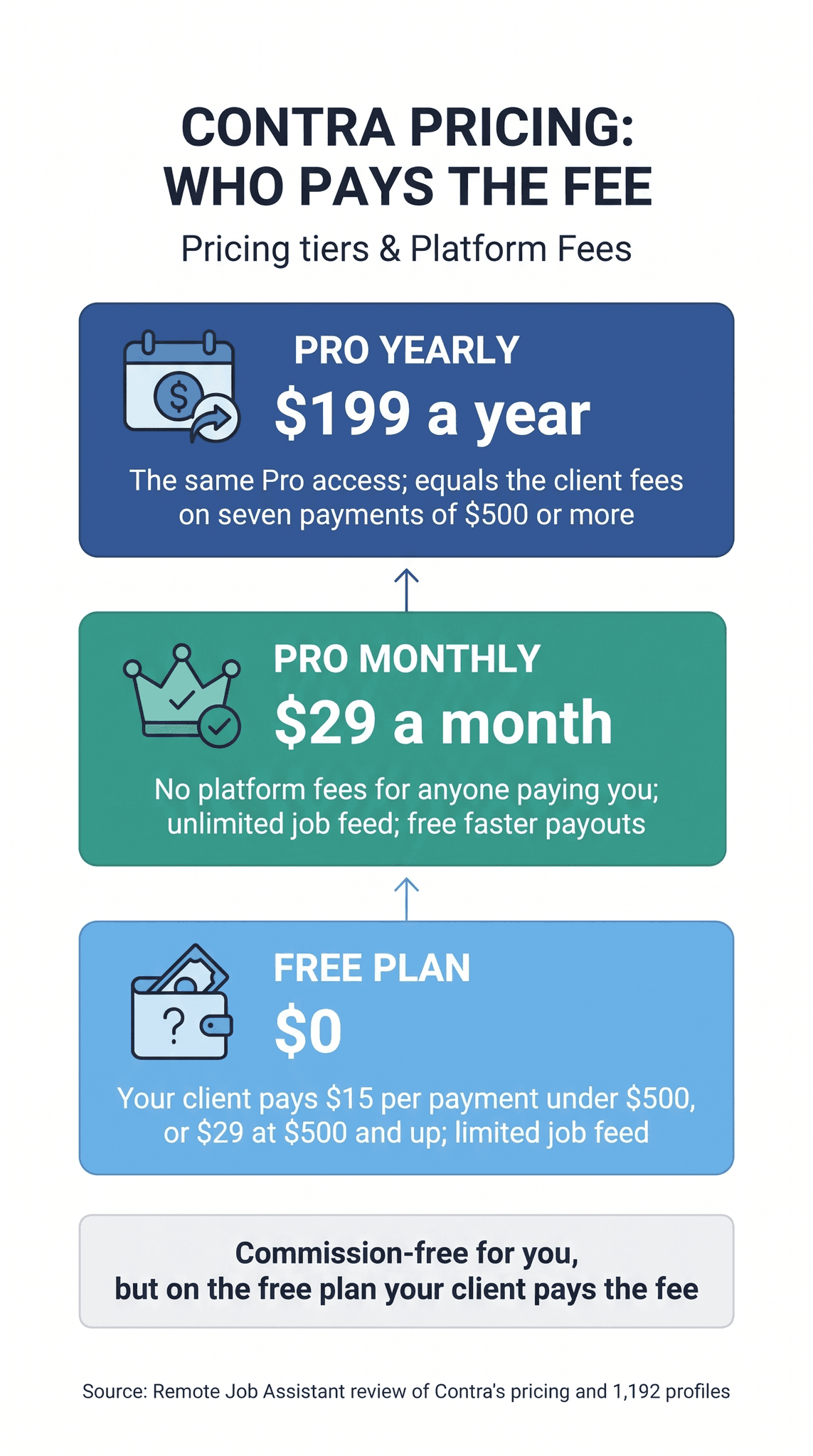
- $15 or $29 platform fee per client payment on the free plan (under $500, or $500 and up); $0 with Pro at $29 a month or $199 a year
- 4 days: the safety-clearance hold on standard payouts since Contra relaunched payments in February 2026
- 1.8 out of 5 on Trustpilot from 70 reviews; 14 of its 22 positive reviews were posted between April 9 and April 22, 2025
What Is Contra?
Contra (contra.com) is a commission-free freelance platform run by Contra.Work Inc. Independent designers, developers, video editors and marketers build portfolio profiles there, find client projects, and get paid through Contra's contracts, invoices and escrow. Joining is free. Contra Pro costs $29 a month or $199 a year and removes the $15 or $29 per-payment platform fee that otherwise lands on your client.
Ben Huffman founded Contra and led it as CEO through its 2021 funding rounds. It soft-launched in March 2020, raised a $14.5 million Series A led by Unusual Ventures in February 2021, then a $30 million Series B led by NEA in November 2021, the same day it went commission-free, according to TechCrunch.
Beyond freelance projects, Contra sells digital products (it acts as the merchant of record and handles sales tax), hosts portfolio websites, runs sponsored design challenges, and operates Contra Labs, which pays creatives to give feedback on AI models.
Two things Contra is not. It isn't a job board for salaried roles, and it isn't an employer or staffing agency; you contract with clients directly. (And if you searched "what is Contra" looking for the Iran-Contra affair or the Konami game, this is a different Contra.)
How Contra Works
As a freelancer, you sign up, build a portfolio profile, list services with prices, and apply to jobs that clients post. The plan you're on decides how many jobs you see: the pricing page lists free accounts as getting "Limited" job opportunities and Pro as getting "Unlimited," plus a boost in search and in job applications.
When a client hires you, you work inside a Contra project: fixed-price escrow, hourly escrow, milestones, or invoice billing, with a built-in contract and dispute help. You can also skip projects and send a one-off invoice or a payment link. Clients can pay those by guest checkout without making an account, by card or, on request, by ACH or SEPA. You cash out to a bank, debit card, PayPal, Payoneer or USDC.
Two details matter more than the feature list. First, card processing fees are charged to the client, not you. Second, since February 2026 standard payouts wait out a 4-day "safety-clearance period" before your bank's own transfer time starts. You can skip the wait with a faster payout, which costs extra on the free plan and is free on Pro.
Onboarding used to be slower. Abdullah Qureshi wrote on Trustpilot in December 2024 that "to actually apply on jobs, I either have to pay Contra or wait 6 weeks." Contra replied that it had since removed the waitlist. The plan split remains: free accounts still see a limited job feed.
How We Tested Contra
We ran every check on November 11, 2026, logged out, the way a freelancer or a client sees Contra before signing up.
Profiles. Contra's sitemap lists 86 monthly profile files containing 214,558 profile URLs. We drew 1,200 at random with a fixed seed so the sample can be repeated. 1,192 pages loaded and 8 had been deleted. From each page's own embedded data we recorded whether it was a freelancer or a client account, the number of hires shown, client reviews, any earnings badge, verified earnings, Pro status, location, and portfolio and service counts.
Jobs. Contra's live job feed requires an account, so we read the 10 public "featured jobs" pages it publishes for search engines (freelance coding, UX, marketing, design and similar). They held 100 job cards covering 53 unique jobs. For each, we pulled the approval date, budget and status from the page data, and we opened individual job pages to see created and expiry dates.
Fees. We read the pricing page, the Pro page, the Help Center "Fees overview" written August 6, 2026, and Contra's February 18, 2026 payments announcement. Archived copies of the pricing and help pages from April 2025 to March 2026 gave us the fee history. Competitor fees come from Upwork's and Fiverr's own help and legal pages.
Reviews. We read all 69 visible Trustpilot reviews word for word and dated each from Trustpilot's own timestamps, then checked Product Hunt (46 reviews), g2.com and Capterra (both blocked our tools, so we report no rating), the Better Business Bureau (no profile), ScamAdviser, Sitejabber (now SmartCustomer), the App Store and Google Play (Contra has no app on either), and Hacker News. We could not read any Reddit thread about Contra, so we report no Reddit sentiment.
Why we didn't sign up or buy Pro. This review asks what a freelancer can check before committing. Testing the job feed properly would have meant publishing a fake profile and applying to real clients' projects, which wastes their time. The limitation is that we can't count the logged-in job feed. For open-job volume we rely on Contra's own published figure, 296 open jobs on May 19, 2025, and on counts reported by reviewers, labelled as theirs.
We compared Contra with Upwork, Fiverr, and Remote Job Assistant's free job board and auto-apply.
Contra Pricing and Fees (2026)
"Contra is always commission-free for all creatives," says the pricing page. That's accurate for your share of a project. It isn't the same as nobody paying Contra.
| Plan | Price | Platform fee per client payment | Job access | Faster payouts |
|---|---|---|---|---|
| Free | $0 | $15 under $500, $29 at $500 and up (paid by the client) | Limited | Fee of 2 percent |
| Pro | $29/month or $199/year | $0 | Unlimited, boosted in search and jobs | Free |
Pricing verified on contra.com and in Contra's Help Center on November 11, 2026.
Card processing sits on top for the client: 2.9 percent plus 30 cents on a domestic card, per Contra's fee table. So on the free plan a $200 card payment costs your client $221.10, a $1,000 payment costs $1,058.30, and a $5,000 payment costs $5,174.30. You receive the full invoice amount before any payout fees. Other free-plan charges: digital products carry a 5 percent fee (minimum $3, maximum $29), and crypto payouts cost 2 percent.
Pro is cheap if your invoices are large. Its $199 a year equals the platform fees your clients would pay on seven payments of $500 or more, or 14 smaller ones. The fee lands on the client, but clients notice it, and waiving it is part of what Pro sells.
Here's what a $1,000 project costs on each platform, from each company's own fee page:
| Platform | You keep | Your client pays on top |
|---|---|---|
| Contra (free plan) | $1,000 | $29 platform fee + $29.30 card fee |
| Contra (Pro) | $1,000, minus your $199/year | $29.30 card fee |
| Fiverr | $800 | $55 service fee |
| Upwork | $850 to $1,000 | Up to $79.90 marketplace fee on the Basic plan, plus a $0.99 to $14.99 contract fee |
Fiverr's payment terms credit sellers 80% of each order. Upwork's freelancer fee runs from 0 to 15 percent per contract.
Contra's fees have also changed often. In April 2025 clients paid a flat $29 per contract. In February 2026 that became a sliding $2 to $29 fee, alongside a new no-fee tier called Contra Max at $999 a year, cut to $499 a year in March. In August 2026 Contra switched to today's flat $15 or $29 and dropped Max. That's four fee structures in 16 months, and the February announcement post now shows the August table under its February date.
For comparison, browsing Remote Job Assistant's board is free; its auto-apply is a separate paid subscription.
What Contra Does Well
It's the cheapest way we found to get paid for a big project. Contra takes no commission. On a $5,000 project, Fiverr's terms keep $1,000 of the seller's side and Upwork can keep up to $750; Contra's maximum is a $29 fee your client pays, or nothing if you're on Pro. Among Contra's 70 reviews on Trustpilot, Anita Autorino (4-star, September 2025) put the appeal plainly: Contra takes no commission, "unlike Fiverr which charges 20% on everything, even tips" (review).
The billing tools are real. Standard and localized contracts, escrow, milestones, hourly billing, invoices, payment links, subscriptions, and digital-product sales are all in one account. Your client can pay by guest checkout without signing up, which removes the main reason clients refuse to move to a new platform. Kayla Elorza, a creative freelancer who joined Contra in early 2023, wrote on Trustpilot in April 2025 that "the day a project wraps, I can have money hit my bank account." That was before the February 2026 clearance hold, so check the current payout times above.
When the work is there, budgets can be good. Evgeny Mishin wrote in September 2025 that "the jobs tend to have a higher average price than on other platforms." The 2025 jobs on Contra's featured pages bear that out at the top end: a website rebuild budgeted at $12,500 to $25,000 and a 3D web build at $7,500 to $15,000. The 14 hourly jobs among them offered $20 to $120 an hour, with a median midpoint of $57.50. If you design or build for the web, compare those rates with our guides to remote UX designer jobs and remote web developer jobs.
It's a strong portfolio home for designers and no-code builders. 744 of the 746 freelancer profiles we sampled carry a portfolio, and 541 list at least one service with a price. Contra's Pro page shows expert badges for tools such as Framer, Spline and Rive. Its Product Hunt record is strong too: 4.5 out of 5 from 46 reviews, a Golden Kitty award in 2021, and its "Indy AI" launch ranked the top product of the day in August 2025.
It's growing, and it's global. Contra's sitemap files, which group profiles by month, listed between 3,652 and 5,577 new public profiles a month through 2024 and 2025, and 7,889 in September 2026. Freelancers in our sample came from India (141), the US (118), Pakistan (71), Nigeria (69) and dozens of other countries, and payouts reach local banks worldwide.
Pro members show more work. 9 of 23 Pro freelancer profiles in our sample show a hire, against 32 of 723 free ones. Read that carefully: freelancers who already have clients have a reason to buy Pro, so it doesn't prove Pro gets you hired.
Where Contra Falls Short
Most profiles show no sign of paid work. 680 of the 746 freelancer profiles we sampled show no hire, no client review, no earnings badge and no verified earnings. None shows $100K or more earned, even though every testimonial on Contra's pricing page carries a "$100K+ earned on Contra" badge. Among US freelancers, 5 of 118 show a hire.
Why: anyone can publish a portfolio for free, and Contra has grown sign-ups much faster than client demand. Its sitemap added 7,889 new public profiles in September 2026 alone, while Contra told a Trustpilot reviewer in May 2025 that "we currently have 296 open jobs." Hira Saleem wrote on Trustpilot in June 2026 that there were "only 325 jobs in total (posted from May 22nd to June 15th, 2026)." That's the reviewer's count, not ours, but it lines up with Contra's own. Another reviewer, Daniel, put it more bluntly in November 2025: "No leads for a one year since I started the plan with Contra."
The public job pages show only expired jobs from 2025. Contra's 10 public "featured jobs" pages carry titles such as "Remote Programming Gigs Today" and "Updated Daily." All 53 jobs on them were approved between May 29 and June 13, 2025, and every one is expired or closed. One page shows "Marketing Assistant for Launch Campaign" seven times.
Why: these are search-engine landing pages, and the job lists on them haven't refreshed since June 2025. The cards print no posting date, so a visitor can't tell the jobs are 17 months old.
"'Gigs Today' is a strange label for 53 jobs that had all expired by July 2025."
"Commission-free" has fine print, and the fees keep moving. On the free plan your client pays $15 or $29 per payment, faster payouts cost 2 percent, digital products cost 5 percent, and crypto payouts cost 2 percent. Fees come up in 6 of 47 one- and two-star reviews. Noah Noé wrote on Trustpilot in June 2026: "i moved here because of the marketing around '0% commission,' but after looking into the pricing, there are still fees involved depending on how you use the platform."
Why: Contra earns money from Pro subscriptions and per-payment fees. Putting the fee on the client keeps the promise to freelancers while still charging for the deal. It's a legitimate model, but the four fee structures in 16 months make it hard to plan around.
Contra takes no commission from you. On the free plan it bills whoever pays you, unless you pay Contra first.
Payouts have been held and reversed since the February 2026 relaunch. 9 of 47 negative Trustpilot reviews describe held or reversed payments, and every one is dated February 25, 2026 or later. Peta wrote that Contra "added a 4 business day 'security review period' and a 2% fee on instant withdrawals" (review). Momo wrote in October 2026: "When I brought my client and he made a payment, they blocked the funds and said the review would take 24-48 hours" (review).
Why: when Contra became the payment processor for every kind of transaction, it took on fraud and chargeback risk. Holding funds for four days and reviewing new clients is how a processor manages that risk. It makes sense for Contra, and it costs a freelancer who needs this week's invoice paid this week.
Support and reputation have slid. 14 of the 47 negative reviews describe slow, silent or AI-only support. Yasir Basheer wrote in July 2026: "I have only received AI-generated messages. When I specifically asked to speak with a human representative, I didn't receive any reply for days" (review); Contra answered another reviewer that it uses "AI triage." The TrustScore is 1.8 from 70 reviews (the 69 visible ones split 44 one-star, 3 two-star, 1 four-star and 21 five-star), and every review with text since September 22, 2025 is one or two stars. The positive history is concentrated: 14 of the 22 positive reviews arrived between April 9 and April 22, 2025, the month after Contra claimed its Trustpilot profile. We're reporting the dates, not alleging who wrote them.
Other platforms rate Contra far higher, and the gap comes down to timing and method. Product Hunt shows 4.5 out of 5 from 46 reviews, but those were written one to four years ago by launch-day audiences, and 15 of the 46 come from Contra's own makers. ScamAdviser gives contra.com 100 out of 100, but that score measures domain age, security certificates and traffic, not whether freelancers get paid, and the same ScamAdviser page notes that it found mainly negative reviews. The most recent independent reviews are the ones on Trustpilot.
Why: a small team scaling a payments product with AI-first support produces exactly these complaints. Payment holds create urgent tickets, and urgent tickets answered by a bot read as silence.
Contra's size claims don't agree with each other. Its Pro page says "Trusted by 1M+ independents" and also "1.5M+ creative experts." One Contra Labs page says both "1.7M+ creative experts" and "1.5M+ verified creative experts." The February 2026 announcement said "more than 1.2M creatives" had earned "over $200M," while the Pro page says "$250M+ verified expert earnings." The public sitemap holds 214,558 profiles, and 446 of the 1,192 we sampled were client accounts, not freelancers.
Why: Contra updates its marketing pages separately, and each counts something different (every sign-up, active creatives, the AI-feedback pool) without saying which. None of the figures gives a denominator, so none can be checked.
The Free-Means-Free Test
The Free-Means-Free Test is a 10-point check for any job or gig platform that markets itself as free or commission-free. It has five questions worth 2 points each, and you can answer all of them before you sign up.
- Who pays? 2 = no fee on either side without a subscription; 1 = a flat or percentage fee on one side; 0 = fees on both sides, or more than 10 percent of the deal.
- Can you see the work before you pay? 2 = every open job is visible free; 1 = a limited feed; 0 = nothing until you pay.
- Can you verify demand? 2 = open-job counts and posting dates are visible and current; 1 = partial; 0 = stale or hidden.
- Do the platform's claims match its own data? 2 = yes; 1 = can't be checked; 0 = contradicted.
- Are there independent reviews you can trust? 2 = 50+ reviews spread over a year with a 3.5+ average; 1 = thin, clustered or mixed; 0 = none, or mostly negative.
Scoring bands: 0-3, use it as a tool, not a lead source. 4-6, use the free tier and verify before paying. 7-10, worth building your search around.
| Check | Contra | Remote Job Assistant |
|---|---|---|
| Who pays? | 1: client pays $15/$29 per payment on the free plan | 1: browsing is free; auto-apply is a paid subscription whose price isn't printed on the page |
| See the work first? | 1: free accounts get a "Limited" job feed | 2: every listing visible free, employer named |
| Verify demand? | 0: public job pages show only 2025 jobs; no open-job count | 1: "Posted" dates are the day we first found a listing, which lags for newly added companies |
| Claims match data? | 0: 1M to 1.7M members claimed; 214,558 public profiles | 1: our "10,000+ remote jobs" homepage figure isn't independently audited here |
| Independent reviews? | 0: Trustpilot 1.8 from 70, mostly negative since September 2025 | 0: no Trustpilot profile yet |
| Total | 2/10 | 5/10 |
One fairness note. The test scores Contra as a place to find work, which is the question most people ask. As a billing tool alone, for clients you bring yourself, Contra would score far higher, because its fees are low and its tools work.
How to use it: before joining any platform, find the fee table and ask who pays; look for a dated job count you can see logged out; and read the newest one-star reviews instead of the average.
Contra vs. Remote Job Assistant
These are different products, and the right choice depends on what kind of work you want.
- What you're looking for. Contra finds and bills freelance projects, most of them short. Remote Job Assistant lists full-time remote jobs and links "Apply Now" straight to the employer's own posting. If you want a salary, compare remote job boards or browse remote jobs paying $100K+.
- Who pays to see the work. Contra's free plan shows a limited job feed. Remote Job Assistant's board is free, with every employer named.
- Applying at scale. Contra has no auto-apply. Remote Job Assistant's auto-apply is a paid add-on powered by JobCopilot, the same engine several job boards resell.
Contra wins on everything to do with money: payments, contracts, escrow, invoices and a portfolio site. Remote Job Assistant does none of that. If you freelance, Contra (or Upwork) is the right category.
Contra is a payments company with a job board attached, not the other way round.
| Contra | Remote Job Assistant | |
|---|---|---|
| What it is | Freelance network and payments platform | Remote job board with paid auto-apply |
| Work type | Freelance projects (32 of 53 featured jobs fixed-price) | Full-time remote roles |
| Cost to browse work | Free (limited feed) or $29/month Pro | Free |
| Fee when you get paid | $0 to you; client pays $15/$29 on free plan | None (employer pays you directly) |
| Contracts, escrow, invoicing | Yes | No |
| Auto-apply | No | Yes, paid (JobCopilot) |
| Trustpilot | 1.8 from 70 reviews | No profile |
| Free-Means-Free Test | 2/10 | 5/10 |
Who Should Use Contra?
Contra is worth using if:
- You already have clients and want contracts, invoices and escrow without a commission. Pro's $199 a year equals the client fees on seven payments of $500 or more.
- You're a designer, Framer or Webflow developer, or video editor who wants a portfolio site that also takes payments, and you treat any leads as a bonus.
- You sell templates or other digital products and want Contra to handle sales tax as merchant of record.
Skip Contra if:
- You need new clients this month. Only 41 of 746 sampled freelancer profiles show a hire. If leads matter more to you than fees, Upwork's larger client marketplace is the better bet even after its fee. For startup contract and full-time roles, see our Wellfound review.
- You need payouts the same week and don't want to pay for faster payouts.
- You want a salaried remote job at $75K or more. Use a job board: start with the best remote job boards, check whether a paid board like FlexJobs is worth it, or read our guides to remote creative director jobs and fractional CMO jobs if you want senior or part-time marketing work.
- You want applications sent for you. See how auto-apply tools compare.
Stop Applying Manually
Our AI applies to hundreds of matching jobs while you sleep. Wake up to interviews, not more applications.
Frequently Asked Questions
What is Contra?
Contra is a commission-free freelance platform run by Contra.Work Inc. Freelancers build portfolio profiles, find client projects and get paid through Contra contracts, invoices and escrow. It is free to join; Contra Pro costs $29 a month or $199 a year and removes the per-payment platform fee that free-plan clients pay.
Is Contra legit?
Yes. Contra is a real company that raised $44.5 million across its 2021 Series A and B, and payments do go through. But its Trustpilot score is 1.8 from 70 reviews, every review with text since September 2025 is one or two stars, and complaints about held or reversed payments began after its February 2026 payments relaunch.
Is Contra really commission-free?
For freelancers, yes: you keep the full invoice amount. On the free plan your client pays a $15 platform fee on payments under $500 and $29 on larger ones, plus card processing. Faster payouts cost 2 percent unless you're on Pro, and crypto payouts cost 2 percent on the free plan and 1 percent on Pro.
How much does Contra Pro cost, and is it worth it?
Contra Pro costs $29 a month or $199 a year as of November 11, 2026. It's worth it if you bill seven or more client payments of $500 or more a year, because it removes the platform fee. As a way to find work, Contra scores 2 out of 10 on our Free-Means-Free Test, so don't buy Pro expecting leads.
Can you actually find clients on Contra?
Some freelancers do, but few profiles show it. In our sample, 41 of 746 freelancer profiles showed at least one hire on Contra, and Contra itself reported 296 open jobs in May 2025. Treat it as a billing tool first and a lead source second.
Contra vs Upwork vs Fiverr: which one lets me keep more money?
On a $1,000 project, Contra pays you the full $1,000, and on the free plan your client pays a $29 platform fee. Fiverr's terms pay sellers $800 of a $1,000 order. Upwork's freelancer fee ranges from nothing to $150 on that project, depending on the contract.
Why is my Contra payout on hold?
Since February 2026, standard payouts wait out a 4-day safety-clearance period before the bank transfer starts, and Contra may review payments from new clients before releasing them. A faster payout skips the clearance wait; it costs extra on the free plan and is free on Pro.
Does Contra have full-time remote jobs?
Rarely. Contra's jobs are mostly short freelance projects: 32 of the 53 jobs on its public featured pages were fixed-price, with budgets as low as $300 to $400. A few mention a path to full-time, but salaried remote roles are easier to find on job boards and employer career pages.
What should I check before joining any freelance platform?
Use the Free-Means-Free Test: who pays the fees, whether you can see jobs before paying, whether demand is visible and current, whether the platform's claims match its own data, and whether independent reviews are trustworthy. Each check is worth 2 points, for 10 in total.
What is the best Contra alternative?
For freelancers, Upwork has far more client demand but higher fees, and direct clients billed through your own invoicing tool cost nothing in platform fees. For full-time remote jobs, use free job boards, employer career pages, and Remote Job Assistant's free board, which names every employer.
Contra is a good billing tool and a weak lead source. It charges you no commission, and its $199-a-year Pro plan removes every platform fee, but only 41 of 746 sampled freelancer profiles show a single hire, its public job pages show only expired 2025 jobs, and it scores 2 out of 10 on the Free-Means-Free Test as a place to find work.
Bring your clients to Contra. Find them somewhere else.
Join Contra to get paid. Don't join it to get found.
Ready to Automate Your Job Search?
Let AI apply to hundreds of jobs for you while you focus on interviews.
Start Auto-ApplyingRelated Tool Comparisons
DailyRemote Review: Is Premium Worth It? We Checked 1,200 Listings (2026)
DailyRemote review: we checked 1,200 listings. 1,192 hid the employer until you pay $23/month, and its own LinkedIn filter undercuts its 73% exclusivity claim.
25 min read
Dynamite Jobs Review: What 499 Live Listings Actually Pay (2026)
Dynamite Jobs is free and legit, but its promoted listings pay a median of about $30K. Our review of 499 live listings, its ratings, and the apply process.
24 min read
Remote Rocketship Review: Is the Paid Remote Job Board Worth It? (2026)
Remote Rocketship scores 4.1/5 on Trustpilot from 71 reviews, but it won't publish its price anywhere. Our verified review of the paid remote job board.
20 min read