
Every Customer Success Manager job posting wants "2-3 years of CS experience." But if every role requires experience, how does anyone get started?
This is the catch-22 that stops most career changers before they begin. You can't get the job without experience, and you can't get experience without the job.
Here's what hiring managers won't tell you publicly: Traditional CS experience is not the only path in. At Remote Job Assistant, we analyze thousands of customer-facing job postings monthly, and the candidates who break into Customer Success consistently share one trait—they translate their existing experience into CS language, not just list their old job duties.
Get Remote Job Tips in Your Inbox
Weekly strategies, salary data, and new opportunities
Unsubscribe anytime. No spam.
This guide shows you exactly how to do that.
Yes, you can get a remote Customer Success job without prior CS experience. The most common entry paths are: transitioning from Customer Support, pivoting from Account Management or Sales, or leveraging industry expertise from a non-customer-facing role. The key is demonstrating that you understand customer outcomes, not just customer interactions.
Remote Job Assistant tracks hiring patterns across hundreds of remote-first companies to help career changers find their path in.
Why CS Hiring Seems Impossible (But Isn't)
Job postings list requirements that filter out 90% of applicants. But those requirements describe the ideal candidate, not the minimum.
Here's what's actually happening: Companies post "2-3 years CS experience" because they want someone who already understands customer outcomes, adoption metrics, and renewal dynamics. But those skills exist in plenty of roles that aren't called "Customer Success."
The real barrier isn't experience—it's translation. Most applicants list what they did. Successful career changers explain how what they did maps to what CSMs do.
Decode Any Job Posting
Paste a job description and get instant insights: what they really want, red flags to watch, and how to stand out.
The Transfer Skill Map
Customer Success is built on skills you may already have. The question is whether you can name them correctly.
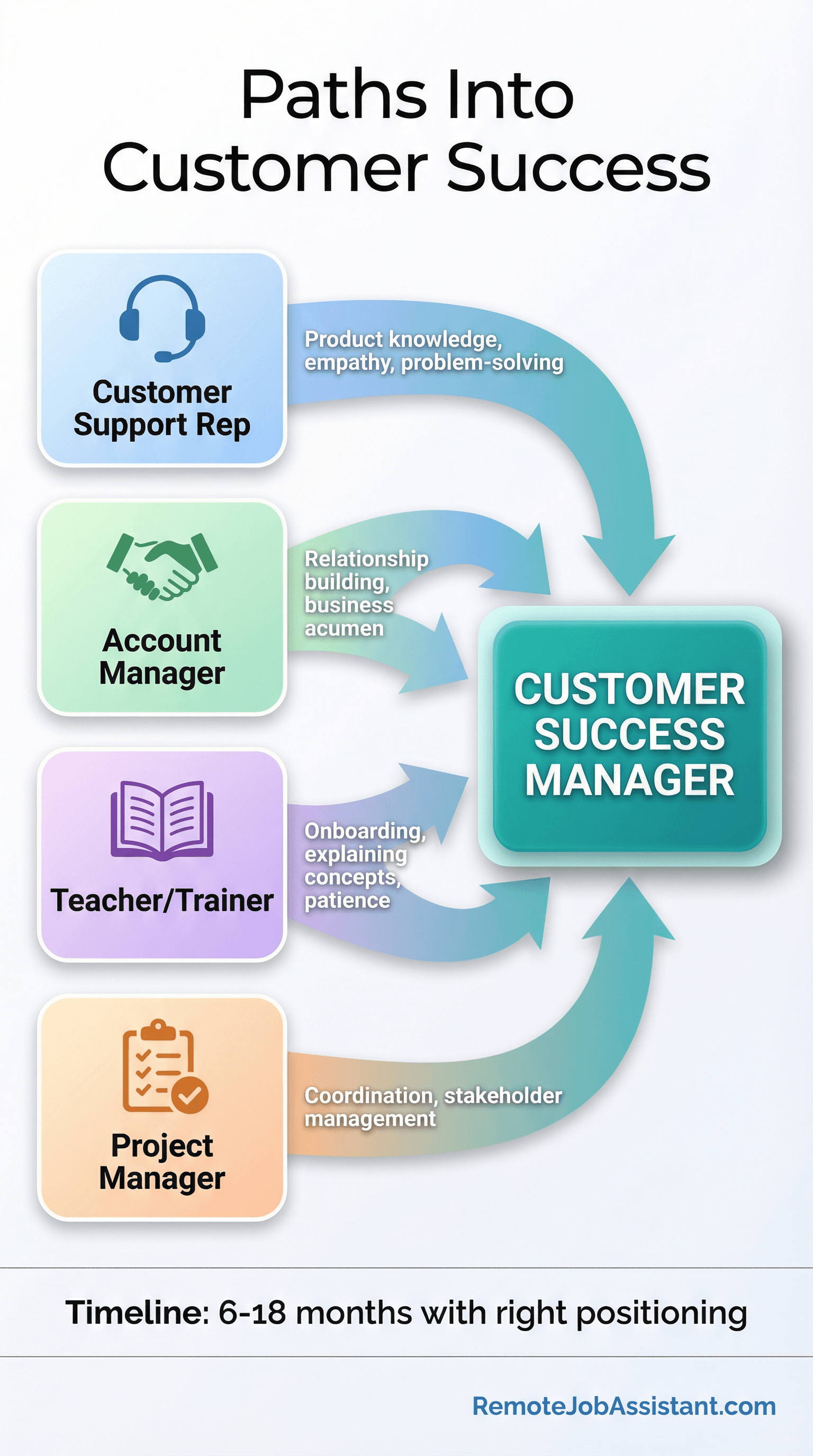
| Your Background | Transferable CS Skills | How to Position It |
|---|---|---|
| Customer Support | Issue resolution, product knowledge, customer communication | "I resolved X tickets monthly while maintaining Y% CSAT—now I want to prevent issues proactively" |
| Account Management/Sales | Relationship building, renewal conversations, upselling | "I managed $Xm in accounts and drove Y% retention—CS lets me focus on customer outcomes, not just quota" |
| Teaching/Training | Onboarding, adoption, explaining complex concepts | "I onboarded X students per year and tracked their progress—that's exactly what CSMs do with customers" |
| Project Management | Stakeholder management, timeline tracking, cross-functional work | "I coordinated across X teams to deliver projects—CSMs coordinate across internal teams for customer outcomes" |
| Technical Support | Product expertise, troubleshooting, documentation | "I know the product deeply and can diagnose issues—now I want to ensure customers succeed before they need support" |
The pattern: Take what you did → Explain why it matters to customer outcomes → Connect it to what CSMs do.
The Entry Ladder: Realistic Paths In
Not every path has the same success rate. Here's what we see working in 2025-2026.
Highest Success Rate: Support → CS at Same Company
Internal transfers are the clearest path. You already know the product, the customers, and the internal teams. Ask your manager about CS openings, volunteer for QBR prep, or request to shadow a CSM.
Why it works: Hiring managers prefer known quantities. An internal Support rep who "gets" customer success is less risky than an external hire with a perfect resume.
Moderate Success Rate: Industry Expert → CS in Same Industry
If you spent years in healthcare, fintech, or e-commerce, companies in that space value your domain expertise. You understand the customer's world—that's harder to teach than CS mechanics.
Why it works: A CSM who can speak the customer's language on day one saves months of onboarding.
Lower Success Rate: Complete Career Change
Moving from an unrelated field (retail, food service, manufacturing) into CS is possible but requires more work. You'll need to build CS knowledge externally through courses, certifications, or volunteer work.
Why it works: It still works—but you're competing against candidates with more obvious qualifications.
What Hiring Managers Actually Look For
We analyzed CS job postings and manager interviews to identify what separates successful applicants from the pile.
The three signals that matter:
-
You understand customer outcomes, not just customer interactions. Support agents help customers fix problems. CSMs help customers achieve goals. If you can articulate why that difference matters, you're ahead of most applicants.
-
You can point to retention or expansion metrics. Even if your title wasn't "CSM," did you do anything that kept customers longer or made them spend more? Renewals, upsells, churn prevention, NPS improvement—anything with a number helps.
-
You show business acumen, not just empathy. Empathy matters, but CSMs also need to understand revenue, prioritization, and when to push back on customer requests. Hiring managers worry that Support-to-CS candidates will be too reactive. Show that you think strategically.
Most CS roles require comfort with ambiguity. Support has tickets with clear resolutions. CS has customers with fuzzy goals and competing priorities. If you thrive in structured environments, CS might feel chaotic—and that's worth knowing before you make the switch.
Stop Applying Manually
Our AI applies to hundreds of matching jobs while you sleep. Wake up to interviews, not more applications.
The Reality Check: Who Struggles in CS
Not everyone who wants a CS role should take one. Here's who tends to struggle:
People who prefer clear, immediate wins. Support tickets get resolved. CS goals take months to materialize. If you need daily wins to stay motivated, CS can feel frustrating.
People who avoid difficult conversations. CSMs sometimes have to tell customers "no," push back on unrealistic expectations, or deliver bad news about renewals. If conflict avoidance is your default, this will burn you out.
People who want to stay purely technical. CS is increasingly strategic—business reviews, stakeholder management, cross-functional work. If you just want to solve technical problems, Technical Support or Solutions Engineering might fit better.
People who expect immediate salary jumps. Entry-level CS pays $55,000-$70,000 at most companies. That's good, but it's not the $90,000+ you see in senior CS postings. The jump happens after 2-3 years of proven results.
Practical Steps: The First 30 Days
If you're serious about breaking in, here's a concrete plan:
Week 1-2: Build CS literacy
- Read Customer Success: How Innovative Companies Are Reducing Churn by Nick Mehta (the foundational text)
- Follow Gainsight, ChurnZero, and Totango blogs for industry terminology
- Subscribe to r/CustomerSuccess on Reddit—real practitioners, real problems
Week 2-3: Translate your experience
- Rewrite your resume with CS language (outcomes, retention, adoption, NPS)
- Prepare 3 stories that demonstrate customer outcome thinking, not just task completion
- Update LinkedIn headline to signal CS interest
Week 3-4: Build evidence
- If possible, volunteer for CS-adjacent work at current job (QBR prep, churn analysis, customer interviews)
- Consider a CS certification (Gainsight, SuccessHACKER, or Aspireship—Aspireship offers job placement support)
- Start applying to roles titled "Customer Success Associate" or "Onboarding Specialist"—not "Customer Success Manager"
Decode Any Job Posting
Paste a job description and get instant insights: what they really want, red flags to watch, and how to stand out.
Entry-Level CS Job Titles to Target
"Customer Success Manager" is often a mid-level title. Look for these instead:
| Job Title | What It Usually Means | Typical Salary |
|---|---|---|
| Customer Success Associate | Entry-level CS, often high-touch support hybrid | $50,000-$65,000 |
| Onboarding Specialist | Focused on new customer activation—great first step | $48,000-$62,000 |
| Implementation Specialist | Technical onboarding, often leads to CS or Solutions roles | $55,000-$70,000 |
| Customer Advocate | Voice of customer internally, less account ownership | $45,000-$58,000 |
| Renewal Specialist | Focused on retention—CS-adjacent, quota-carrying | $50,000-$65,000 + bonus |
Salary data based on Glassdoor 2025 averages for remote positions.
Frequently Asked Questions
Can I break into Customer Success without SaaS experience?
Yes, but it's harder. Many companies prefer candidates who understand subscription economics and software adoption. If you lack SaaS experience, target CS roles in industries you do know—healthcare, finance, e-commerce—where your domain expertise compensates.
Is Customer Success entry-level?
The role itself isn't entry-level, but entry-level CS positions exist (Customer Success Associate, Onboarding Specialist). Full "Customer Success Manager" titles usually require 1-3 years of relevant experience, whether in CS specifically or in transferable roles like Support or Account Management.
How long does it take to transition from Support to Customer Success?
Typically 6-18 months if you're intentional. The fastest path is an internal transfer at your current company. External moves take longer because you're competing against candidates with direct CS experience.
What certifications help for Customer Success?
The most recognized are Gainsight's certification, SuccessHACKER's CSM certification, and Aspireship (which includes job placement). Certifications help but don't replace experience—they're most useful for career changers who need to demonstrate CS knowledge.
Do I need to know specific CS tools like Gainsight or ChurnZero?
Tool knowledge helps but isn't required for entry-level roles. Companies expect to train you on their stack. What matters more is understanding CS concepts—health scores, QBRs, adoption metrics, churn indicators—which you can learn without access to enterprise tools.
Start Your Transition
Breaking into Customer Success isn't about checking every box on a job posting. It's about showing that you understand what CS actually is—and that your background prepared you to do it.
If you're coming from Support, check out how Customer Success differs from Support to sharpen your positioning. Ready to apply? Browse remote customer success positions or explore entry-level remote opportunities that can serve as stepping stones.
The candidates who break in aren't the ones with perfect resumes. They're the ones who can explain—clearly and confidently—why their experience makes them ready.
Want an ATS-Optimized Resume?
Get our complete resume toolkit with templates, examples, and strategies.
Get the Resume ToolkitRelated Career Transitions

How to Follow Up on a Job Application (Templates That Actually Work)
Learn when and how to follow up on a job application with copy-paste templates for senior professionals—remote-specific guidance, timing data, and a 3-step sequence.
22 min read

Best Remote Jobs for Former Teachers in 2026 (No Classroom Required)
Former teachers are landing $60K-$90K remote jobs in 2026—and you can too. Your classroom skills translate to instructional design, EdTech, corporate training, and more. See the exact career paths teachers are taking.
14 min read

Remote Nursing Jobs 2026: The Complete Guide to Leaving the Bedside
Move from bedside to remote nursing in 2026. Utilization review, case management, telehealth, and more. See which nursing specialties pay $70K-$95K remote and require no bedside work.
15 min read