
You're scrolling through job listings and see three roles that sound almost identical: Customer Success Manager, Account Manager, and Customer Support Specialist. The descriptions overlap. The salaries vary wildly. And you're not sure which one actually fits your skills.
This confusion isn't your fault. Companies use these titles inconsistently, and most career advice lumps them together under "customer-facing roles" without explaining the real differences.
At Remote Job Assistant, we analyze thousands of job postings across customer-facing roles monthly—and we've noticed that these three titles represent fundamentally different jobs with different metrics, different career paths, and different day-to-day realities. Here's how to cut through the confusion.
Get Remote Job Tips in Your Inbox
Weekly strategies, salary data, and new opportunities
Unsubscribe anytime. No spam.
The Core Difference in One Sentence Each
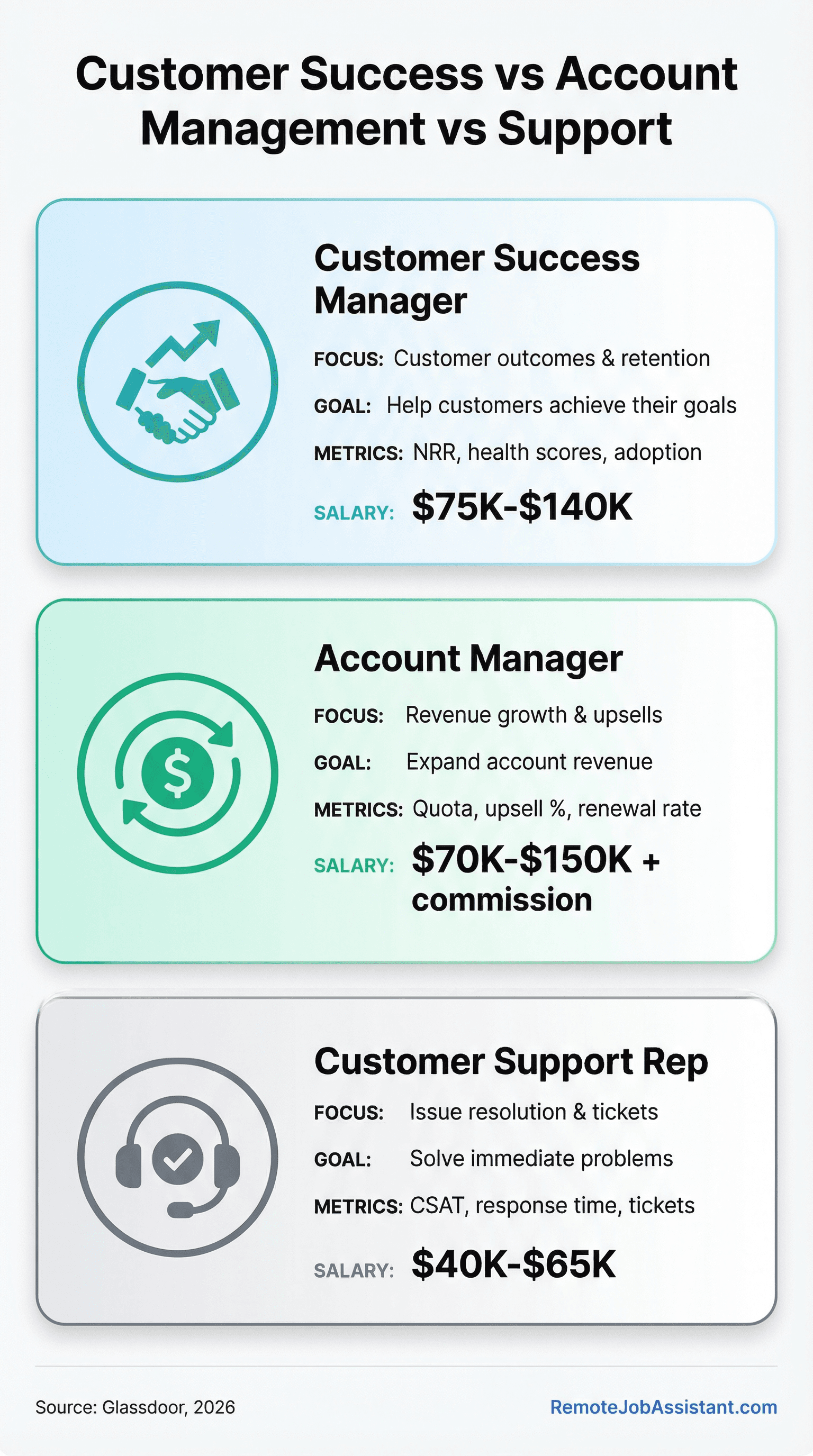
Customer Success helps customers achieve their goals so they renew and expand. The focus is proactive and outcome-oriented.
Account Management maintains business relationships and grows revenue from existing accounts. The focus is transactional and revenue-driven.
Customer Support solves specific problems when customers reach out. The focus is reactive and resolution-oriented.
The simplest way to remember it: Support fixes what's broken. Account Management protects and grows the deal. Customer Success ensures the customer gets value before problems arise.
How the Three Roles Compare
| Factor | Customer Success | Account Management | Customer Support |
|---|---|---|---|
| Primary Focus | Customer outcomes and adoption | Revenue retention and growth | Issue resolution |
| Timing | Proactive (before problems) | Periodic (renewal cycles) | Reactive (after problems) |
| Success Metric | Net Revenue Retention, NPS | Upsell/Cross-sell revenue | CSAT, Resolution time |
| Revenue Role | Indirect (enables renewals) | Direct (owns quota) | None (cost center) |
| Typical Salary | $65,000–$95,000 | $60,000–$90,000 + commission | $40,000–$55,000 |
| Reporting To | CS Leader or COO | Sales or Revenue Leader | Support or Ops Leader |
Salary data based on Glassdoor 2025 averages for remote positions.
Decode Any Job Posting
Paste a job description and get instant insights: what they really want, red flags to watch, and how to stand out.
Why These Roles Exist (The Economic Reason)
Understanding why each role emerged helps you understand what companies actually need from each one.
Customer Support emerged because products became too complex for self-service. As software and services grew more sophisticated, companies needed dedicated people to answer questions and solve problems. Support exists to reduce friction and prevent customer frustration from escalating.
Account Management emerged because sales teams needed relationship owners post-sale. When a company sells to another business, someone has to maintain that relationship, handle renewals, and find opportunities to expand the deal. Account Managers exist to protect and grow revenue from existing customers.
Customer Success emerged because SaaS subscription economics changed everything. When revenue comes from monthly or annual renewals instead of one-time purchases, keeping customers becomes more valuable than acquiring new ones. Customer Success exists to ensure customers get enough value to keep paying.
The causal chain matters: If Support doesn't exist, customers churn from frustration. If Account Management doesn't exist, renewals fall through the cracks. If Customer Success doesn't exist, customers cancel because they never achieved their goals—even if nothing technically "broke."
What Each Role Is NOT
This is where most people get confused.
Customer Success is not Support with a fancier title. If your "CSM" role involves answering tickets all day, it's actually a support role with misleading branding. Real Customer Success is strategic—quarterly business reviews, adoption tracking, executive relationship building.
Account Management is not Sales with existing accounts. Account Managers focus on retention and expansion, not hunting for new logos. If a role has you cold-calling prospects, it's a sales role regardless of what the title says.
Support is not failed Customer Success. Support is a distinct skill set focused on rapid problem resolution. Great support reps often don't enjoy (or excel at) the long-term relationship building that Customer Success requires.
Many companies misuse these titles. A "Customer Success Associate" at one company might do pure support work, while a "Senior Support Specialist" elsewhere might own strategic accounts. Always read the job description carefully, not just the title.
The Downsides Nobody Mentions
Every role has structural problems. Knowing these upfront helps you choose wisely.
Customer Success drawbacks:
- You're often blamed for churn you can't control (bad product, wrong customers, economic conditions)
- Metrics can be fuzzy—"customer health" is harder to prove than "tickets resolved"
- You depend on other teams (Product, Engineering) to fix the problems you surface
- Many companies underfund CS, leaving you with 50+ accounts when 20 is realistic
Account Management drawbacks:
- Quota pressure can damage relationships (customers sense when you're selling vs. helping)
- Compensation often depends on factors outside your control (product launches, pricing changes)
- You may inherit bad accounts from previous AMs and own someone else's mess
- The "farmer vs. hunter" dynamic means you're sometimes seen as less valuable than new-business sales
Customer Support drawbacks:
- Repetitive work—you'll answer the same questions hundreds of times
- Career ceiling is real; Director of Support roles are rare compared to Sales or CS leadership
- Often treated as a cost center, meaning budget cuts hit Support first
- Emotional labor is high; you absorb customer frustration daily
Stop Applying Manually
Our AI applies to hundreds of matching jobs while you sleep. Wake up to interviews, not more applications.
Career Path Implications
Where each role leads matters as much as where it starts.
Customer Success career path: CSM → Senior CSM → CS Manager → Director of CS → VP of Customer Success → Chief Customer Officer
The CCO path is relatively new but growing fast. Many CS leaders transition into General Management or COO roles because they understand the full customer lifecycle.
Account Management career path: AM → Senior AM → AM Manager → Director of Account Management → VP of Sales/Revenue
Account Management often feeds into broader sales leadership. Strong AMs who can also hunt sometimes move into Enterprise Sales or VP of Sales roles.
Support career path: Support Rep → Senior Support → Team Lead → Support Manager → Director of Support → VP of Customer Experience
The VP of CX path is emerging, but it's still less common than CS or Sales leadership tracks. Many Support professionals transition laterally into Customer Success, Product Management, or Technical Writing.
Support → Customer Success is the most common lateral move. If you're in Support and want to level up, focus on building business acumen (understand your customers' goals, not just their problems) and ask for strategic account ownership. See our full guide on how to get into Customer Success with no experience.
Which Role Fits You?
| If You... | Consider |
|---|---|
| Love solving puzzles quickly | Support |
| Enjoy long-term relationship building | Customer Success |
| Are motivated by commission/quota | Account Management |
| Prefer reactive work (problems come to you) | Support |
| Prefer proactive work (you set the agenda) | Customer Success |
| Want direct revenue attribution | Account Management |
| Are energized by variety and volume | Support |
| Are energized by depth with fewer accounts | Customer Success or Account Management |
Decode Any Job Posting
Paste a job description and get instant insights: what they really want, red flags to watch, and how to stand out.
Frequently Asked Questions
Is a Customer Success Manager the same as an Account Manager?
No. Customer Success focuses on ensuring customers achieve their goals and get value from the product. Account Management focuses on maintaining the business relationship and growing revenue. Some companies combine these into one role, but the skill sets and metrics are different.
Which role pays more: Customer Success or Account Management?
It depends on the company. Base salaries are similar ($60,000–$95,000), but Account Managers often have commission or bonus structures tied to upsells, which can push total compensation higher. Customer Success roles increasingly include variable pay tied to retention metrics.
Can you move from Customer Support to Customer Success?
Yes—this is one of the most common career transitions. Focus on understanding your customers' business goals (not just their technical problems), volunteer for strategic projects, and ask for exposure to renewal conversations or QBRs.
Which role is better for introverts?
Support can work well for introverts who prefer focused problem-solving over extensive relationship building. Customer Success requires more proactive outreach and relationship nurturing. Account Management often involves executive-level conversations and presentations.
Is Customer Success a long-term career or a stepping stone?
Both. Many professionals build 10+ year careers in Customer Success, progressing to VP or CCO roles. Others use CS as a stepping stone into Product Management, Sales Leadership, or General Management—because CS provides deep customer insight that's valuable everywhere.
Find Your Next Role
Now that you understand the differences, you can search more strategically.
Browse remote customer success positions to see what's available, or explore our guide to remote customer success jobs for salary data and companies hiring. If Support is your path, check out remote customer service jobs for entry points. For Account Management, remote sales roles often include AM positions at the mid-career level.
The right role isn't the one with the best title—it's the one that matches how you work best.
Ready to Find Your Remote Job?
Browse thousands of curated remote jobs or let AI apply for you.
Browse Remote JobsRelated Job Guides
Remote Ecommerce Jobs: What 1,694 Postings Show (2026)
Remote ecommerce jobs are concentrated: 322 of 1,694 US postings were remote. See which marketplace, brand, agency and SaaS seats pay $100K+ from a home office.
55 min read
Remote Interior Design Jobs: What 1,409 Postings Show (2026)
Remote interior design jobs are rare: 40 of 1,409 US postings were remote. See which designer, planner, and FF&E seats pay $75K+ from home, and where.
46 min read
Remote Journalism Jobs: What 1,438 Postings Show (2026)
Remote journalism jobs are rare: 77 of 1,438 US newsroom postings were remote. See which reporter, editor, and audience seats pay $75K+ from home, and where.
39 min read