

You've been job hunting for months. You've tailored dozens of resumes, written countless cover letters, and refreshed LinkedIn so many times you've memorized every "Open to Work" banner in your network. And still—nothing but automated rejection emails and radio silence.
At some point, a thought crosses your mind: Can I just pay someone to do this for me?
The answer is yes. They're called reverse recruiters.
Get Remote Job Tips in Your Inbox
Weekly strategies, salary data, and new opportunities
Unsubscribe anytime. No spam.
A reverse recruiter is a job-search professional who works on behalf of you—the job seeker—not employers. They manage your applications, outreach, and follow-ups. Unlike traditional recruiters who are paid by companies to fill roles, reverse recruiters are paid by candidates to execute the job search and land interviews.
At Remote Job Assistant, we track job search services across the remote work landscape—and reverse recruiting has exploded in demand over the past two years. With job searches now averaging five months and 72% of job seekers reporting that the process negatively affects their mental health, it's no surprise that professionals are looking for help.
But what exactly does a reverse recruiter do? How is it different from a regular recruiter or headhunter? And most importantly—is it worth the money?
This guide breaks it all down.
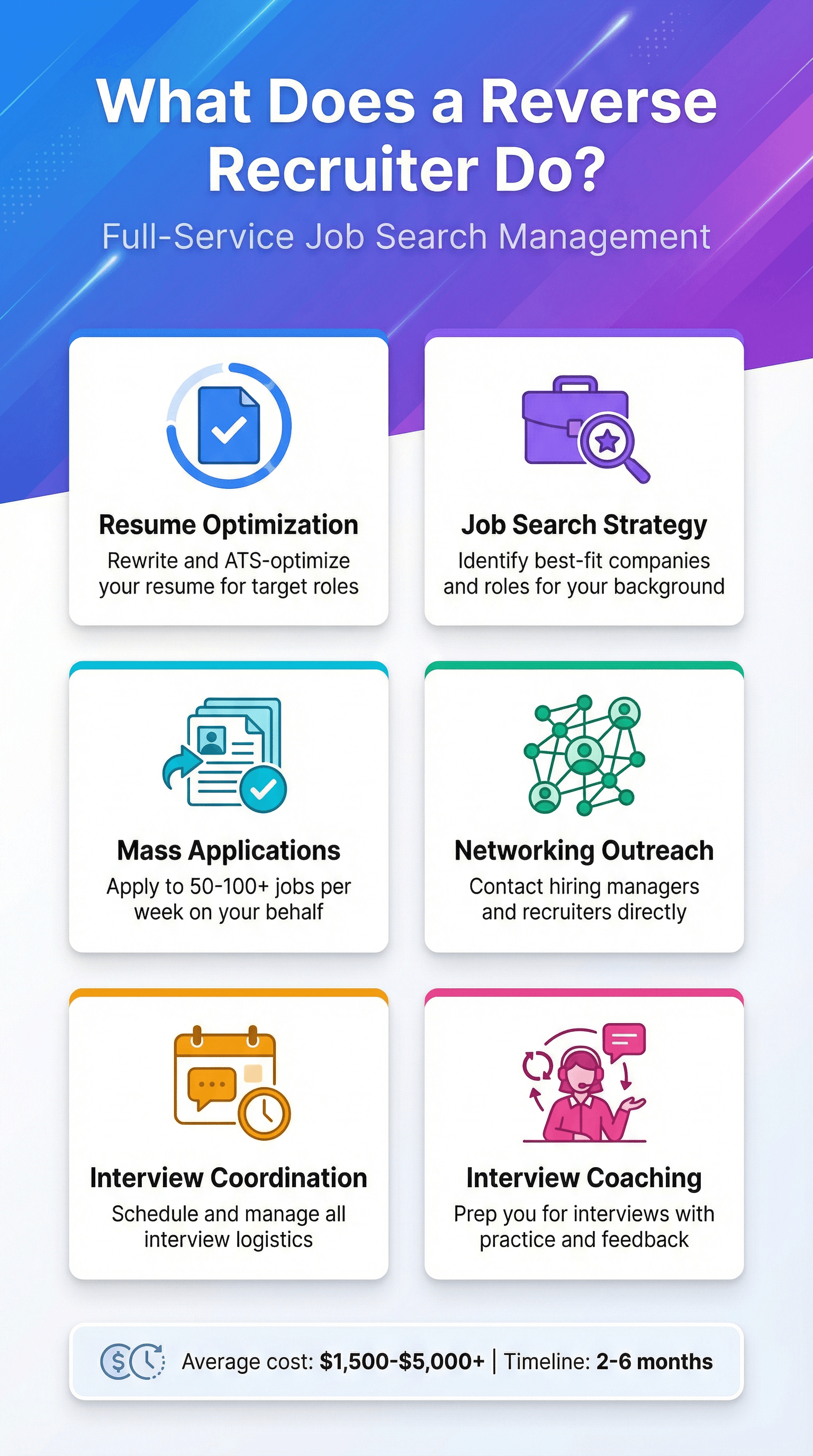
A reverse recruiter is a professional you hire to manage your job search on your behalf. Unlike traditional recruiters who work for employers, reverse recruiters work for you—searching for jobs, submitting applications, reaching out to hiring managers, and helping you land interviews. Services typically cost $1,500 to $5,000+ depending on your career level and the package you choose.
What Is a Reverse Recruiter?
A reverse recruiter is a job search professional who works exclusively for you, the job seeker. You pay them to conduct your job search—finding opportunities, submitting applications, networking with hiring managers, and scheduling interviews on your behalf.
The "reverse" part refers to who's paying. Traditional recruiters and headhunters are paid by employers to fill open positions. Reverse recruiters flip that model—they're paid by job seekers to find opportunities.
Think of it like hiring a real estate agent when you're buying a house. You could search Zillow yourself, schedule showings, and negotiate offers. But a buyer's agent does all that work for you while advocating for your interests, not the seller's.
What a reverse recruiter typically does:
Job Search Management — Searching job boards, company career pages, and their professional networks to find positions matching your criteria.
Application Submission — Customizing your resume for each role and submitting applications on your behalf.
Hiring Manager Outreach — Reaching out directly to recruiters and decision-makers at target companies via LinkedIn and email.
Interview Coordination — Managing scheduling, follow-up communication, and keeping your search organized.
Career Coaching — Providing interview prep, salary negotiation advice, and strategic guidance (often included or available as an add-on).
The core promise is simple: you focus on showing up to interviews and performing well. They handle everything else.
Reverse Recruiter vs Traditional Recruiter vs Headhunter
One of the biggest points of confusion is how reverse recruiters differ from the recruiters and headhunters you might already know. Here's the breakdown:
| Factor | Reverse Recruiter | Traditional Recruiter | Headhunter |
|---|---|---|---|
| Who pays them | You (the job seeker) | The employer | The employer |
| Who they work for | You | The employer | The employer |
| Their goal | Land you interviews and job offers | Fill the employer's open positions | Find specific candidates for hard-to-fill roles |
| When they contact you | When you hire them | When you match their open roles | When you fit a specific search they're running |
| Cost to you | $1,500–$5,000+ | Free | Free |
| Loyalty | 100% to you | Split (they want to fill roles quickly) | To the employer paying the search fee |
Traditional recruiters and headhunters can be helpful, but they're not working for you. They're incentivized to fill positions quickly—not necessarily to find the best fit for your career goals. A reverse recruiter's only job is to advance your interests.
Decode Any Job Posting
Paste a job description and get instant insights: what they really want, red flags to watch, and how to stand out.
Why Reverse Recruiting Exists
Reverse recruiting isn't just a clever business model—it emerged because the modern job search is genuinely broken.
According to Bureau of Labor Statistics data, the average job search now takes nearly five months. For professionals over 45 or those changing careers, it often takes longer. Meanwhile, studies suggest that up to 70% of jobs are filled through networking rather than public applications—what's often called the "hidden job market."
The math is brutal. If you're employed full-time while job searching, you might have 5-10 hours per week to dedicate to applications and networking. At that pace, a typical search that requires 100+ applications and dozens of networking conversations can drag on for six months or more.
Reverse recruiting exists because three things are simultaneously true:
1. Job searching is a full-time job. Between researching companies, tailoring resumes, writing cover letters, networking, and managing interview schedules, an effective job search demands 15-25 hours per week. Most employed professionals don't have that time.
2. Most people aren't trained in job searching. Your expertise is in your actual career—accounting, engineering, marketing, whatever it may be. Job searching is a completely different skill set that you use once every few years. Reverse recruiters do it professionally, every day.
3. The stakes are high. A poor job search doesn't just cost you time—it costs you money. Every month of extended unemployment or staying in an underpaid role represents real financial loss. For a $100K professional, a job search that runs two months longer than necessary costs roughly $16,000 in lost wages.
This is why the service appeals particularly to executives, career changers, and time-strapped professionals who calculate that paying $3,000 for a service is cheaper than losing months of income.
What Does Reverse Recruiting Include?
Service packages vary by provider, but most full-service reverse recruiting engagements include some combination of these elements:
Resume and LinkedIn Optimization — Most services start by rewriting or optimizing your resume and LinkedIn profile. This is typically included in the initial package, not charged separately.
Target Company Research — Identifying companies that match your criteria, including those not actively posting roles but likely to have relevant needs.
Application Management — Submitting applications on your behalf, often customizing your resume for each submission.
Direct Outreach — Reaching out to recruiters, hiring managers, and other decision-makers at target companies through LinkedIn messages and emails.
Progress Reporting — Regular updates (usually weekly) on applications submitted, responses received, and next steps.
Interview Preparation — Coaching on how to handle specific interviews, often including mock interviews and feedback. Some services include this; others charge extra.
Salary Negotiation Support — Guidance on evaluating offers and negotiating compensation. Again, sometimes included, sometimes extra.
Stop Applying Manually
Our AI applies to hundreds of matching jobs while you sleep. Wake up to interviews, not more applications.
How Much Does a Reverse Recruiter Cost?
Reverse recruiting isn't cheap, but pricing varies significantly based on the provider and service level. Here's what to expect in 2026:
| Service Level | Typical Price Range | What's Usually Included |
|---|---|---|
| Entry/Basic | $1,500–$2,500 | Resume rewrite, LinkedIn optimization, 30-60 days of job search, weekly updates |
| Standard | $2,500–$4,000 | Everything above + 90 days, hiring manager outreach, interview prep, weekly calls |
| Executive/Premium | $4,000–$7,500+ | Everything above + senior recruiter assignment, extended engagement (4-6 months), salary negotiation, dedicated support |
Some providers charge flat fees; others use monthly retainers ($500–$1,500/month). A few charge a percentage of your first-year salary once you're placed, though this is less common in reverse recruiting than in executive search.
Some services advertise lower starting prices but charge extra for "add-ons" like interview coaching, LinkedIn optimization, or salary negotiation support. Always ask for the full cost breakdown before signing.
Whether reverse recruiting is "worth it" depends entirely on your situation. For a detailed analysis, see our complete guide to reverse recruiting services or use our ROI calculator to run the numbers for your specific salary and timeline.
Decode Any Job Posting
Paste a job description and get instant insights: what they really want, red flags to watch, and how to stand out.
Who Benefits Most from Reverse Recruiting?
Reverse recruiting isn't for everyone. But for certain situations, it can be a smart investment.
You're employed and time-strapped. If you're working 50+ hours a week and can't dedicate 15-20 hours to job searching, outsourcing makes sense. Your time has monetary value—if you earn $75/hour and a service saves you 150 hours of searching, the math works.
You're targeting $100K+ roles. At higher salary levels, the ROI calculation shifts. If a reverse recruiter helps you land a job two months faster or negotiate a 5% higher salary on a $150K offer, the $3,000 service fee pays for itself multiple times over.
You're changing careers or industries. Career changers often struggle because they don't know how to position their transferable skills. A reverse recruiter brings expertise in framing your experience for a new field.
You've been searching for months without results. If you've submitted 50+ applications and gotten nowhere, something in your approach isn't working. Fresh expert eyes—and hands—can break you out of the rut.
You're in a confidential search. Executives, senior leaders, and anyone who needs discretion benefits from having a professional manage outreach without broadcasting their job search.
For a deeper dive on specific situations, see our guides on reverse recruiting for executives, reverse recruiting for remote jobs, and reverse recruiting after a layoff.
Who Should Probably Skip It
Reverse recruiting isn't the right fit for everyone. Save your money if:
You're entry-level or early-career. At lower salary levels, the ROI doesn't usually work. A $2,500 service is harder to justify when you're targeting $45K roles. Focus on building your skills and network instead.
You haven't tried searching on your own. Before paying someone, give it a genuine effort. You might be closer to success than you think—and the experience teaches you valuable skills.
You're making a straightforward lateral move. If you're a marketing manager looking for another marketing manager role in the same industry, you probably don't need help. The positioning is straightforward.
You're in a highly specialized niche. Some fields are so narrow that generalist reverse recruiters won't add value. If you're a quantum computing researcher or a maritime law specialist, industry-specific recruiters may be more useful.
Your budget is tight. If $2,500 represents a significant financial strain, the stress of the expense may outweigh the benefits. Consider alternatives like career coaching or auto-apply tools first.
Reverse recruiting probably isn't for you if: (1) you're targeting roles under $60K, (2) you haven't submitted at least 20-30 applications on your own, (3) you don't have a clear target role in mind, (4) the cost would create financial stress, or (5) you're looking for a quick fix rather than a strategic partnership.
How to Vet a Reverse Recruiting Service
If you decide to move forward, choose carefully. Here's what to look for:
Transparent pricing — They should clearly explain what's included and what costs extra. Vague pricing is a red flag.
Realistic expectations — Anyone promising job offers in weeks or guaranteeing placement is overpromising. Quality searches take 60-90 days minimum.
Industry relevance — Ask if they have experience placing people in your field and at your level. A service that's great for tech executives may not be ideal for healthcare professionals.
Clear process — They should be able to walk you through exactly what happens after you sign up, week by week.
Refund or satisfaction policy — Reputable services stand behind their work with some form of guarantee or refund policy if they don't deliver.
No high-pressure tactics — If they're pushing you to sign immediately or creating artificial urgency, walk away.
For a detailed comparison of specific services, see our guide to the best reverse recruiting services and the questions you should ask in how to choose a reverse recruiter.
Alternatives to Consider
Reverse recruiting is one option, but it's not the only way to get help with your job search:
Professional resume services ($150–$500) — If your resume is the weak link, fixing that alone might be enough. Our remote resume guide covers when this makes sense.
Career coaching ($100–$300/session) — A coach teaches you to fish rather than fishing for you. You learn job search skills you can use throughout your career.
Auto-apply tools ($20–$100/month) — Services like JobCopilot automate the application process while you focus on networking and interviews. Less comprehensive than reverse recruiting, but a fraction of the cost.
DIY with better tools — With the right resources—our job board, ATS-friendly resume templates, and interview guides—you can run a professional-quality search yourself.
The smartest approach is often to escalate gradually: optimize your resume first, try auto-apply tools, consider coaching, and only then explore full-service reverse recruiting if you're still stuck.
Frequently Asked Questions
What exactly does a reverse recruiter do?
A reverse recruiter manages your job search on your behalf. They search for opportunities matching your criteria, submit tailored applications, reach out to hiring managers, coordinate interviews, and provide strategic guidance. You hire and pay them directly—unlike traditional recruiters who work for employers.
How much does reverse recruiting cost in 2026?
Most reverse recruiting services cost between $1,500 and $5,000+, depending on the service level and your career stage. Entry-level packages typically run $1,500–$2,500, standard services are $2,500–$4,000, and executive-focused services can exceed $5,000. Some providers charge monthly retainers instead of flat fees.
Is hiring a reverse recruiter worth it?
It depends on your situation. Reverse recruiting tends to be worth it when you're targeting $100K+ roles, you're time-strapped, you're making a complex career change, or you've been searching for months without results. It's usually not worth it for entry-level roles, simple lateral moves, or if you haven't yet tried searching on your own.
What's the difference between a reverse recruiter and a headhunter?
A headhunter works for employers and gets paid by them to find candidates for specific roles. A reverse recruiter works for you and gets paid by you to find jobs matching your criteria. Headhunters are loyal to the company paying them; reverse recruiters are loyal to you.
How long does reverse recruiting take to find a job?
Most services quote 60-90 days to generate strong leads and interviews, with job offers typically coming within 3-6 months. This is usually 2-3 months faster than self-directed searching, though results vary based on your industry, level, and market conditions.
The Bottom Line
A reverse recruiter is a professional who manages your job search for you—finding opportunities, submitting applications, and reaching out to hiring managers on your behalf. Unlike traditional recruiters who work for employers, reverse recruiters work exclusively for job seekers.
Whether to hire one depends on your situation. If you're time-strapped, targeting senior roles, or stuck after months of searching, the investment can pay for itself through faster placement or better offers. If you're early-career, budget-conscious, or haven't yet given DIY searching a real try, start with less expensive alternatives.
Ready to learn more? Explore our complete reverse recruiting services guide for detailed comparisons, pricing breakdowns, and our ROI calculator. Or browse remote job opportunities and high-paying remote positions to start your search today.
Ready to Automate Your Job Search?
Let AI apply to hundreds of jobs for you while you focus on interviews.
Start Auto-ApplyingRelated Job Guides
Remote Ecommerce Jobs: What 1,694 Postings Show (2026)
Remote ecommerce jobs are concentrated: 322 of 1,694 US postings were remote. See which marketplace, brand, agency and SaaS seats pay $100K+ from a home office.
55 min read
Remote Interior Design Jobs: What 1,409 Postings Show (2026)
Remote interior design jobs are rare: 40 of 1,409 US postings were remote. See which designer, planner, and FF&E seats pay $75K+ from home, and where.
46 min read
Remote Journalism Jobs: What 1,438 Postings Show (2026)
Remote journalism jobs are rare: 77 of 1,438 US newsroom postings were remote. See which reporter, editor, and audience seats pay $75K+ from home, and where.
39 min read